Two Years Since 10/7
From the Editor
Dear Friends,
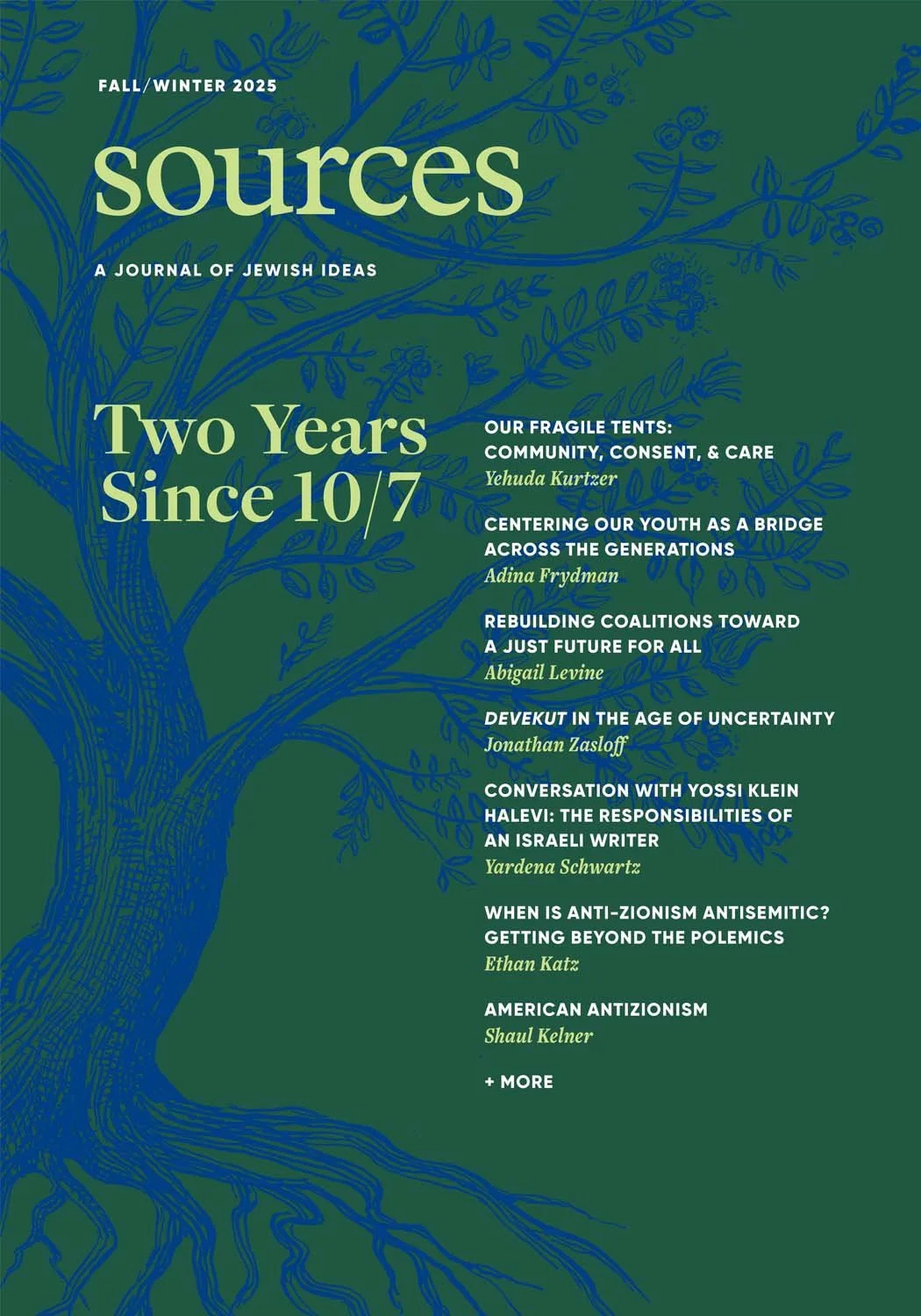
Two years have come and gone since Hamas’s attack on southern Israel on October 7, 2023. Like any anniversary, October 7 this year was a day for remembering the original event, how it affected us and others, and for marking all that has changed in the last two years. It was a day of grief and also a day of cautious optimism—President Donald Trump had announced a potential peace plan at the end of September; it would be signed on October 9. Since then, Hamas has returned the remaining living hostages and the bodies of almost all the murdered hostages; and Israel has released Palestinian prisoners and remains of prisoners. Despite flare-ups of violence between Hamas and the IDF, the ceasefire seems to be holding.
We chose the theme for this issue, Two Years Since 10/7, in February, knowing that it would launch two months after the actual anniversary of that terrible day. The timing suits Sources. While the anniversary itself was a day for commemorative ritual and ceremonies, now we can turn to careful analyses and constructive visions, which is precisely what you will find here.
The issue is divided into three sections, each answering a different challenge. In the first section, Rebuilding, four pieces address how the North American Jewish community might overcome some of the painful ruptures that emerged over the last two years. Yehuda Kurtzer presents a more inclusive view of what community is for and argues that greater openness about communal norms and values will allow for a greater sense of belonging. Adina Frydman examines the generational divide between Jewish young adults and their parents and grandparents, offering a multi-step program for rebuilding connections and ensuring the future of Jewish leadership. Then, Abigail Levine advocates for rebuilding coalitions between Jewish and non-Jewish social justice groups that were torn apart after 10/7 and offers conceptual distinctions that will make that work possible. Finally, by drawing on sources that include the book of Joshua, Hasidic thought, and Abraham Lincoln’s diary musings, Jonathan Zasloff’s account of devekut, cleaving to God, offers a radical take on the project of American Judaism.
The next section of the journal addresses the rise of antisemitism and anti-Zionism. In a Conversation piece with journalist Yardena Schwartz, writer Yossi Klein Halevi explains how anti-Zionism has led him to change his approach to writing about Israel. Ethan Katz then offers a framework for understanding when anti-Zionism is or is not antisemitic and suggests that liberal Zionists who appreciate the history of anti-Zionism may today find allies in unlikely places. Shaul Kelner, whose piece follows Katz’s, also argues for better historical understanding of anti-Zionism, but he sees it primarily as a dangerous social movement rooted in symbols and rituals rather than as an ideology with any intellectual coherence. Finally, Chaim Seidler-Feller pushes back against recent developments in contemporary religious Zionism that are fueling fundamentalist political movements in Israel, drawing on Jewish sources to argue that religious Zionists must prioritize peace and compromise.
The last section of the journal focuses on polarization. Thinking as a political philosopher, Alon Shalev considers why liberal societies are prone to polarization and then both why and how we must fight against this tendency, which is all too powerful right now. Joshua Kullock offers an innovative reading of a midrash about the creation of the sun and moon as a homily on competing values. Finally, Shoshana Cohen shares her observations about the practices and values that have sustained Israeli Jews over the last two years along with her concerns about the risks they bring.
I imagine that you might be wondering whether, on the whole, this issue of Sources is a hopeful one. I know that in the time that passes between when I finish writing and when you are reading these words, anything could happen. Our world could change radically in negative or positive ways that will affect how this issue lands and the implications that might emerge from each author’s work. Nevertheless, I think that every issue of Sources is hopeful, this one included. I say this not because all of our authors are optimistic—they are not—but rather because I believe that Jewish hope is best defined as a restlessness and discontent with whatever the present offers. Jewish hope is a refusal to be satisfied and a belief that things can always be better.
This is a hypothesis I’ve been developing in my own thinking and teaching over the last few months, and I will share more of it in the future. For now, though, I offer the liturgical use of Psalms 37:25 as evidence. The verse appears in the final paragraph of Birkat Hamazon, the Grace after Meals, and some also sing it as a Shabbat zemer. It begins in Hebrew with the words naar hayiti: “I have been young and now I am old; I have not seen the righteous forsaken, nor his seed begging for bread.”
The verse is a declarative statement. And, unless one is willfully hiding from reality, it is a lie. It is so untrue, in fact, that when singing this paragraph of Birkat aloud in a group, some choose to recite this verse in a whisper, pointing to the Holocaust as the reason why they cannot sing it aloud.
I believe naar hayiti is best understood not as a statement of fact but as an expression of yearning. We dream of growing to old age in a world that is just, in which no one, righteous or otherwise, suffers without apparent cause. We say this verse aloud, over and over and over again, because we will never stop wishing for the world it describes, never stop asking God to make it real, never stop doing what we can do to make it a reality. If I am right that Jewish hope is exactly this sort of refusal to accept the shortcomings of the world we live in, then yes, this is a hopeful issue, and these are hopeful times.
Longtime Sources readers might notice that Kelner’s and Zasloff’s articles in this issue break with the journal’s usual style. In his piece, Kelner analyzes a phenomenon he refers to as “antizionism,” which appears everywhere else in the journal as “anti-Zionism.” I allowed the variation because the “antizionism” is an expression of his argument about the movement and insisting on “anti-Zionism” would get in the way of his point.
In his article, Zasloff refers to God as “Hashem,” a Hebrew word that means “the name” and thus offers a way of referring to God indirectly. This is a first for Sources, where until now God has been known simply as “God.” Zasloff argues that God is inaccessible and that the central task of Judaism is to seek God; as he explained to me when I initially pushed back on his nomenclature, “Hashem” captures this tension of desire and distance in a way that the more familiarizing “God” cannot. My own preference, for myself and for the journal, is still “God,” but I see the work that “Hashem” is doing to further Zasloff’s point, and so I allowed this deviation as well.
Editing requires a persnickety sensibility, but as these two pieces demonstrate, it occasionally also requires some flexibility. Perhaps there’s a larger lesson in this, but at a minimum, I hope that your thinking will be richer for engaging with these exceptions and the larger arguments they support.
I welcome your comments and reflections at editor@sourcesjournal.com. Please also take a few minutes to fill out our Reader Survey, which you’ll find at sourcesjournal.org through the end of the year. We are eager to understand your experience reading the journal and to use that understanding to make Sources ever more interesting, insightful, and important.
Claire E. Sufrin