Our Fragile Tents: Community, Consent, and Care
Yehuda Kurtzer

Yehuda Kurtzer is President of the Shalom Hartman Institute.
Over 50 years ago, the political scientist Daniel Elazar characterized North American Jewish identity as defined by both kinship, belonging to the Jewish polity by virtue of family, tribal, or national bonds, and consent, belonging by virtue of our agreement to belong. Kinship bonds are sometimes described as more powerful than bonds created with others through consent, because they seem to demand a kind of unconditional loyalty; but bonds created through consent have their own power, rooted in ourdeciding to join and honoring the value of our personal autonomy, even as those bonds tether us to others. The legal scholar Heidi Hurd calls the power of our ability to create obligations to others and bonds between people, just by virtue of agreeing to them, “moral magic.”
Credit: Kurt Hoffman/Adobe Firefly
Indeed, consenting to belong is a long-valued idea in Jewish tradition. The rabbis of the Talmud challenge the validity of the covenant with God at Sinai at the time of the giving of the Torah because it was imposed by force, and they argue instead that Jews in later generations accepted the obligations of the covenant by virtue of their own consent (bShabbat 88a-b). This is a vital teaching for post-Enlightenment Jews: we, too, are entitled to consent to this covenant, which then becomes binding for us as it was for our ancestors.
For the past four decades, and especially since the pivotal 1990 National Jewish Population Study, the North American Jewish community has gradually come to embrace—first reluctantly, then more enthusiastically—that we are more a community of consent than one of kinship. There are plenty of reasons for this: Judaism and Jewish identity have become a matter of choice in a market capitalist environment; Jewish peoplehood and particularism must compete against the “melting pot” (in America) and within a complicated climate of multiculturalism (in Canada); and mostly, the idea of belonging to Jewish community competes with, and feels lesser than, belonging to greater society.
Jewish leaders struggling to preserve Jewish community have responded to this challenge of shrinking attachments by imagining a different model for the Jewish community—shifting from the kinship-based enclave to the consent-based Big Tent. This can entail two things: emphasizing participation over long-term attachment, and/or trying to cultivate attachment through radically open approaches to welcoming people in.
Chabad and Birthright are signature examples of the first strategy, offering opportunities for participation as entitlements with low barriers to entry, a willingness to “meet people where they are,” and a refusal to measure success through the metrics of sustained membership. This strategy has taken off across the Jewish community.
There are beautiful aspects to this approach. Even impromptu moments of community—like the intimacy among bus buddies on a Birthright experience, or the temporary attachment to the other several hundred students eating Shabbat dinner at a campus Chabad—can feel electric and meaningful. A helpful analogy is the sense of community you can feel at a baseball game, surrounded by several thousand fans, cheering and booing, performing the rituals of the game; then trickling out afterwards, back to our anonymity. Closer to home, perhaps, was the response of so many Jews after the attacks of October 7 in choosing to attend the rally in Washington, DC, despite holding wildly diverse views on Israel (and dissenting views with some of the speakers). The activity of “standing uncomfortably close to others” was a ritual of performing community, even if everyone knew that it was going to be a short-lived, temporary community.
At the same time, while we have more opportunities than ever for connecting, we are getting increasingly lonely. It should come as no surprise to us that this turn towards episodic participation and engagement is coterminous with a loneliness epidemic and the rise of a global sensibility that we are meant to curate our lives and interests in ways that atomize us. More than anything, I worry that placing too much emphasis on creating one-off Jewish experiences will not just replacethe sense of belonging that comes with membership; it may erode our very capacity for sustained, more meaningful belonging.
The second strategy, cultivating thicker attachment against the odds with a strategy of welcoming, has found expression in the shift of liberal Jewish leaders who first tried to fight against intermarriage, then accepted it as inevitable, then welcomed interfaith families, and eventually worked to break down the barrier between Jews and the “Jewish-adjacent” among their stakeholders. This evolution, which happened across denominations, has led to widespread rethinking of membership models—like imagining synagogues and JCCs more as honeycombs than hubs—as well as efforts to help Jewish communities manage difference through dialogue. There are also pluralistic institutions in our community that grew in this way, and even as they face major challenges from the rise of polarization and partisanship, many of them are still thriving and holding diverse communities together across difference.
In both cases—in emphasizing participation over membership, and in emphasizing welcoming over boundaries—the Jewish community cultivated this Big Tent strategy to respond to what felt like permanent threats to the models of community that assumed kinship over consent.
October 7 and its aftermath changed all of that. Since that day, the primary emphasis of Jewish leaders has moved from widening the Big Tent to narrowing it, and from building Jewish community to trying to protect it.
Safety questions plague the American Jewish community today, with danger coming from both outside and inside. The Hamas attacks on Israel on 10/7 reawakened a dormant but widespread Jewish fear of being violently overrun, as diaspora Jews identified with Israelis’ experience of vulnerability and witnessed a dangerous rise of antisemitic hostility and violence here at home. These fears were compounded for many diaspora Jews by the feeling that allyship had failed, that our neighbors did not “have our backs.” In turn, we have transformed our Jewish institutions into fortresses, prioritizing the safety of those on the inside—or with the credibility to become insiders—over a culture of hospitality and welcoming.
In January 2022, Rabbi Charlie Cytron-Walker invited in a disheveled man at the entrance of his congregation in Colleyville, Texas. The man turned out to be a violent hostile, holding the rabbi and several congregants hostage for several hours until the congregation and the police could defuse the situation. Asked about it afterwards, the rabbi insisted that while there is always a tension between being unsafe and welcoming the stranger, we should never become lax in our commitment to the latter because of fear of the former.
Tragically, I cannot imagine most Jewish leaders after 10/7 even thinking of these two priorities—welcoming and safety—as living side by side. Rather, I think they have become sequential in our minds: once we guarantee our safety, we can consider welcoming the stranger. Or even conditional: only once we are safe can we consider welcoming the stranger. For a community that had shifted its orientation so deliberately to hospitality, this is a seismic turn.
Our concern about safety has turned inwards as well. Since 10/7, many Jewish communities have become consumed by the question of which ideas about Israel and the war, especially on the Left, are dangerous to members and therefore must be guarded against. Some of those who hold less mainstream views about Israel, particularly on the Left, have disaffiliated from Jewish institutions of their own accord, unwilling to be in community with people who hold more centrist views about Israel. All this boundary-making has taken a toll on communities and even families: as the comedian Alex Edelman lamentably joked at Central Synagogue on Yom Kippur this year, “The word ‘Israel’ literally means ‘to wrestle,’ although in 2025 it also means ‘estrangement from your friends and family.’”
This safety panic had two effects, as I described in a November 2023 essay in The Forward: On the one hand, there has been a reconsolidation of sorts among the “messy mainstream” of American Jews, to include progressive Zionists who had struggled prior to the war for acceptance in the organized Jewish community but showed up in solidarity with Israel after October 7; and a new demarcation between them and far-Left organizations, non- and anti-Zionist organizations that fought openly against Israel’s right to its self-defense and now openly advocate for Israel’s end as a Jewish state. I observed that this was more of a voluntary exit by these organizations than a banishment, and that in making this decision to shift from being what philosopher Michael Walzer calls “connected critics” to “critical outsiders,” I concluded that “the Jewish Left will have no seats at any tables besides the ones they set for themselves.”
The rupture was also a solidarity story. According to their own descriptions, Leftist Jews experienced alienation from the Jewish community and its institutions in ways that affirmed their desire for separate communal structures. Recounting this, I suggested there was a real need for a new, parallel-but-separate infrastructure. Journalist David Klion, responding to my Forward essay in the New York Review of Books in January 2024, agreed that the Left’s ideological alienation from the organized Jewish community’s core commitments meant that the Jewish Left would simply have to create community institutions of its own.
These shifts happened in tandem with what many observers described as a “surge” in Jewish communal participation in its mainstream institutions, mass mobilization for rallies and organized support for Israel, and a spike in charitable giving to support Israelis in their time of crisis. Here, too, was a solidarity story, and these swirling trends together depicted how solidarity can mean inclusion for some and exit or alienation for others.
It was easy to describe some of what was happening at that moment as concretizing the tension between “the universal” and “the particular,” and to notice the ideological, iconographic, and semiotic parallels between this rupture today and other famous ruptures in the Jewish past.
But all our language about communities and institutions masks how painful this rupture has been for individuals caught in the middle. Choosing to disaffiliate from an institution can have social, emotional, and material costs; the tensions around affiliation and loyalty are tearing families apart and causing internal struggles for individuals who feel pulled in multiple directions. Even for those who are not directly affected in these ways, something feels very off—both as we witness a reversal of the Big Tent trend that had characterized decades of evolution in our communities, and as we are forced to ask whether the very idea of community is possible in this climate of fear.
Jews on the Right and Jews on the Left do not trust one another to keep them safe. Worse, they believe that the other side, with its politics and its external allies, is actively endangering them. What chance do we have to think capaciously about community in this climate of mutual suspicion and fear? The kind of fear that has taken root in the Jewish community—of danger on the outside, of threats already on the inside—destroys any desire or incentive to think expansively about our networks of belonging. Jews on both sides are claiming kinship ethics to express solidarity with those who they think keep them safe, but neither feels a strong enough sense of kinship to other Jews, just because they are Jews, to tolerate these differences between them. This further undermines Jewish collective identity, which then makes us even less safe.
We are caught between the priority of opening our doors to the stranger and tolerating difference inside our house, and all these fears have come to define Jewish life in this fraught moment. What will it take for us to reclaim our agency in this story?
***
Opening the flaps of the Big Tent promised new possibilities for the Jewish community to expand and for all the moral gains that come with greater inclusion. I want to offer a reminder of what community can be, and then offer some pathways, in source texts and strategies, to help us weather this crisis.
I believe that the heart and majesty of Jewish community, when it works, is a commitment to care. We find in a healthy Jewish community the experience of being cared for emotionally, spiritually, and materially, and we are enriched by the opportunity and nobility of caring for others.
It is tempting to define belonging to community in utilitarian terms, as a sort of deal we make with others. We exchange our time, a measure of personal autonomy, and financial resources to belong to a Jewish community, and the more we give of ourselves, the tighter the bond should feel. We accept the costs because we believe they are matched, if not exceeded, by the returns. It is worth it for me to bring a casserole to a potluck because I will get access to seven other casseroles, a better meal than I would have had on my own. I might go to synagogue services on a weeknight even if I don’t need to say kaddish for a deceased relative, because in supporting those who need a quorum as they say kaddish, I’ll better ensure that they’ll be there for me when I am the one in need.
Weak communities and weak bonds to community accentuate our awareness of the economic trade-off; indeed, these are the sites when we feel conscious of the fact that our relationships to others and to the institution itself are more transactional than relational.
But in a strong community, the spiritual experience of belonging transcends cost-benefit analyses. If you’ve ever been uplifted by an experience of communal singing and prayer, one that makes you feel connected to everyone in the room, or if you’ve experienced the warm hug of strangers caring for your needs in your own home while you are sitting shiva,you know you cannot really quantify what you’ve gained relative to what you have given. We have core anthropological, psychological, spiritual, and even biological needs for community in ways that are hard to define—though most of us can tell when a community “feels right” and when it is time to move to a different one.
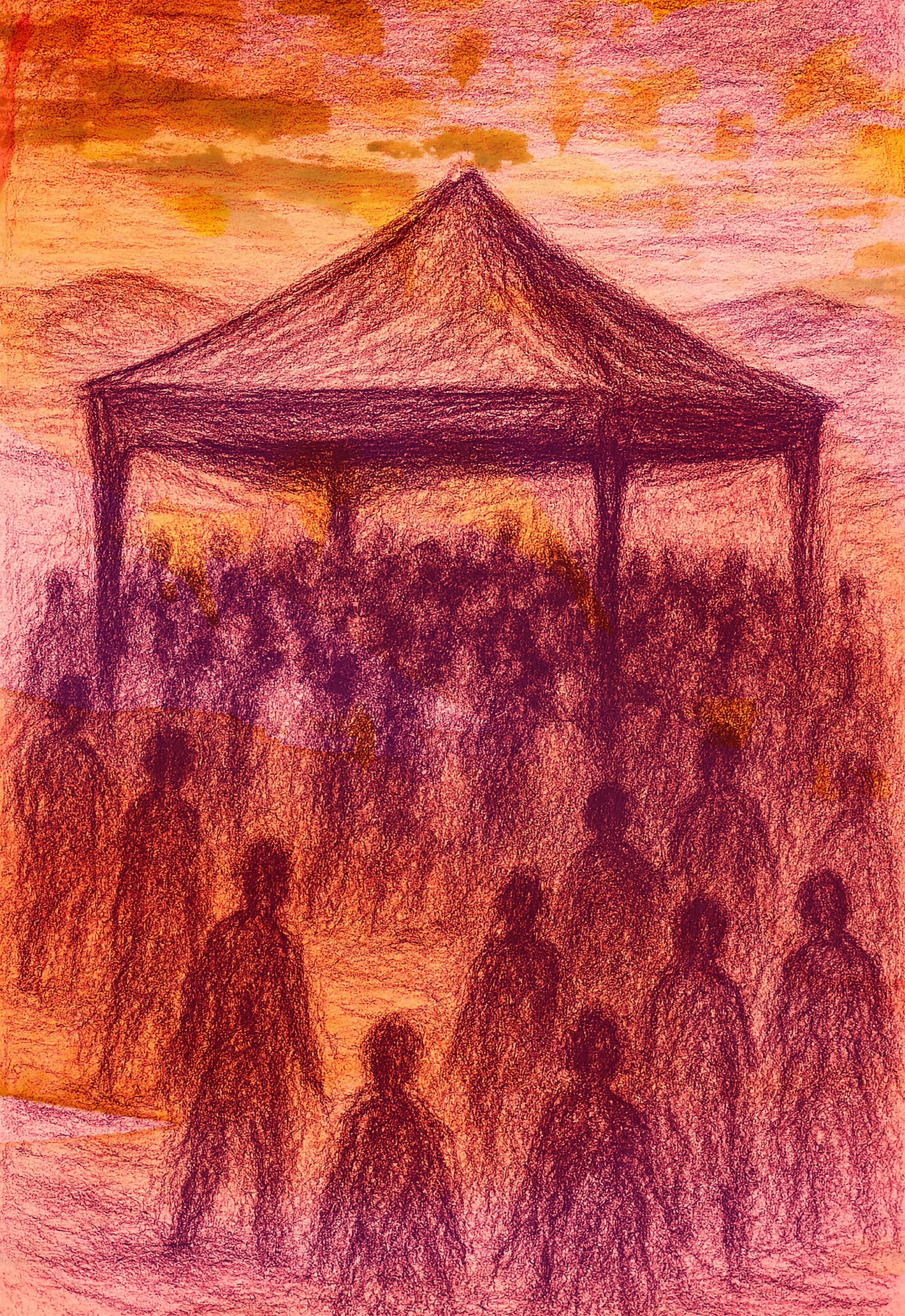
The Bible describes the Israelites as a community whose warmth can be characterized by our (big) tents. In Numbers 24:5, the prophet Balaam, seeking to curse the Israelites, instead blesses them with the ode of “how goodly are your tents, Israel,” describing the serene encampment of the people Israel in the wilderness. Isaiah exhorts the Israelites to recover from their tragic downfall by enlarging their tents, pulling back the curtains, and strengthening the stakes—making it possible for them to spread out again (54:2).
But the source that I believe underlies the widespread metaphor of the Jewish community as a “Big Tent” is the tent of Abraham, which is described by the sages in Genesis Rabbah 48:9 as “open on both sides” and “like a large plaza.” According to the midrash, this orientation made it possible for Abraham to chase down passersby to invite them into his home and to express his passion for hospitality. In this metaphor, the core value of Jewish community is that it is a place of welcoming and generosity.
A later midrash, in Avot d’Rabbi Natan, expands this idea by attributing the original big tent to Job, rather than Abraham. Job, the midrash argues, had his door open on all four sides to make it possible for the poor to enter from any direction and have their needs met. The shift from Abraham as the hospitable protagonist to Job is powerful: Job’s core identity throughout the book that shares his name is as our tradition’s quintessential mourner; his home is a shivahouse, a place for others to care for him. They come to comfort Job, and some of them, who need support and sustenance, can find it there in the same place. True to life, this shivahouse is also full of food—some set out by his loved ones, some in the deli trays delivered by the members of his community. This tent places care in the center, not resulting from an economic exchange or an assumption of reciprocity but from the inherent purpose of the gathering place.
This Job midrash makes invisible one of the toxic themes of the Book of Job, the awful theologies and theodicies that Job’s “friends” offer him during his period of mourning, and maybe that’s the point: communities of care can tolerate the periodic awfulness we sometimes cast at one another. I’ve been in shivahouses where people say genuinely dumb and hurtful things, or don’t know what to say at all, and I’ve seen mourners make up for all these missteps with grace, a sense of appreciation that at least those who misstepped cared enough to show up.
What would happen in our communities if, rather than insisting that the only way we can care for ourselves is through protection against danger, we make care our priority, the reason for which our communities exist?
Can that be enough?
A community centered on care should be able to tolerate internal controversies. Good communities should and often do house debate and dispute; such debates demonstrate the passion that its members hold for the community and its betterment, and when they do not tear the community apart, they attest to its structural integrity. Good communities foster debate with healthy norms rather than trying to suppress it. Good communities are held together through bonds of loyalty between people who disagree, because those people have come to believe that they were heard in their dissents without being reviled, and they trust they will not always be on the losing side. Good communities are heterogeneous and validate the differences and autonomy of individuals within their midst. Good communities subordinate danger because they know that they are already large-scale trust exercises, offering us spiritual and physical protection by the power of belonging to something bigger.
Maybe one step forward in the wake of the wreckage that the war has wrought on us—the fear it has incited in us against each other—is a simple reminder of what our Big Tent is supposed to be. Yes, there are moments when the tent flaps need to be walls, and the walls need to be guarded; and yes, it is a powerful way of showing care to those on the inside to take their security seriously; and yes, once in a while we need to boot out those who are hammering away at one of the poles and compromising the structural integrity of the tent. All these caveats are true, but none of them should replace the reasons the tent exists in the first place. When they do, we find ourselves protecting something for no purpose other than its own preservation.
***
There are some practical steps we need to take in this moment to help reverse the culture of narrowness that is damaging the Big Tent of Jewish communal life, and that threatens our overarching need to expand its parameters rather than shrinking them.
First, we must be clearer about when and how we set boundaries in Jewish communities, so that our safety instincts do not harm our efforts to be welcoming more than they need to. This requires us to recognize that different kinds of communities, all of which operate by consent, operate very differently and provide care differently for those included in their walls. Our own micro-communities—a havurah, a synagogue, a local friend group, what we might call “my Jewish community”—are examples of a community of participation; what we often call “the organized Jewish community,” in contrast, is a specific nexus and network of organizations and institutions collected around a set of core principles, making it a community of interest; and sometimes we say “the Jewish community” to describe American Jews without making any claim to homogenize the group beyond the fact that they are all defined in one way or another as American Jews. This third group we might call a community of nationality.
Making these distinctions will help us in several ways. The terms of belonging to any of these meanings of “Jewish community” are different and should be policed differently. The category of “American Jews” is big enough and diverse enough—this is by design, a feature not a bug, as seen in biblical tribalism, Second Temple sectarianism, and modern denominationalism—that we should not use political loyalties to question who is “Jewish enough,” or mark the people we disagree with as “un-Jews.”
The fact that a particular Jewish institution wants to split off from our communal orthodoxies with its own ideological agenda may be bad for “the organized Jewish community,” but it rarely affects “my Jewish community,” and it is part and parcel of the complexity of being in the same “American Jewish community.” When an individual can no longer abide belonging to “my Jewish community,” it is extremely painful; but the wider world of belonging remains open to them. The better we understand these distinctions, the less violence and damage we do to one another during tectonic shifts. It is okay, a good thing, for some Jews to organize their own new micro-communities that reflect their values better than the ones they are leaving, and there is no reason for us to catastrophize that exit. And at the same time, we should work much harder to hold together “the organized Jewish community,” and as best we can, “the American Jewish community,” across those differences.
Second, our communities should assert their values up front and reiterate those values regularly. This helps them head off the kinds of controversies and arguments that flow into the vacuum created by lack of clarity. Value clarification is essential both to address the ideological and political issues of the day and also to enable the primary mission of care. If we go back to remind ourselves what our communities are all about, perhaps we will be more capable of letting people opt in and out, rather than spending so much of our time policing the boundaries.
This would also mean that different communities—the kinds I enumerated above, and even various individual communities in each category—would be transparent about the sort of care they can provide. A member of a synagogue or havurah should expect something different than a member of a national advocacy organization. When a community stipulates its values around Israel and any other contentious issues, and it makes clear what kind of care members can expect, it will reduce the conflict that members feel in holding these two elements—commitments and expectations—in tension with each other.
And then, within our institutions, we must differentiate between the right to belong and the right to be platformed. It is reasonable for any Jewish community to insist that it has core ideological commitments and to refuse to center or otherwise create a platform for counter-commitments held by a minority of members. But this should be done carefully; sometimes disagreement is a productive way of interrogating core commitments and an opportunity to sharpen those commitments, and it is a mistake to always treat dissent as dangerous.
By and large, communities that are clear on their core values can and should feel confident in expressing them and in denying a pulpit to those who do not share these values, without feeling that they have done something wrong. In turn, dissenters who agree to such rules—and who acknowledge that they are in the minority—should retain the right to belong, the right to be respectfully heard by the leaders, and should expect to be cared for like all others under the auspices of the shared tent. The better we can distinguish between the need to belong and the need to be right, the less we will be tempted to overpolice boundaries.
Finally, and perhaps most importantly: institutions are not individuals, and we cannot apply the same rules we use for the former in how we treat the latter. Precisely because we are fundamentally fickle about our institutional loyalties, we should avoid attributing to the member of any group the worst characteristics or policies of that group, and avoid treating their belonging to such a group as an act that disqualifies them from our communities—or worse, our families.
It is perfectly fair for a big Jewish communal institution to cease partnering with another institution because of a major values disagreement. It is a terrible side effect when individuals who affiliate with the rejected institution—whether by belonging, or by advocating its views, or by sharing an article about it on social media—are treated by members of the first institution as heretics. This elevates belonging to a characteristic of identity in ways we would never allow done to ourselves.
Have I become my synagogue by virtue of being a member? Am I a formal stakeholder in a company simply because I bought their product? Am I kin to an opinion writer because I agree with her? We consent regularly to continue to invest in relationships with people and institutions without expecting perfect alignment on every issue. We have not lost our autonomy in doing so. One way we rescue the right to personal autonomy, even as we advance the importance of belonging, is by ensuring that we do not give belonging more than it is entitled to.
I cannot imagine a circumstance where I would excise a family member for their views, though I might take steps to insulate myself against being assaulted by those views; and even in such a case, I think I would still feel responsible for a level of care to that person. Can our communities do the same? When we center care, I believe we can.
Controversy and conflict can test a community to the point of rupture. Our conflicts bear witness to our values, and once again we are learning all the ways that politics—in particular, the politics of Israel and Jewish peoplehood—continue to constitute the primary theater of Jewish life, as they have for most of the past century. Moreover, since these issues hover around questions of Jewish safety, it is not surprising that our responses right now feel zero-sum: what endangers me makes you feel safe and vice versa. The very power of community is also what can make it feel dangerous: in putting our fates and fortunes in the hands of others, and sacrificing some measure of autonomy, we all incur some measure of vulnerability in the sheer act of belonging. Perhaps the thing we have been so sadly jettisoning for two years, a commitment to the centrality of care, is the countercultural antidote to this moment of vulnerability. There always have been, and probably always will be, barbarians who threaten us at the gates, and maybe even some who we see as sympathizers within; all we can do is to trust each other to keep us safe, and to comfort us when we are not.
On the evening of October 7, 2023, here in the diaspora where we knew a lot already about the events that were transpiring in southern Israel, we gathered with friends and members of our community: first at synagogue, for a sober marking of Simchat Torah and to honor our visceral need to be with other people who were suffering with us and to pray together; and then at our home, to share a makeshift meal and to hold something of a quiet vigil of singing and more crying.
I think of that evening often, aware that if we had spent that time arguing about the Israeli response, or about the morality of the occupation, or any of the other issues that have torn our communities apart since, it wouldn’t have worked; we would have been unable to take care of one another as we did that night.
Two years later, as our ability to care for each other continues to erode, we need the shelter of our communities more than ever. We are suffering in so many ways, all of us, and the instinct to prioritize safety over caring is leaving us no less anxious about the threats out there. But we are cold inside, too, suspicious of each other, with no energy left to tend to the fire that invites strangers to turn off from the path and come in. It is time to reclaim our fragile tents, and even the Big one—not from those who wish us harm, but from our own neglect.