Centering Our Youth as a Bridge Across the Generations
Adina H. Frydman
Adina H. Frydman is the CEO of Young Judaea Global.
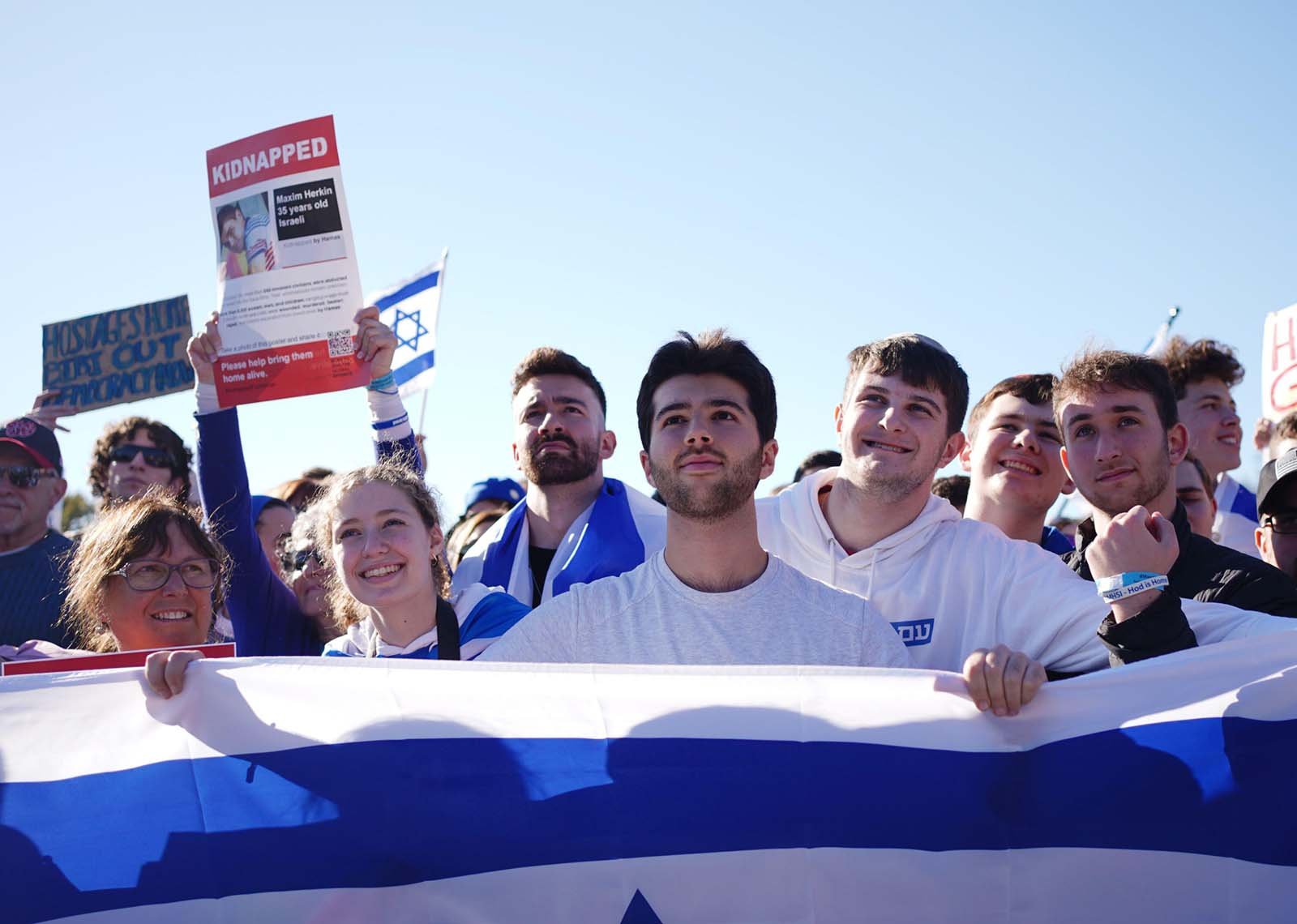
Photo Credit: Bonnie Cash/UPI UPI/ALAMY
In the days leading up to the rally, as I helped my teenage son write the words he would say from the dais at the March for Israel in Washington, DC on November 14, 2023, we deliberated about whether to stick with messaging that would be more universally palatable and whether to avoid touching any third rails. This was to be a unity event, a rare and precious moment of achdut, of oneness, reflecting a time when the majority of the North American Jewish community could coalesce and speak with one voice, just as Israelis had united under the Israeli flag—or at least that’s how I remember those early days following October 7, especially in comparison to how divided we are two years later. It seemed that most of the North American Jewish community could rally behind three basic ideas: Antisemitism—bad! Standing with the people of Israel—good! Freeing the hostages—without a doubt! Beyond that, it got a bit sticky. But even on just those three points, the teens who were to speak at the March had what to say.
Colleagues from BBYO, RootOne, and Tzofim North America, along with me from Young Judaea, comprised the planning team for the youth pre-event to kick off the rally. Our first task was to select a diverse group of teens to emcee the program. The group included teens of different genders who came from different religious denominations and Jewish communities, including American Jews and Israeli American Jews. We wanted them to stand up and speak together as a group to symbolize the unity across difference that we were trying to inspire at this rally.
As we prepared, one of the teens responded to the draft script by asking, “Why don’t we mention the loss of life among innocent Palestinians?” Barely 30 days had passed since October 7, and the adults representing the rally’s sponsors, who had to approve any changes, said no. The teen pushed back: If something is not included about Palestinians, I won’t participate. The request went back to the producers, and they agreed to one mention. Ultimately, the script read:
Now more than ever, we must make our communal spaces accessible, inviting, and welcoming—particularly to those in our community who may be newer to participation or feel that their positions may be at odds with the broader Jewish world. We can disagree and embrace one another. We can debate and still protect each other. We can advocate for Israel’s right to exist and support peace for, and with, the Palestinian people.
The result of this compromise was that the teens felt heard and felt ownership of their pre-event, and, more importantly, they felt they had a platform to express their Jewish pride and their support of Israel in their own way. They brought tremendous energy to the rally, speaking to the 30,000 teens and college students filling up the area in front of the stage and to the 300,000 adults standing strong behind them. Most of the footage of the day indeed showed a sea of young faces.
A Pew Research Center study conducted in February 2024 found that “not all Jewish Americans are experiencing the conflict the same way…. Younger and older Jews view the war differently, mirroring patterns in the broader U.S. public. In both groups, younger adults tend to express much more negative attitudes toward Israel than older Americans do. U.S. Jews also differ by age when it comes to the level of connection they feel with Israel.”
Surveys such as this one suggest that the way an individual Jew relates to Israel reflects which particular era of Israel’s history they lived through in their formative years, with divisions based mostly on key dates of the Israeli-Palestinian conflict. Are you a post-48 (establishment of the State), post-67 (Six-Day War), post-73 (Yom Kippur War), post-82 (First Lebanon War), post-87 (First Intifada), or post-2000 (Second Intifada) Jew? Now we must recognize and respond to the reality that our young adults are post-October 7 Jews.
In my work at Young Judaea, a 116-year-old Zionist youth movement, I see growing differences between generations along with an even more concerning inability to talk across diverse perspectives while maintaining civility and respect. These generational differences were exacerbated by October 7.
We work with youth from ages 4-24, and as program participants enter their teenage and young adult years, we introduce skills and practices for navigating differences of opinion. While these skills are mostly developed and used in a peer-to-peer context, or between participants and counselors, they are also easily translated into the home context as teens and young adults begin to formulate their own perspectives, sometimes in contrast to their parents or grandparents.
Having healthy but difficult conversations within families is critical, especially when there are growing gaps in perspectives. If we don’t bridge these gaps, they may cause irreparable ruptures. This same dynamic is playing out in our broader community, where there are generational gaps between the current and outgoing leaders of Jewish organizations and the up-and-coming leaders of the next generation. If we don’t actively work on bridging these generations, we will continue to see a diminished leadership pipeline because young people see existing organizations as “their parents’ or grandparents’ institutions” and resist taking the torch. The result, over time, will be that the institutions we love so much will disappear.
So, how do we take steps to close these gaps? Below, I will walk through various approaches to this challenge, especially around Israel, Jewish identity, and empowering youth.
Let them lead: A model of youth empowerment
When God desired to give the Torah to Israel, He said to them: “Will you accept My Torah?”
They replied: “Yes.”
He said: “Then provide a guarantor that you will keep it properly, and upon that I will give it to you.”
They suggested: “Let our forefathers be the guarantors.”
God responded: “They themselves need guarantors!”
Then they suggested: “Let our prophets be guarantors.”
God again said: “I have complaints even against them!”
Finally, they offered: “Then let our children be our guarantors.”
God said: “They are indeed good guarantors. Through them I will give you the Torah.”
In this story, based on a midrash from Shir HaShirim Rabbah, God is preparing for revelation and seeks a guarantor who will ensure that the Torah will be kept after it is given. Ultimately, God accepts the children of the Israelites as their guarantors, rather than their forefathers, Abraham, Isaac, and Jacob, or the prophets. Why? It could be that the children represent God’s commitment to the future, that children represent a purity of faith, or that the children can serve as guarantors simply because we will transmit our values to them. I read this passage as teaching us that children are not merely recipients of our Torah—they are the living bridge linking past and future generations. And in that role, they are far from passive; they are active players taking ownership of their present and serving as a dynamic link to the future.
We have learned in our work engaging teens that if we want to rally teens around something, the motivation needs to come from them or their peers. It’s less “if we build it, they won’t come,” and more “if they build it, it is much more likely they will come.” Creating real opportunities for our youth to voice their perspectives and to lead their peers will result in a more empowered, confident, and bold generation. They may not always say it the way we would, and at times they might get it wrong, but that is part of the learning process.
Within Young Judaea, as with other youth movements, peer leadership is core to how we teach and empower our teens. For example, when teens plan the movement’s annual National Convention, we give them parameters and frameworks, and then we let them dream. As they put the plan together, we go through several rounds of discussing and revising the plan with them to ensure relevance and resonance for their teen peer audience. We are mindful of safety and of educational standards. But they take the lead, and then as they run the program, we observe the teens and offer feedback in a structured and productive manner. We take a long view, knowing that they have several years to improve.
In addition to increasing the likelihood of a successful conference, this process also builds skills that participants take with them for the rest of their lives. Alumni in a range of careers often tell us that it is these building blocks of peer leadership that have driven their professional successes.
The children are listening—and they need role models
I once heard a parenting expert say, “Remember, the children are always listening.” Similarly, observing our actions will have a greater influence on our kids than what we try to teach them with words. As we zoom out beyond parenting to see our kids as part of a larger world, we need to consider how the actions of today’s Jewish leaders are shaping the next generation as it comes of age. Many claim that there is an impending Jewish leadership crisis, but I would argue that the crisis is happening now.
We must lift up the types of leaders that we want our children to emulate. Who are the leaders modelling the types of behaviors and middot, character traits, that we want our children to emulate? When we encourage them to look to influential leaders from throughout history and around the world now, we should push our children to see these figures as human, with both positive character traits and flaws, worthy in some ways of serving as a model, but not in others.
Sometimes it is not the public figure but the parent, the sibling, the teacher, or the youth group advisor who can have the deepest influence. We must strive to be those role models for the youth in our lives and surround them with other living models in their everyday lives. One of the benefits we see in a youth movement is that there is an aspirational arc that is created from the very first day a four-year-old camper starts in day camp and looks up to the 22-year-old unit head. When the process works, that four-year-old camper grows into that 22-year-old unit head, through years as a junior camper to a senior camper to a counselor-in-training to a counselor to a unit head, and—who knows?—maybe one day, even camp director!
For this arc to work successfully, not only the camp unit heads, but even the counselors-in-training and counselors, must understand that as they are taking care of their campers’ psychophysical needs, they are stewarding the next generation of Jewish citizens and leaders. What they do and how they do it matters greatly. This is a mindset that we try to teach and model throughout our programs. Our current leaders around the Jewish world must similarly understand that it is not enough to have arrived at a position of leadership; part of the role is modelling leadership for the next generation and inspiring them to step forward.
This was exactly what I was trying to do this past summer with a social media post I shared, expressing uncertainty about conflicting reports coming out of Israel and Gaza. I wrote:
I have spent the last few days consuming articles and reels and podcasts all in pursuit of discerning the truth from the fake news, the libels from the responsible journalism.
And I can say that I am both confused and have real clarity.
And perhaps it will be liberating to many of you who are sitting in this confused place to hear that it is ok not to declare “a side” when in fact, the facts are quite murky and there are agendas on all sides.… The more clear I get on some things, the more confused I am on others. While holding complexity and contradictions is exhausting and uncomfortable, the alternative is a black and white world that will lead us to polarization and fragmentation. Our ability to hold curiosity, empathy, humility, and healthy skepticism will hopefully get us closer.
I intended my post to show, with vulnerability and honesty, what it would look like to admit that we might not have all the answers and that there may be opposing truths. I wanted to use my leadership role to give others permission to do this, too. In fact, I felt that seeing other leaders do just this had given me permission to do so, as when journalist Matti Friedman wrote in the Free Press this past July, “When I asked a former senior government official if there is mass hunger among Gazans, he answered me honestly: ‘I don’t know.’”
My post quickly became a flashpoint. In their comments, middle-aged friends and colleagues questioned and even accused: How is it that a leader of an organization can be unsure? What kind of leadership is that?
Those of us who came of age after the Six Day War or after the First or Second Intifada tend to think that Jewish leaders should unabashedly support and defend Israel and that the messages we give to our communities should take an approach of hasbara or advocacy. But a growing number of young people are best described as what Donniel Hartman called “troubled committed” or even “troubled uncommitted” when it comes to Israel. While that may be uncomfortable for older generations, hasbara simply does not resonate with many of our youth. We must make space for the troubled and show them how they can still be committed to Israel.
They can handle nuance—so make space for machloket
One way to further isolate the younger generation is to speak in absolutes about Israel and the current conflict. It undermines their instinct to discern and ignores the fact that they are already being inundated with competing narratives.
Teens and young adults can hold more nuance than we think; they can engage with competing ideas. In her 2022 book, My Second Favorite Country: How American Jewish Children Think About Israel, education scholar Sivan Zakai argues that children can handle more complexity than we usually imagine. She suggests that “taking children’s ideas seriously requires a shift in educational practices in order to help children better navigate a world in which people disagree.” She also takes issue with the larger trend in education that “pushes schools to teach children what adults think that children ought to think about the world rather than structuring the learning around the questions the children are curious about or the ideas that children find both intriguing and confusing.”
Our job is not to simplify things; it is to give young people the space and permission to hold and unpack the complexity they see and to encounter divergent viewpoints. They are able both to question and to strengthen their own views and those of their peers. Many of us are familiar with the phrase machloket l’shem shamayim from Pirke Avot 5:17, describing arguments that are “for the sake of heaven.” But we may not be familiar with the passage: “Every dispute that is for the sake of heaven will in the end endure, but one that is not for the sake of heaven will not endure.”
What does the text mean when it says that the argument will endure? The 15th century commentator Bartenura writes that “this means that the people engaged in the conflict will endure and will not be lost.” In other words, what has sustained us as a people is our ability to engage in this type of healthy discourse.
What might it look like to encourage our youth to seek out a bar plugta, a debating partner, rather than running toward those who agree with them? Those who challenge us can be our greatest teachers and help us reach deeper understanding.
Invest in models that work: immersive Jewish education
In his State of the World Jewry Address at the 92nd Street Y last spring, Dan Senor pointed to the success of immersive education in Jewish day schools, summer camps, and gap year programs at strengthening Jewish identity. Effective immersive Jewish educational endeavors like these place learners in experiential and stimulating environments to promote active, hands-on learning and improve engagement and retention. While each of these settings has a different educational approach, some more formal than others, in each one, teachers serve as role models of a living Judaism. Investing in these settings will be another key to closing the generational gap by providing settings where our youth can personally experience and live their Judaism, their connection to Israel, and their place within the Jewish people.
Following October 7, immersive Jewish education played an even more critical role as people sought comfort, connection, and a place to express their commitments. In 2024, a Jewish Federations of North America survey found that 43% of the Jewish community across all levels of previous involvement were seeking to or engaging more in Jewish life. Jewish day schools centering education and identity formation were creating sacred rituals; chanting the prayer for the State of Israel and for the Israel Defense Forces, reciting prayers for the release of the hostages, and singing “Hatikvah” became a new staple of morning services. Other schools started reciting psalms and prayers for healing the sick, along with reading profiles of the hostages or recently killed soldiers. My children’s schools collected supplies for IDF units where their alumni were serving and brought some of those alumni in as guest speakers.
Even more than Jewish day schools, Jewish summer camps are immersive and ideological, and they can be microcosms of the ideal communities we wish campers to create when they go out into the world. Camps that proudly displayed Israeli flags and yellow ribbons or brought Israelis on as staff and campers during the summers of 2024 and 2025 brought the aftermath of October 7 right into the center of camp life.
Gap year programs in Israel no doubt offered the most immersive experience of all. Those North American young adults who were in Israel on October 7, 2023, literally lived through the Hamas attack and its immediate aftermath. They encountered Israelis every day, participated in demonstrations, volunteered with rebuilding efforts, and experienced the trauma of sirens and shelters. On Young Judaea’s Year Course, over the last two years, we witnessed an increase in the number of participants who chose to stay in Israel and join the army after spending time there on their gap year. The participants who went back to the United States are now among the most active Zionists on their college campuses, leading student organizations, spearheading petitions and lawsuits, and speaking out boldly on behalf of Israel.
Ain’t nothing like the real thing—get them to Israel again
According to the Pew Research Center study “Jewish Americans in 2020,” 9 in 10 Jews who have been to Israel more than once say they feel at least somewhat attached to it. Fewer than half of Jews who have never been to Israel say they feel attached to it. There have been many attempts to get young Jews to spend time in Israel en masse, Birthright Israel being the largest intervention in the past 25 years. More recent funding has been directed towards summer programs such as RootOne or MASA internship programs.
Studies suggest that the longer the trip, the greater the impact. Although they can be costly, gap year programs in Israel can lead to lifelong engagement, connection, and commitment to lead—the impact on every Jewish identity marker is deep and lasting. In a 2015 UJIA study of Israel gap year program participants, respondents reported that their time in Israel—even more than family, school, friends, or synagogue—had been extremely important in shaping their Jewish lives.
One of the concerning trends since October 7 is that while there might have been an initial surge to travel to Israel on solidarity missions, youth travel to the country has decreased significantly. Before Israel’s war with Iran disrupted many travel plans, the Israel Education Travel Alliance expected to see a major increase in 2025 with 60,000 participants in Israel trips over the year, after seeing only 35,000 in the 15 months between the October 7 atrocities and the end of 2024. Following the Iran war in June, however, the updated projections indicate that only 30,000 will come this year, including 25,000 who already travelled during this past summer.
I want to note as well that those traveling now are seeing Israel through a distinctly post-October 7 lens. Most organized trips today include volunteering, visits to Hostage Square or the Nova Festival massacre site, encounters with hostage families and soldiers, and meetings with different sectors of Israeli society, including Druze citizens who were central to the rescue efforts after Hamas’s attack.
Bring Israel to them—mifgashim work
Given the difference in lived experiences and the intensity of the past two years, the gap between young Israeli Jews and young North American Jews is also widening, and it is best addressed by investing in intentional encounters, mifgashim, between individuals in the two groups.
For years, bringing shlichim, Israeli emissaries, has been an effective way to connect North American Jews with contemporary Israel. And teen shlichim in particular can initiate very powerful peer-to-peer encounters. Summer 2024 was the first summer we created these intentional encounters at our camps, and it was magical. Through the Jewish Agency’s Campers2Gether program, we brought displaced Israeli teens from the Gaza envelope to be campers in our summer camps. We intended to offer the Israeli teens a summer of respite and joy following their harrowing year, and we did not realize in advance how transformative it would be for our North American campers as well. They were able to see Israel through connection with a real-life Israeli rather than watching a social media reel or hearing about it in the news. And Israelis who have been hearing about the anti-Israel protests on college campuses and the rise in antisemitic rhetoric around the United States similarly got to meet real-life American teens and to hear about their lives and interests.
Make space on the margins of the tent—they want to stay connected
In the Torah portion Matot, we read about the tribes of Reuben and Gad approaching Moses with a surprising request: They want to settle outside the Land of Israel, on the east side of the Jordan. At first, Moses is angry. It sounds like they’re turning their backs on the national mission, just as the Israelites are preparing to enter the Promised Land. But Reuben and Gad explain: We're not abandoning the people. We’ll build homes for our families here, but we’ll go to battle with you. We will not return until every Israelite has their inheritance (Num. 32:16-18).
In the end, Moses agrees. One interpretation is that Moses understands that they were seeking to balance their personal convictions with their commitment to the Jewish people. I think this understanding speaks beautifully to the moment we’re in.
Today, even within the Zionist movement, there are people who are struggling with how to relate to Zionism and the State of Israel. That struggle may be political, ideological, and/or generational. But underneath it, many, especially teens and young adults, are saying: “I care. I want to be part of the Jewish future. I just need space to show up in a way that’s honest and meaningful.”
Like Reuben and Gad, they’re not turning away. They’re asking to be included, even if their relationship with the land (and now the state) looks different from the mainstream. The strength of our people lies not in uniformity, but in shared responsibility, honest conversation, and standing together even when we don’t all stand in the same place.
I recently returned from a trip to Israel where I had dinner with a Young Judaea alum in her late twenties who made aliyah a week before October 7. I found it to be a very challenging and a deeply inspiring conversation.
This alum shared that she chose to make aliyah because “Israel is a part of who I am—growing up in Young Judaea created an unbreakable connection.” At the same time, she feels strongly that for her, to live in Israel means to be an active part of changing the reality to bring it closer to the ideal she once learned about. She struggles to understand how Israel’s commitments to being both Jewish and democratic can coexist given the realities on the ground. In her own way of responding to this tension, she regularly joins other young Jews, both native Israelis and other recent olim, volunteering with NGOs advocating for Palestinian rights in the West Bank.
She then turned to me and said, “I know I am disappointing you and the movement.” I was stunned. How could she think that we would consider her a failure? And yet, I also understood.
For many, her position is squarely outside the Zionist tent. First, she openly criticizes Israel. Second, she acknowledges and affirms Palestinian narratives, which some see as a slippery slope to anti-Zionism. But what I see most is that she has chosen to make a life for herself in Israel, and she has committed herself to changing the current reality to better reflect Israel’s ideals. She is an aspirational Zionist.
Just as I was challenged then, I encourage each of us to continue to stay open and to challenge ourselves. Our young people deserve no less, and they need to hear both clarity around the bounds of the tent but also the flexibility to make space for those who choose to dwell on the margins while insisting on being with us.
Ultimately, the best way to close the generational gap is to widen our tents and to make space for the troubled committed. The fear that leads to the narrowing of our tent, rather than creating clarity and conviction, will lead to the growth of the troubled uncommitted camp that will dwell happily outside of our tent.
***
I’m writing this almost 700 days after October 7, and while I wish I could return to that “standing at Sinai” moment at the Washington, DC rally when we stood alongside our children and unabashedly declared our unshakeable connection and commitment to Israel and to the Jewish people, I must acknowledge that it was only one moment in time. And, truth be told, we have likely romanticized that event in our collective recollection. While 300,000 people showed up, many more did not. More importantly, if we held the same march tomorrow, would we get 300,000 people? And which generations would be represented?
We have our work cut out for us if we are to return to that revelatory time. Working across generations and centering our children will be key.