Conversation with Yossi Klein Halevi: The Responsibilities of an Israeli Writer
Yardena Schwartz
Yardena Schwartz is an award-winning journalist and author of Ghosts of a Holy War: The 1929 Massacre in Palestine that Ignited the Arab-Israeli Conflict.
Yossi Klein Halevi is a Senior Fellow at the Shalom Hartman Institute in Jerusalem and co-host of the podcast For Heaven’s Sake. He is the author, most recently, of Letters to My Palestinian Neighbor.
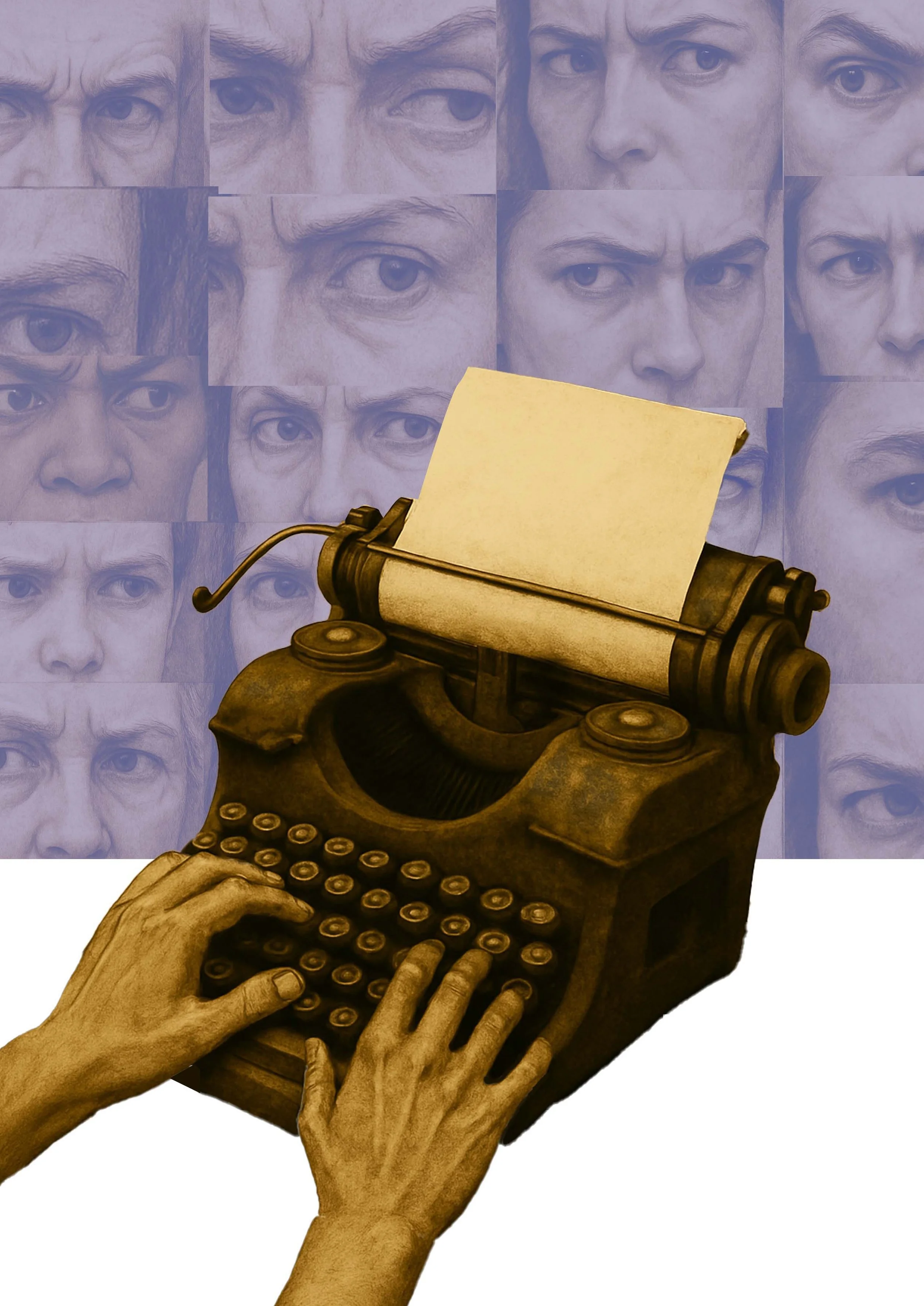
Credit: Kurt Hoffman/Adobe Firefly
As we reflect on the two-year anniversary of 10/7, Sources invited journalist Yardena Schwartz to speak with her mentor Yossi Klein Halevi about how the war in Gaza has led him to change his approach to writing about Israel. He begins by describing the early years of his career as a Zionist writing about Israel—a time when the Village Voice hired him as its Israel correspondent—and then speaks with sadness about his distrust of mainstream publications and their audiences today.
Yardena Schwartz: Our stories are very similar, Yossi. We are both American Jews who began our journalism careers in New York. We both made aliyah and worked as freelance correspondents, telling Israel's story to the outside world. You began in the early 1980s reporting from Israel for publications like the New York Times Magazine and the New Republic.
Can you speak a bit about what it was like to be a Jewish journalist living in Israel, writing for mainstream publications in the 1980s? Because it is very, very different today.
Yossi Klein Halevi: When I made aliyah in 1982, I came as a correspondent for the Village Voice, which was the most bohemian and left-wing of any mainstream or semi-mainstream American newspaper. It was obvious from my writing that I was a Zionist and that my politics were centrist, not left-wing. And yet it didn’t matter to my editors. It seemed the most natural thing in the world to be writing for them. I’d always wanted to write for The Voice. It helped create what used to be called the New Journalism, applying literary techniques like dialogue and character development to non-fiction, and that was the kind of writing I wanted to do. Writing for The Voice was my dream job.
When I think back, I'm struck by how bizarre it was, that the Village Voice had an Israel correspondent and that they gave the position to a Zionist. I saw my role as being a translator of Menachem Begin’s Israel to a left-wing audience. That's a job description that is inconceivable today. The reality has not just changed but reversed.
I ask myself sometimes what I would do if I were beginning my career today, hoping to write about Israel for a liberal-left American audience. Would that be possible? I think I might have opted instead to immerse in Hebrew and write for an Israeli audience.
Yardena: I started out doing essentially what you were doing about four decades later. I moved to Israel in 2013. And I was also writing the Israel story as a freelancer for publications like Time, The New York Review of Books, and Foreign Policy. Now, just a few years after the last pieces I wrote for these publications, the same stories they commissioned from me two or three years ago would never be accepted today were I to pitch them.
Do you think this transformation of the field of journalism is reversible? Is it still important for writers like us or for a younger generation of Zionist writers to try to tell Israel’s story to an increasingly hostile audience?
Yossi: We have a responsibility to continue telling the Israeli story, especially now. I’m thrilled to see young writers doing that. We need multiple voices from different perspectives, all sharing a passion for the Israeli story. As for me, I intend to keep writing. It’s all I’ve ever done; it’s all I know how to do. You don’t retire from the job of being a writer—especially when the story to which you’ve devoted your life is under attack.
Yardena: How are you telling that story differently, given that now it’s much more of an internal conversation? Do you tell Israel’s story differently?
Yossi: I don't think so. I try to tell the Israeli story through stories. Even in my political commentary, I bring in stories.
I have always felt that the way to defend Israel is not to defend Israel, it’s to explain Israel. Whatever Israel is at in any particular moment, let's deal with it. The Israeli story is strong enough to speak for itself. I try to convey something of the awe I feel at being privileged to be alive at a time when there’s a Jewish state. That’s something I will never take for granted.
But what has changed for me, especially in the last months, is my understanding of my audience. I’ve taken a break from assignments from general publications and confined my writing to the Jewish community. That has always been the core of my audience, but not necessarily my intentional focus. I wrote for liberal publications that were widely read by American Jews, but I didn’t restrict myself to that audience.
I find it increasingly difficult to engage with general audiences because of the growing delegitimization of Israel. If you think my country is a genocidal criminal, I don’t know what to say to you. I don’t mean that as pushback, though of course I’m enraged at what is being done to Israel. I mean it literally: I don’t know how to write about Israel in a nuanced way for readers who hate it. I’m used to writing as a matter of course for audiences critical of Israel’s policies. But they didn’t question Israel’s legitimacy.
In the past, I didn’t feel the need to weigh every word I wrote. I was never concerned about whether I was making Israel look bad. My responsibility was to convey the reality of Israel. But recently, I realized that I was writing more self-consciously. I was worried about how it would be understood or distorted.
Around the same time, I received an assignment from an American magazine for which I’ve written for years. I wrote one draft after another. Nothing worked. I couldn’t find the words. There needs to be mutual trust between a writer and a readership. I feel that trust is gone on both sides.
Early on, when I began my career, I decided to focus on writing about Israel because I saw our return home as one of the most amazing stories of our time or of any time. I love the nuances and texture of the Israeli story; I love helping readers understand why even Israel’s failures are fascinating and important. But a genocidal state isn’t “fascinating,” it’s a moral abomination that has to be dealt with, not understood. How do I write about my Israel for readers who may see its existence as a crime? It’s like an actor trying to perform before an audience that’s throwing things at the stage. I feel frozen.
We’re all trying to find our voice in this new era. We’ve never experienced such a time of deep confusion in Jewish life. On the one hand, antisemitism is back on a global scale—and thanks to social media, it’s happening seemingly everywhere simultaneously in a way that was never true before. But even as we’re once again being victimized, power has deprived us of victimhood. How do we find a way to hold both October 7 and the Gaza war in a coherent narrative?
When I struggle with that and other questions in my writing, I need to trust my audience. That’s why I’ve decided to write for Jews who are committed to Israel. At least for now, until I can find a new way of speaking to general audiences.
Last year, I went on an American campus tour, from Columbia to Berkeley. I wanted to speak to as wide an audience as possible. And so, I asked Hillel directors not to book me in Hillel but in a neutral public space. If there are disruptions, we'll deal with it. I didn’t want to hide in a self-imposed ghetto. But in the end, it didn't matter, because almost the only students who showed up were the Hillel kids, so it might as well have been at Hillel.
That was a moment of realization for me. Maybe it’s right, at this time, for me to focus on speaking to Jews. Maybe we need conversations in our own spaces, away from the hostile glare.
There’s another reason why I’m turning inward and writing primarily for a Jewish audience. In my next phase of work, I feel a need to go deeper and deal with the spiritual meaning of the Jewish story, and that can only be done for readers I trust and who care about Israel.
Yardena: When you spoke 10 years ago on these same college campuses, was the audience much more mixed?
Yossi: When I came out with my book, Letters to My Palestinian Neighbor, in 2018, I did a campus tour with some of the Palestinians who wrote letters in response. We had terrific crowds wherever we went. Some of my talks were co-sponsored, along with Hillel or Jewish Studies, by the Asian Students Association and other groups. Today, we’re pretty much on our own.
Yardena: Do you feel that being a teller of Israel's story today is, in a sense, like therapy, offering comfort, in a way, for Jews in the diaspora who are just so confused and so lost in this avalanche of disinformation? Is that why you're feeling that now your true purpose isn't to tell the Israeli story to people who don't understand Israel, or who don't believe Israel should exist, but rather to tell the Israeli story to the people who care about Israel and want to see it exist for many years to come?
Yossi: If there's any therapy involved, it's for the writer. The therapeutic aspect of writing is that it forces you to take emotional distance from what you're writing about because your goal is not to emote, but to clarify your feelings and help others to do the same. That process requires you to detach from the events around you.
People said to me after October 7, how can you constantly write about it? You must feel overwhelmed. But trying to describe the moment allowed me to live it less intensely.
Yardena: Your conversations with Donniel Hartman on the Hartman Institute’s For Heaven’s Sake podcast probably also helped you take a step back and really put your thoughts and feelings in order, in a way that helped you—and all of us—make sense of the incomprehensible.
Yossi: It's part of the same process. Donniel and I spend a lot of time, separately and together, trying to understand Israel at any given moment. As soon as you try to analyze the emotions we’re experiencing as a people, you’re stepping out. You've become an observer.
At the same time, you can’t live in Israel and remain only an observer. Israeli novelists are very engaged in political issues. Amos Oz and A.B. Yehoshua were political activists. David Grossman and even Etgar Keret write about the issues of the day. You can't be an Israeli writer and not be engaged. The larger reality constantly impinges on one’s private life.
Yardena: You mentioned earlier that you started to turn down assignments from general publications. It’s actually comforting to me to know that they're still asking you to write for them. Can you tell us about the stories they are asking you to write?
Yossi: One newspaper wanted a retrospective on the second anniversary of the war. I said no, because they were looking for an Israeli-bares-his-soul story, and I didn’t trust their readership enough to share my angst with them.
Yardena: Do you worry that if voices like yours are absent from mainstream publications, misinformation about Israel will become even more convincing?
Yossi: I'm worried about becoming a fig leaf or a token.
Yardena: Do you feel betrayed in a way by your own profession, or by the magazines and newspapers that were your literary home for so many years?
Yossi: I'm not a working journalist anymore. But I loved journalism, and I loved journalists. I found them generally smart, curious, funny. My most meaningful educational experience was the one year of graduate work I did at the Medill School of Journalism at Northwestern University. I was a terrible student until then. I was AWOL through most of my 12 years in yeshiva, and my college education never quite happened. But I came alive as a student in journalism school.
I was taught by what turned out to be the last generation of traditional journalists. This was the late 1970s. My fellow students were all there because of Watergate. Everyone wanted to be a journalist in the seventies because of Woodward and Bernstein. I wanted to be a journalist because of Herzl and Jabotinsky. When I was first getting drawn to writing, I learned that the Zionist movement had been led by journalists and writers. The Jewish state was written into existence. Journalism seemed to me a miraculous profession. I felt that all the different parts of me came together in journalism. The writer, the Jew, the Zionist.
My teachers at Northwestern were classic curmudgeons straight out of the old Chicago newsroom.
They believed in journalism as an almost sacred mission. They had tremendous integrity. They taught us that the role of a journalist is to search for truth, not justice. And that’s where journalism in my generation went wrong, in the switch from the pursuit of truth to the pursuit of justice. If you want to be a social justice warrior, join an NGO. Journalism is, or was, about the elusive search for truth.
Yardena: I've struggled with the idea of calling myself a journalist over these past two years and wondered if maybe I should also consider myself a former journalist.
Yossi: I used to be so proud of being a journalist. Hemingway was a journalist. Isaac Babel....
Yardena: Mark Twain....
Yossi: What an amazing tradition. I’m heartbroken by what has happened to it.
Yardena: I'm glad you brought up the role that journalists and writers played in establishing the foundations of Zionism and the State of Israel. I think it's safe to say that this moment in Israel's history is the most pivotal we've had since the founding of the state. I'm wondering what role you think Jewish writers, Israeli writers, and journalists can play in this moment, as we rebuild, recover, and figure out what Zionism is today, and what the state of Israel represents in the wake of October 7.
Yossi: Writers of the Israeli story perform two roles. One is to ensure that our stories don't get lost. Writers work against amnesia.
The second role for writers is to help shape a narrative of their time and place. This is especially important living in a country whose story is under attack.
As a writer, I try to find new ways of telling the stories we all think we know. My book, Like Dreamers, which was about seven paratroopers who fought in the 1967 War and how their lives unfolded afterward, was an attempt to create a new reading of the post-1967 Israeli story as a struggle within the utopian camp of Zionism, between the fading kibbutz movement which had helped found the state and the rising settlement movement, which saw itself as inheriting the mantle of Zionist pioneering. That insight surprised me. That’s how I sensed I was onto something interesting.
Yardena: I should mention that you were my mentor in writing my book about Hebron. You've mentored many journalists and writers of the Israel story. When you meet with young writers, or anyone who is determined to tell Israel's story to the outside world and help explain, not defend, but help explain Israel to the outside world and to the Diaspora as well, what advice do you give and how has your advice changed ?
Yossi: I'm very proud of you and of your wonderful book.
In terms of what advice I would give to a young journalist or non-fiction writer interested in telling the Israeli story: Love your characters. Even if you don’t like them as people, love them as stories. Try to understand their motives, the life experiences that led them to where they are now. Especially if you abhor their politics. They’re part of the Israeli story; treat them with literary respect.
If I may add some unasked-for spiritual advice: Try to work as much as possible from a place of service to the Jewish people. We all have healthy egos—you can’t spend your days locked in a room writing if you don’t believe that what you have to say is urgent and everyone must read you. My wife Sarah used to tease me, because every time I would publish an article, I’d tell her, “Now, this is going to change the discourse. People are really going to understand something about Israel that they haven't understood before.” And when I would publish a book, I was sure it was going to change the whole narrative. Gradually, you learn it doesn't work that way and to see your rightful place in the cosmos.
At a moment like this, when telling the Israeli story has become more important than ever and yet also more difficult, and so many publishing avenues are being closed to Israeli writers, you need to own the sacrificial nature of this work. In the East, they talk about detaching from the fruits of your labor, and that’s become a major focus of my own spiritual work. I try to start my writing morning by offering the work to God and asking for His blessing. But you don’t have to be religious to practice detachment and service to the Jewish people.
Yardena: So, we won't give up on telling Israel's story. Maybe for now it will be for a smaller audience, but hopefully not for too much longer.
Yossi: I think, Yardena, that if we tell a strong story, a true story—or true stories—to ourselves, those will resonate outward.