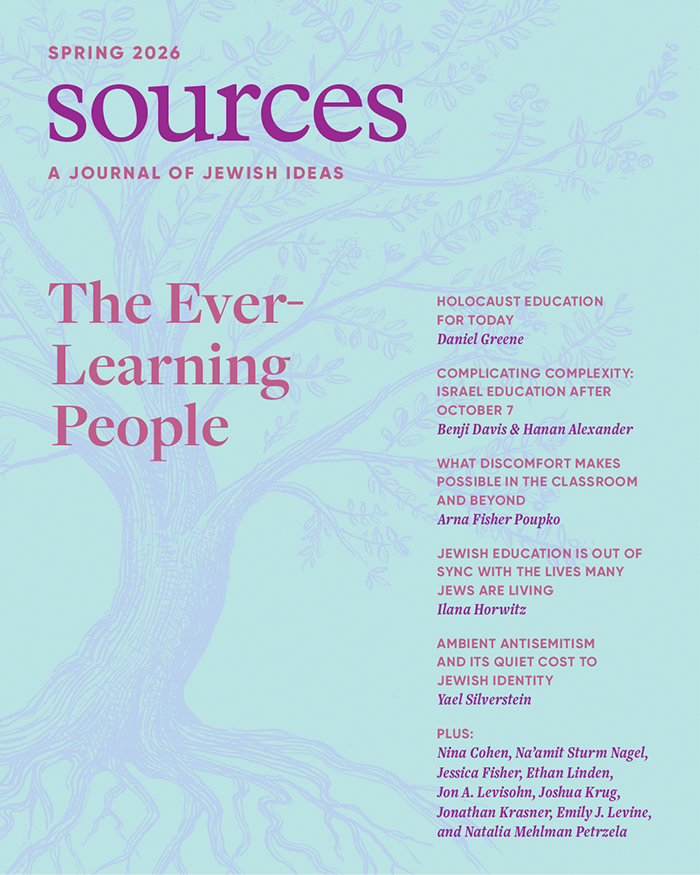
The Ever-Learning People
From the Editor
Dear Friends,
The philosopher Simon Rawidowicz famously called Jews “the ever-dying people” in an essay chronicling our peculiar tendency in nearly every generation to imagine ourselves standing on the brink of disappearance. The phrase captures something important about Jewish historical consciousness. But as Rawidowicz explains, even as we have feared our demise, we have also always set up the next generation for renewal. As he describes it, Jews are “always fearing the end, never afraid to make a new beginning, to snatch triumph from the jaws of defeat, whenever and wherever possible. There is no people more dying than Israel, yet none better equipped to resist disaster.”
Learning and education is one of the enduring practices through which Jews have renewed themselves. The language of continuity—of survival—has dominated conversations about Jewish education for several decades. But such conversations often miss the deeper questions we need to be asking: Who are we striving to become as Jews? What is our vision of Jewish life and moral responsibility? We must clarify the ideas that can shape a vibrant, meaningful, and morally serious Jewish life in our time and then be guided by them in our teaching and learning.
Over the five years Sources has been in print, we’ve explored a wide range of challenges facing contemporary Jewish life. Many of the previous fourteen issues have included an essay or two on learning and education, generally in connection with a particular issue’s theme. But now, we are flipping the script and calling this issue, “The Ever-Learning People.” The pieces inside explore Jewish education from a variety of angles and with attention to a variety of specific subject areas.
Altogether, we are asserting that Jewish learning is both the passing on of a certain body of knowledge to the next generation and the developing of students’ sense of belonging and contributing to a rich civilization; and that this process must be driven by a vision of Jewish thriving. Today, this means that Jewish education must engage with questions of peoplehood, pluralism, moral responsibility, and the exercise of Jewish power in a democratic world, and it must empower students of all ages to build a vibrant, meaningful, and morally serious Jewish life.
The essays gathered here take up this challenge by exploring how we can cultivate learners capable of grappling with the intellectual and moral horizons of Jewish life in the twenty-first century. They inquire about how, where, and what we teach and learn, offering sharp critiques where needed and suggesting new models that can move us forward.
The first section, Contents & Purposes, explores some of the most pressing questions of Jewish education today. Daniel Greene revisits Holocaust education, highlighting political burdens we are unfairly placing on it, and arguing that its central task should be helping students understand what happened, why it happened, and what moral questions it raises for the present. Nina Cohen reflects on teaching civic education in an Orthodox high school and shows how helping students navigate loyalties to family, faith, nation, and Jewish peoplehood can strengthen their participation in American democracy rather than undermine it.
Na’amit Sturm Nagel then offers American Jewish literature as a powerful educational resource, demonstrating how contemporary literary texts invite students into the interpretive work of wrestling with complexity and cultivating their own voice within Jewish life. Benji Davis and Hanan Alexander address the challenge of Israel education after October 7 by proposing a model of “rooted and respectful criticism” of both Israeli and Palestinian narratives. In the final piece of this section, Jessica Fisher and Ethan Linden present people, place, and purpose as a three-part structure for teen education that can strengthen young adults’ Jewish identities and provide the emotional support they need.
The second section, Teaching & Learning, asks about the conditions that make learning possible. Arna Poupko Fisher reflects on the interplay of disjuncture, humility, and trust, arguing that meaningful adult learning emerges when intellectual challenge unfolds within relationships capable of holding it. A roundtable organized by Jon A. Levisohn and featuring Deena Aranoff, Jane Kanarek, Joshua Ladon, and Ariel Mayse, asks about the purposes and limits of Jewish text study in educational settings. Joshua Krug closes the section with a meditation on teaching as a relational and personal act, suggesting a vision of teaching as a project of awakening students’ yearning to engage with the Jewish tradition.
The third section, Rethinking Jewish Education, reexamines the place Jewish education occupies within the broader architecture of contemporary Jewish communal life. Jonathan Krasner interrogates the past two decades’ emphasis on innovation as a strategy of renewal, explaining why our educational institutions have actually tended to resist such attempts and offering suggestions for a different approach. Ilana Horowitz explores how the contemporary structures of Jewish community and education remain organized around assumptions that no longer reflect the realities of many Jewish lives. Together, these essays invite educators and communal leaders to reconsider how Jewish education might evolve if its ambitions were to be matched by the conditions in which Jewish learning and life actually unfold. Emily J. Levine considers three generations of her family’s engagement with educational institutions against a backdrop of nineteenth- and twentieth-century German and American Jews and the compromises they made in pursuit of higher education.
The final section, Jews & Higher Education, turns to the contemporary university as a setting where questions of Jewish identity, belonging, and intellectual life come sharply into view. Yael Silverstein introduces the concept of “ambient antisemitism,” describing the ways institutions create climates that signal to Jews that they are less welcomed or less protected. The framework offers a way to understand contemporary antisemitism not just as isolated incidents but as a pervasive social condition. Natalia Mehlman Petrzela reflects on being a Jewish professor in the aftermath of October 7, arguing that classrooms must remain spaces for intellectual seriousness and humanistic inquiry even as political polarization reshapes campus life.
Taken together, these essays illuminate what it is for Jews to be an ever-learning people. To educate toward ideas is not simply to transmit tradition but to sustain the ongoing conversation through which Jews interpret their inheritance, debate meaning, and imagine how it might guide Jewish life in the world today.
Joshua Ladon, Guest Editor
Claire E. Sufrin, Editor