Jewish Education, Jewish History, and Parenting between Universalism and Particularism
Emily J. Levine
Emily J. Levine is Associate Professor of Education and (by courtesy) History at Stanford University.
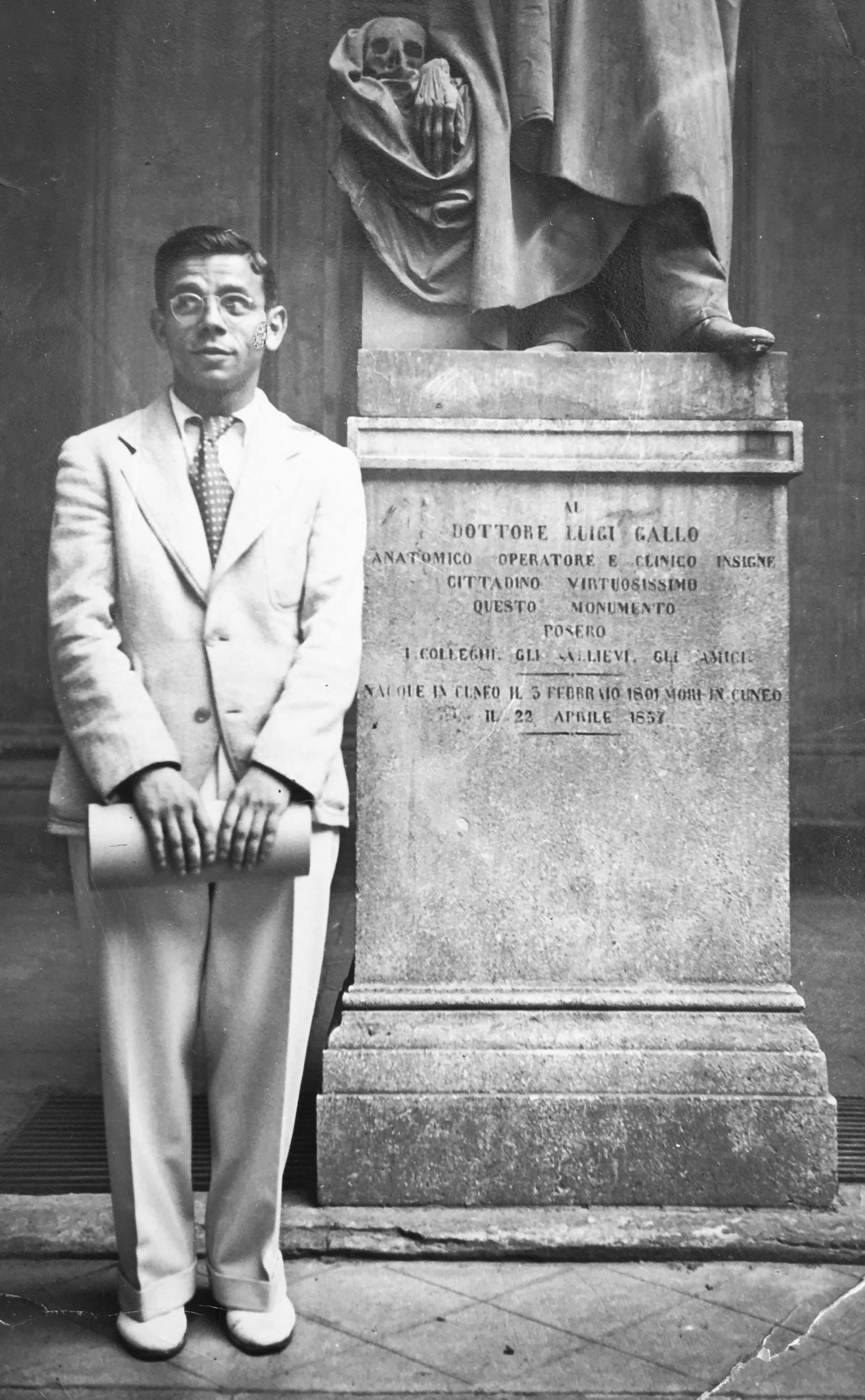
THE AUTHOR’S GRANDFATHER, MAX SHAPIRO, AT THE UNIVERSITY OF TURIN, ITALY (COURTESY OF THE AUTHOR)
A longer version of this essay appears in German in Being Jewish Today: Jüdische Stimmen aus Amerika, edited by Amir Eshel and Thomas Sparr.
“It’s Shabbat, Mommy,” my ten-year-old J. said sharply as we stepped off the S-Bahn in Berlin, his hand already moving toward his kippah. The rabbi had warned us not to wear identifiably Jewish clothing on our way to synagogue. I paused, searching for an explanation though I knew I would not find one that would satisfy either of us completely. We had traveled forty-five minutes from our temporary home in leafy Dahlem with the Stanford in Berlin program to attend services at the Oranienburger Strasse synagogue, an architectural symbol of German Jewry’s former grandeur—and its fragility. Standing there, pulled between my son’s certainty and my own hesitation, I understood that raising a Jewish child must include teaching him how to make judgments about who he is and how he wants to navigate Jewish difference in a world that does not offer clean choices.
“You simply can’t wear a kippah in this neighborhood,” I finally blurted out. And then we turned to file through the synagogue’s metal detector.
My fumbling explanation on that Berlin sidewalk—and then back in our permanent home in northern California when he wanted to wear a Star of David necklace or hang an Israeli flag—echoed a much older Jewish problem. It’s one I have spent years studying at a safe analytical distance but had never expected to have to teach so directly: how much to integrate, how much to insist on difference, and how to balance universal commitments with particular obligations. As a historian of German Jews, I was trained to see these tensions as intellectual problems with historical contours and institutional consequences.
Parenting collapsed that distance. The same questions that once occupied me as a scholar are now challenging me at home. The most essential Jewish education, I have come to understand, takes place precisely in these moments, where judgment must be exercised without the comfort of purity, and where compromise must be practiced openly and honestly. Teaching my children how to negotiate their Jewishness in public has also deepened my appreciation of the Jewish intellectuals I study and the dilemmas they faced, and their stories have helped me to make sense of my own options and how my family’s story fits into Jewish history.
***
Long before I had to answer questions of kippah wearing in public as a parent, I had learned to recognize them as a historian. German-Jewish scholar of mysticism Gershom Scholem gave this dilemma its most unsparing diagnosis. Writing in 1964, Scholem famously argued that the so-called German-Jewish dialogue was no dialogue at all but a one-way street. German Jews had learned German local dialects. They cooked and ate German foods. They even fought in World War I. (Later scholars described them as having become “good” Germans.) But they had never been accepted, Scholem wrote two decades after World War II, when the devastation of the Shoah was laid bare.
But had they been wrong to try? Are we American Jews wrong to try?
Scholem called his autobiography From Berlin to Jerusalem, in reference to his journey from his hometown in Germany to the capital of what was then Palestine, where he helped found the Hebrew University in the interwar years. But it was also a typology of the tension between the universal (“Berlin” and the West) and the particular (“Jerusalem” and the Jewish).
As Scholem was well aware, the negotiation between Germanness and Jewishness played out in an especially significant way for Jewish intellectuals who wanted to participate fully in the universalist ideals of the modern research university. Some sought to apply secular tools to Jewish texts, recasting Judaism as a culture shaped by time and circumstance rather than an unchanging religious system. Others concluded—often reluctantly—that minimizing visible Jewish particularity was the price of institutional inclusion.
This problem first took institutional form in the nineteenth century movement known as the Wissenschaft des Judentums (or the Science of Judaism), founded by Leopold Zunz, a 23-year-old student at the newly established University of Berlin. Zunz drew on the methods of philology and history that were pervasive at the time to argue that Jewish texts deserved the same scholarly seriousness as those of Greek or Roman antiquity. According to “Something about Rabbinic Literature”—yes, that was the bland title of his quietly revolutionary 1818 pamphlet—Judaism is not an unchangeable system, but part of humanity’s shared intellectual inheritance. As Ismar Schorsch describes in his formidable biography of Zunz, the founders of the Wissenschaft des Judentums believed that rigorous historical and philological study in the German tradition of Wissenschaft, or scholarly research, could secure Jewish dignity within modern culture. A history of the Jews, Zunz argued, was crucial to “the understanding of man.”
Yet Zunz’s project exposed a painful contradiction. Jewish learning was entering the academy only as an object of study, detached from the practices, authorities, and people that had once defined and sustained it. Zunz himself remained caught between worlds—too Jewish for the university, which declined to create a chair in Jewish history and never integrated the Wissenschaft des Judentum into its ranks, and too secular for parts of the Jewish community, which feared that Wissenschaft would hollow out religious life. Later generations of German Jews refined but did not resolve this dilemma, including such thinkers as Ernst Cassirer who placed his hopes in a cosmopolitan humanism, lecturing on Goethe in synagogues and appealing to Enlightenment ideals even as antisemitism hardened in German universities around him during the Weimar period.
During the early twentieth century, American-born Jews on the other side of the Atlantic were also attracted to the universalist message of science and the promise of integration, but they faced different obstacles to being accepted in academia. In a scathing 1923 critique called The Goose-Step, the muckraking American journalist Upton Sinclair exposed the racism of elite American universities, whose admissions policies, he explained, were stacked against those who were “trying to break into ‘society.’” All of this added up to what Sinclair called an “academic pogrom.” He offered a proposal to the excluded: “If I were a cultured Jew in America… I should make it my task to persuade wealthy Jews to establish an endowment and gather a faculty of Jewish scientists and scholars—there are enough of them to make the most wonderful faculty in the world.”
Sinclair’s recommendations were not far from what was already happening. In contrast to German Jews who, by necessity, used private philanthropy to create institutions of modern Jewish learning outside the university, American Jews largely sought to break into existing universities by funneling money to the teaching of Semitic languages and the support of Jewish graduate students, especially as the US university movement was coming into its own, loosening its ties to Christian sects and assuming a non-sectarian ecumenical Protestantism at the turn of the twentieth century. This was a new expression of Zunz’s dual hope—namely, that the more rigorous study of Jewish texts would bring Jews closer to their religion and simultaneously earn them more respect from their non-Jewish German colleagues.
For a short time, around institutions such as Harvard and publications like the Menorah Journal, a confident synthesis briefly seemed possible: Jewish learning would deepen Jewish life while also enriching the broader humanities. In the inaugural issue of the Menorah Journal, the editors announced that it would be “an expression of all that is best in Judaism… fearless in telling the truth; promoting constructive thought rather than aimless controversy [and] dedicated first and foremost to the fostering of the Jewish ‘humanities’ and the furthering of their influence as a spur to human service.”
According to historian Daniel Greene, the so-called Menorah movement, which ultimately spread to over 80 colleges and universities in North America, viewed itself as Zunz’s intellectual descendant. It is noteworthy that it produced luminaries and authorities on the Jewish past who are well known today, including historians Salo Baron and Cecil Roth, and the Hebrew literature professor, Harry Wolfson. All three were at the peak of the aspirations of cultural pluralism—a term that their colleague, Horace Kallen, coined in 1924 while part of the magazine’s milieu. Yet even the Menorah Journal failed to entirely resolve the tension contained within the synthesis of secular and Jewish priorities.
***
The literary couple Lionel and Diana Trilling are an example of the bridge between these cohorts and the tension that persisted across them. Lionel Trilling spent most of his career at Columbia University, where he was tasked with teaching the Western canon—according to an old joke, “Protestant students were taught Roman Catholic philosophy by Jewish professors.” He got his start at the Menorah Journal, where he wrote both book reviews and novellas dealing with Jewish themes. But in the 1930s, as he became more professionally ambitious and the American academy became more antisemitic, he felt pressure to leave behind this focus on Jewishness. Rising to prominence at Columbia, Trilling ultimately became one of the most influential literary critics of midcentury America. “Liberalism,” he once observed, “is not only the dominant but even the sole intellectual tradition” of modern American culture. In light of his biography, the statement conveys confidence, but also constraint. As Adam Kirsch has deftly shown, Jewish identity hovered at the edges of Trilling’s writing—felt deeply, acknowledged obliquely, rarely allowed to organize the center of his intellectual life.
Diana, too, sought to minimize her husband’s focus on specifically Jewish topics during this time, as she recounted it in her memoir, The Beginning of the Journey. But even as she insists that Jewish identity was not a significant feature in their lives, she dwells on the topic for a significant portion of the memoir. She writes that Lionel would have preferred to forget that initially he wasn’t gentile enough for his colleagues at Columbia, who tried to dismiss him in 1936 for vague reasons that only thinly disguised their antisemitic intent. The decision was ultimately reversed, and in 1938, Trilling became the first tenured Jewish professor in Columbia University’s English Department. By that point, the magazine that helped to launch his career, the Menorah Journal, had fallen into obscurity, having lost steam around 1929, as the Jewish intellectuals who once filled its pages became more active in leftist politics and departed for more political journals.
I immersed myself in the history of German and American research universities for my book Allies and Rivals, where I traced how they emerged over the nineteenth and twentieth centuries in competitive and cooperative exchange with one another. Jews played a prominent role on both sides of the Atlantic and in the mutual exchange of ideas that led to this institutional innovation. But Jewish engagement with Western universalism had its limits on both sides of the Atlantic, too, as Scholem had anticipated.
What struck me, rereading these debates years later, was how familiar they felt. Education was the site where ideals confronted actual circumstances, where compromise became unavoidable, and where losses would need to be absorbed, whether one was turned towards Berlin or Jerusalem.
For a long time, I believed—like many American Jews—that my family’s story had turned out differently from the intellectuals I studied. The United States is not Germany. That belief began to unravel when I returned to my own family history, especially the story of my maternal grandfather, Max Shapiro. Though he never sought to be a professor, his pursuit of education was shaped by a constant push and pull between particularism and universalism.
A child of immigrants, Max was born in 1911 in New York, shortly after his parents, Harry and Sarah, arrived from Vilna. Max was determined to be a physician. When he was rejected from medical school at the University of Chicago because of the school’s discriminatory quota system for Jews, he learned Italian (his third language, after Yiddish and English) and traveled to Europe in the mid 1930s to enroll in medical school in Mussolini’s Italy. Max began at the University of Bologna but graduated from the University of Turin in 1939. An anti-fascist stronghold, Turin allowed some Jewish students—Primo Levi among them—to complete their degrees on a case-by-case basis, even as other Italian universities began expelling Jews. One photograph from this time depicts Max resplendent in a beige linen suit, posing in the hall of medical monuments at the University of Turin, eyes askance, clutching his diploma, and exuding modest charm.
A debilitating illness prevented me from getting to know Max. As a result, these stories of his earlier life and especially his studies in Europe were the basis of my connection to him. As a student in Italy, he traveled extensively throughout the continent and as far as Palestine between 1936 and 1939, his visa granting him free passage throughout the region; the photographs that he took on his travels depicting this historic time have become family treasures.
When my family and I were living in Berlin in 2025, I often looked at these photos and tried to track his journey in relation to ours. Max had labeled a photograph of a central European building draped with a Nazi banner, “before the plebiscite, 1938” on the back. A colleague immediately recognized the building as being in Vienna, which we also visited on a short trip from Berlin. Max likely took a train through Vienna on his way to Vilna when he visited his grandparents for Passover that fateful spring.
Max’s collection of photographs from this era includes black-and-white, old-country portraits worthy of the celebrated Jewish photographer Roman Vishniac, interspersed with scenes from his holidays with classmates on the Italian Riviera and in the Alps. As a capstone to our trip in Berlin, we traveled to Italy in an attempt to follow Max’s footsteps to Positano and to recreate an exquisite photograph he took on the beach with the winding stairs of the seaside Italian village in the background.
What I had taken to be an exception in my family’s past now looked like an early lesson in the costs and consequences of educational compromise. Max’s choices were made under duress. Education offered him survival, mobility, and legitimacy, but demanded the contraction of his Jewish life to what could be carried privately. His story has long been told in my family as one of resilience and success—and it is that—but it is also a story of unavoidable loss.
On the other side of my family, my grandparents were more fully American, and they faced a different version of the same dilemma. Their world was defined less by exclusion than by opportunity. My American grandparents met in the summer of 1941 at Fleischmann’s, an upscale Jewish resort in the Catskills, in a scene straight out of The Marvelous Mrs. Maisel, when my grandmother, Florence, spotted Jack Levine, a strapping young man, walking up a hill and offered him a ride. A romance ensued despite Jack’s army assignment to Fort Knox—she wrote him a letter there in which she mentioned that she was trying to use up her personal stationery “just in case I get married soon.” He courted her at a rooftop Glenn Miller concert and proposed at her family’s New York City home on 79th and West End. He received a furlough for their wedding at the Pierre. They were married for nearly 60 years.
Jack’s father, my great-grandfather, was named Falk—and, like Max’s parents, he was born in Vilna. For him, too, education promised advancement, stability, and belonging. Like grandpa Max, he wanted to become a doctor, and his trajectory was in some ways a mirror image of Max’s. Whereas Max moved from the US to Europe in search of a more tolerant medical school, Falk moved in the opposite direction. He was accepted to study medicine in Leipzig following his Abitur from a Russian gymnasium with honors, but his medical career was cut short due to the outbreak of pogroms in 1907, which forced the family to hurriedly depart for New York. There, Levine senior opened a small candy store and young Falk worked in the shipping department of a ladies’ dress factory, ultimately becoming an entrepreneur and business owner of a multi-generation shoe business.
But for all my American-born grandparents, as they made their way in the world, Jewish knowledge thinned for reasons I can’t pinpoint. Was it less necessary? Less relevant? Was there simply not enough time in the day anymore to be a father, a businessman, and a yeshiva bochur? They certainly believed themselves to be engaged Jews and gave their hard-earned money and countless hours to support liberal American Jewish institutions. But there is no doubt that their textual fluency diminished, and their grandchildren and now great-grandchildren bore the consequences.
This is not just a story of the failure of liberal Jewish institutions that we read so much about. When my parents approached the head of the Orthodox Jewish day school to which they were considering sending me in the 1980s, they were told that they would only be welcome if they kept Shabbat and strict kashrut. Turned off by the gatekeeping, and with no pluralist Jewish day schools available to them at the time, they demurred. Ironically, their interest in giving me a “traditional” education landed me in an Episcopal school not unlike the German Gymnasiums that my eventual research protagonists attended.
With a sizable population of Jewish students, there was a running joke that the crucifix prominently displayed in our school’s chapel actually stood for the “T” of its name, Trinity. Needless to say, no one really believed this, but the cross-that-is-really-a-T joke persisted because enough Jewish students and their families wanted the cross to be not a particular symbol that excluded them but a universal one that was inclusive. Countless Jewish students managed to deflect the criticism of their perplexed grandparents and to show their commitment to the dominant culture.
Each generation makes decisions about what to carry forward and what to leave behind.
***
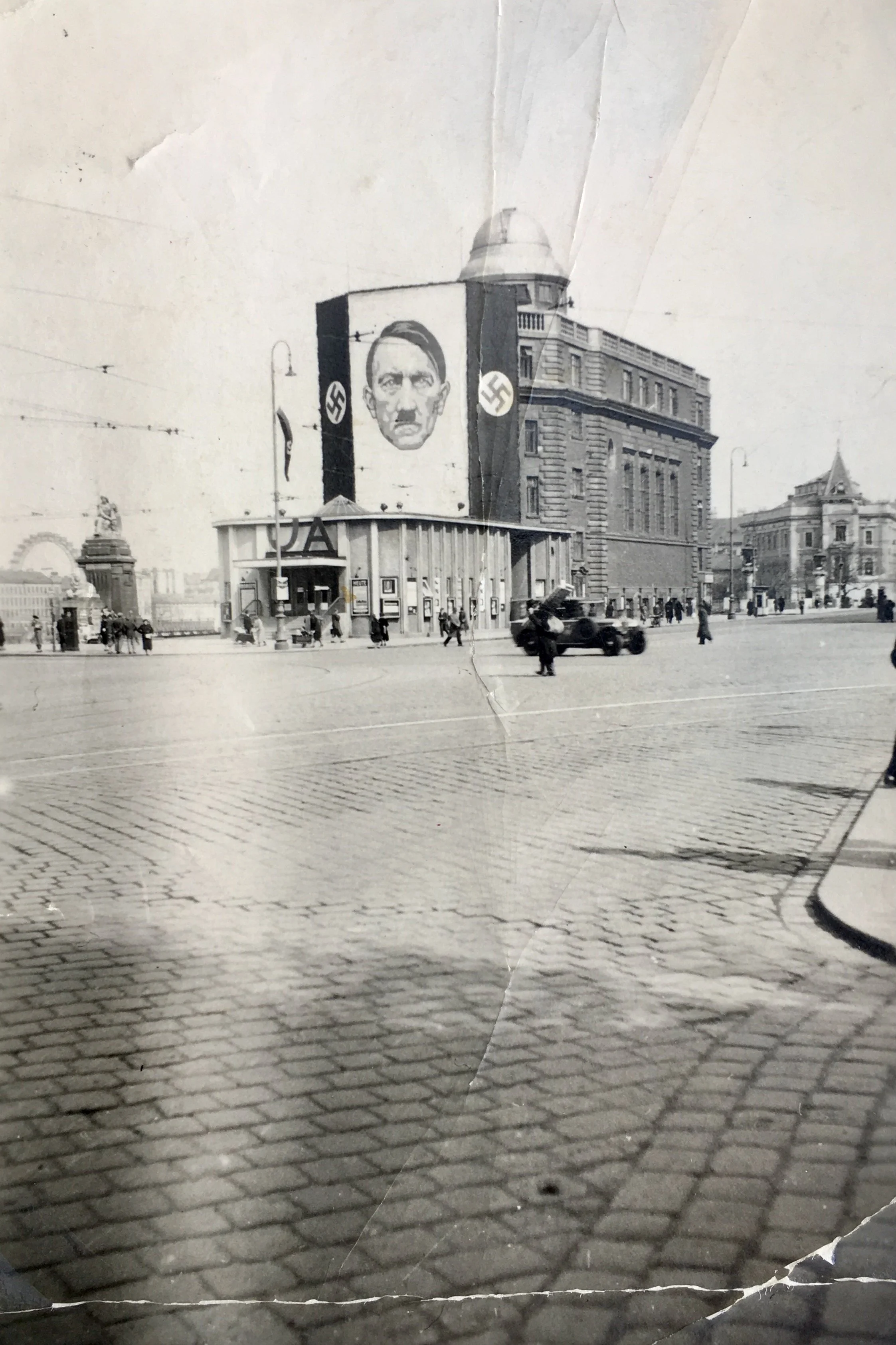
"BEFORE THE PLEBISCITE, 1938" (COURTESY OF THE AUTHOR)
Remaining true to the humanist tradition, I became a scholar of modern Germany. Over the years, I have become more aware of how my family history has weighed on my own professional path. It’s not a coincidence that I wrote my dissertation and first book, Dreamland of Humanists, on German Jews in Weimar-era Hamburg who faced a similar dilemma about how to balance their allegiances to the particular and universal worlds of which they were a part. These secular German Jewish protagonists to whom I have been drawn as scholarly subjects were engaged in a similar dance of embracing the dominant culture of universalism with a German inflection. Previous scholars have assumed that these Jews, like Cassirer (mentioned above), Aby Warburg, and Erwin Panofsky, moved “beyond” Judaism to borrow George Mosse’s well-known phrase, or that they amounted to no more than “non-Jewish Jews,” to cite the eponymous book by Isaac Deutscher. But much like Zunz, they believed that being a Jew meant contributing to the general inquiry of ideas. And—albeit less overtly than Zunz—they also sought to open German audiences to the Jewish world.
Scholem would tell this tale of Jewish humanists as one of delusion. But something told me to look more closely at the decisions that Warburg, Cassirer, and Panofsky made about what to include, their modes of inquiry. Notably, their inflection changed depending on the audience. When conducting my dissertation research in Hamburg, I repeatedly encountered disbelief: Warburg and his circle weren’t Jewish in any meaningful sense. It was Hitler who determined they were Jewish.
To be sure, the public version of Aby Warburg revealed a banker’s son uncomfortable with his Jewishness, who went as far as to court antisemites so that his beloved library would not be associated with the Jewish world. But I unearthed in the archives that Warburg spoke differently depending on who his audience was. When he learned Cassirer was considering leaving Hamburg for a job at the University of Frankfurt, he spoke of the loss of a prominent Enlightenment scholar in public, while in private he anxiously worried about the loss of the “German Jewish tradition” in Hamburg. What could Warburg have meant? Cassirer was no scholar of Talmud or even Jewish Studies in the Zunzian sense. My conclusion: Warburg believed that Cassirer’s contribution to secular scholarship was itself a source of pride and identity for the Jewish world. Unlike Berlin Jews whom he viewed as too secular and Frankfurt Jews whom he ridiculed as too Jewish, Hamburg represented the middle ground.
In retrospect, it’s not surprising that, having grown up in that precarious center myself, I would be drawn to these figures and be the first scholar to see in them a familiar predicament of modern Jewishness that eluded others. Mine was not “only” a Jewish story but neither were they “non-Jewish Jews.”
The tragedy I highlighted in the book’s denouement was that Jews who considered themselves to be contributing to the universal were nefariously misinterpreted as making contributions to the particular. Even as Jews insisted that their work in secular humanities was an expression of their Germanness, Germans ultimately never accepted them, and continually interpreted their contributions to art history or European philosophy as “Jewish” scholarship. That is, their Jewishness was held against them.
But another tragedy, that I don’t think I fully appreciated until I became a parent, is assuming that contributing to the universal is enough to sustain the distinct tradition of the particular.
I do not wish to blame my parents any more than I do my grandparents, whom I cherish, and to whom I dedicated my first book for what I called the “tireless spirit and exceptional grace with which they navigated these worlds.” But I’ve come to appreciate the inevitability of the imperfect nature of their decisions.
Still, we can choose to write about anything. It is one piece of agency we have as scholars and historians. As such, it’s significant that choosing to write about secular Jewish intellectuals was not a coincidence but a conscious decision for me.
My research has always existed at the lively intersection of Germans, Jews, and ideas, leaving me to decide whether to describe myself as a scholar of German history, Jewish history, or the history of ideas. I always insisted to anyone who asked that I was a historian of Germans and ideas, while my grandparents, Jack and Florence—who perhaps at that point regretted their lack of Hebrew and Jewish learning—always told their friends proudly that their granddaughter was a Jewish historian. In an ironic reversal of the crucifix’s fate at my Episcopal school, they were inverting my contribution to universalism to give meaning to their particular identity.
If the joke in the end was on me, it has not diminished the centrality of the power of storytelling to my identity and only heightened the question of whose stories I should tell. I also became a historian because I believe that the stories we tell ourselves about the origins of our identities are a source of enduring power and meaning.But as I tell the stories of German Jewish intellectuals, I continue to wonder: Should I use the power of storytelling to highlight the particularity of Jewishness or to emphasize Jewish contributions to a more universal narrative? And what of my own story?
Even now, as a professor with tenure at an elite institution, I think often about whether devoting my life to the university was the right choice and what I’ve given up to pursue it. Over the course of my studies, my German became near perfect while my Hebrew School linguistic abilities languished. While on an earlier sabbatical in Berlin in 2012–2013, I received an invitation to attend a conference in Jerusalem on German Jews. For the occasion, I was determined to salvage my Hebrew and even hired an Israeli language tutor to help me practice basic conversation. But when I arrived in Jerusalem, I found myself tongue-tied. The irony did not escape me that I was better able to communicate at the conference with my non-Jewish German colleagues than my Israeli ones. Every time the conference took a cigarette break, a strange mix of pride and sadness overcame me as I quietly shuffled over to the German-speaking group, the only circle in which I was able to schmooze with confidence.
***
In July 2023, we decided that our family’s first post-pandemic international trip should be to Israel. By then, we had made the decision to send J. to a secular grade school, even though we worried that he would miss out on the special feeling of belonging that he would no doubt have at a Jewish school. To compensate for this, we resolved to also pour incredible amounts of time and money into Hebrew tutors, camps, and other forms of instruction—including this trip to Israel.
The trip was powerful for all of us, but especially for our two children. Later, on October 7, my husband and I were sitting with them in synagogue for Shabbat morning services. A congregant who arrived late ran up to the rabbi who was leading services and whispered into his ears what he had presumably just learned: that Israel had been attacked inside its borders. The congregation was dancing and singing around the Torah when the rabbi yelled for the group to stop and delivered the news, imploring us to cease our laughter. Upon hearing the news, eight-year-old J. burst into tears.
In 1928, Salo Baron, an historian at Columbia, criticized what he called the “lachrymose conception of Jewish history.” Jewish history, he argued, was too often cast solely as a story of suffering and persecution. But it was more than just that. Despite Baron’s intervention, the violence of the Shoah just a few years later brought the “lachrymose conception” back again to a dominant position.
After October 7, Baron’s dictum was on my mind when I read of American-born Israeli author Yossi Klein Halevi’s clever distinction between what he called Purim Jews and Passover Jews, and I discussed it with family and friends in the spring of 2024. Purim Jews, who relish the macabre holiday where Jews celebrate being saved from near destruction, and the destruction of their enemies in their place, believe that everyone is always out to get us. Passover Jews, on the other hand, identify with the liberation of the Jews from bondage in Egypt, and believe it is now our unique obligation to save others from bondage as well. Both holidays carry obligations to retell the story but whether one puts the emphasis on the near destruction or on the saving, on the oppression or on the rising up, remains the question.
Am I a Purim Jew or a Passover Jew? A Purim or Passover historian? A Purim or Passover parent?
After October 7, many of our friends urged us to reconsider our decision to send our children to secular school. One Jewish foundation even offered us a scholarship to assist in making the switch to a religious school. But this wasn’t the answer for us. The answer is still being Jewish in the wider society, being open and proud about our religion and culture.
In the months after returning from Berlin in 2025, I found myself pondering the fact that we may be no more able to reconcile the universal and the particular in twenty-first-century Menlo Park than Zunz was in nineteenth-century Berlin or Trilling in twentieth-century New York. In fact, the cycles of history suggest it was more likely that destruction would follow the great heights US Jews had achieved in America and that we would continue to fluctuate between extreme acculturation and extreme insularity punctuated by moments of promising mutual dialogue.
I remain proud of my son, from whom I learn how to navigate this dilemma anew. And it has sent me back into my own family history, to an earlier generation that had faced the same problem under very different circumstances. In this way, raising children forces us to confront the compromises we inherited, the ones we quietly made ourselves, and the fact that no generation escapes them.
On the way to tennis practice one recent afternoon, I suggested that my son wear his baseball cap to protect against the sun. Like most ten-year-old boys, he rarely dresses appropriately for the weather. But I would be lying if I said I hadn’t also noticed that the cap would cover his kippah. He considered it for a moment. “That makes sense,” he said. “But do I wear Mets or Giants?”
I smiled. Jewish education, I have come to believe, is not about offering children a vision of purity or certainty. It is about giving them the confidence to exercise judgment in imperfect circumstances—and the honesty to recognize that compromise is not a failure, but a condition of living fully in the world.