Rethinking Jewish Text Study: A Conversation
Convened by Jon A. Levisohn with Deena Aranoff, Jane Kanarek, Joshua Ladon, and Ariel Mayse
Jon A. Levisohn is the Jack, Joseph and Morton Mandel Associate Professor of Jewish Educational Thought at Brandeis University, where he directs the Jack, Joseph and Morton Mandel Center for Studies in Jewish Education.
Deena Aranoff is Faculty Director of the Richard S. Dinner Center for Jewish Studies and Senior Lecturer in Medieval Jewish Studies at the Graduate Theological Union.
Jane Kanarek is Dean of Faculty and Professor of Rabbinics at Hebrew College.
Joshua Ladon is Vice President, West Coast, and Senior Faculty at the Shalom Hartman Institute of North America.
Ariel Mayse is Associate Professor of Religious Studies at Stanford University and Senior Scholar-in-Residence at the Institute of Jewish Spirituality and Society.
WIKIMEDIA COMMONS
The Premise of Making Text Study Central—and Its Limitations
Many Jewish educators and scholars start from the assumption that the study of Jewish texts is and ought to be central to Jewish education—and then go on to ask how to do that work more effectively or how to tackle challenges of that work. The implication is this: To be Jewishly educated, really educated, fully educated, means to have access to the Jewish textual tradition. Or, as JTS Professor of Jewish Education Barry Holtz wrote in 2003: “Study [of Torah] goes to the heart of membership in the religious world of being a Jew.” And, of course, the ancient sages had their ways of expressing this idea, as when they said, for example, Talmud Torah ke-neged kulam, “the study of Torah is equivalent to all the other commandments.” For this conversation, Jon A. Levisohn asked several colleagues to reconsider the assumption itself.
THE METHOD OF MAKING STUDY CENTRAL—AND ITS LIMITATIONS
Jon A. Levisohn: All of us have spent and continue to spend a significant portion of our lives engaged in the study and teaching of Jewish texts. That work is at the heart of what we do professionally. It’s also foundational to our personal and religious identities. At the same time, we’re interested in thinking more critically about the assumption. Why do we assume that Jewish text study is so important, and what work does that assumption do for us? Let’s start by trying to articulate some of the limitations of the idea.
Deena Aranoff: For me, what’s important about classical Jewish texts is that they emerged from a particular context. The etiology of these texts was a historical one. As I consider the history of Jewish textual formations, I return again and again to Haym Soloveitchik’s classic article, “Rupture and Reconstruction,” in which he proposes that the mimetic process by which Jewish practices unfolded in previous eras—the product of the encounter between inherited traditions and the immediate circumstances of everyday life—has been replaced by a more ivory tower approach in which halakhah unfolds in relative, academic isolation. One of the dangers of an exclusive focus on the texts alone is an inaccurate sense of the texts themselves. Sacred Jewish texts rarely operated in this disembodied way. They were born in a relational context and derived their vitality and sense from this context.
Ideally, I propose that we might approach Jewish texts with an awareness of their embeddedness in everyday life. Our texts are alive with experience. They have emerged from the lives of the people who formed them—not just their minds, but their lives. That’s what I try to do in my book, Mother’s Milk. I read classical Jewish sources as the textual remains of a much broader social reality. Everyday life operates within our texts, and these texts shape everyday life. It’s the beautiful dance of revelation over time.
Joshua Ladon: One way to see the limits of Jewish text study is to ask not only what texts teach, but what the practice of “doing text study” is doing in our institutions. My research on how contemporary rabbis and educators teach with source sheets pushes me to ask a basic question: When we say, “Jewish text study,” do we imagine simply the words on the page or participation in a recognizable Jewish practice? If it is the latter, then the format of the sheet, the chevruta structure, even ceremonies around receiving a siddur or chumash, are not just accessories—they are part of what we mean by Torah in lived educational settings.
The challenge is that once text study becomes the default ritual form of Jewish learning, we start assuming it fits everyone. For example, at our synagogue, there's a Saturday night program in the winters, after Shabbat, for parents and kids. The assumption there is that we’re all going to sit down together and have a chevruta with our kids. That assumes not only a shared commitment to texts, but a shared developmental capacity, learning style, and family dynamic.
I have one kid with whom I can sit and study a text, and two other kids with whom I cannot. So why do we have the assumption that that’s going to work for everyone? When this form of learning is privileged early on, it can subtly teach that being “good at Judaism” means being good at sitting, reading, and talking about texts. And that if you struggle with this thing, you might not feel so “at home” in Judaism.
A second danger of privileging Jewish text study is that it has become a bit of a stamp of approval. The presence of text study signals that a program counts as “serious” or “authentically Jewish,” even before we ask whether it serves the people in the room. I’m seeing more and more informal Jewish educational settings where the goal is to participate in a particular activity beginning with a text. The text functions as a way of legitimating the activity rather than necessarily shaping it or the participants. For example: B'reishit bara Elohim et hashamayim v'et ha'aretz, “In the beginning of God creating the heaven and the earth”—and now, let’s recycle. That may or may not be pedagogically justifiable. And when the justification is thin, the text risks becoming symbolic decoration rather than a site of real learning.
Ariel Mayse: My approach to text study is a coat of many colors. I'm a rabbi who has taught in yeshivot and in rabbinical schools and who still continues that work. I am engaged with an organization called the Institute of Jewish Spirituality and Society, which explores how Jewish sources can be applied to contemporary social and environmental problems. I also work in a secular university where I'm a historian of Jewish ideas, in a department of religious studies where most of my colleagues work on very different fields or traditions. Within the broader context of the university, where much of my teaching engages with ecology and the study of sustainability, I'm charged with trying to make less opaque what seem like very strange religious or spiritual ideas to a broader network of interlocutors.
My first questions, when I think about the limitations of text study, are: for whom, and by whom? Who is the one engaging in this activity? Why are they doing this? For whom do they toil? Each educational environment has its own practical, ethical, and pedagogical limitations, opportunities, and challenges. The whole concept of studying texts means such different things for people in different contexts, and I think it's worth being mindful of that.
It’s useful to remember that the word “text” has no easy correlate in historical Hebrew. We've got words for tablets, books, scrolls, manuscripts, pages, verses, folios, homilies, responsa, letters…. Perhaps the closest we come to “text” is tractate, or masekhet, sharing a root related to words for textiles. It's interesting to me that we don't have such a word. That's worth remembering as we try to pull out a more textured understanding of this subject.
My real concern, though, is that Jewish text study is oftentimes a silo-building exercise, governed by a set of assumptions about authority and expertise. But that can present a very cramped version of what it means to learn Torah. Is it not learning Torah to go out into the world and to build things with your hands, whether that's a work of art or other kinds of cultural or physical productivity? Is that not also learning Torah? Do we understand Torah to be a thing that lives in an ark, or a thing that lives in a book, or a thing that lives inside our heads? What if we take seriously, at least in mythic terms, the ancient idea that the world is created through Torah? What might that do?
Finally, Jewish text study, in many of the contexts that I have been involved in, operates with a very limited definition of what is a relevant text. On one hand, many enormously important texts are excluded from our conversations, and on the other, we often fall into the trap of seeking Jewish prooftexts for what we already think to be true: I hold stewardship of the world as a value, so I just have to figure out how to “say it in Jewish.” This leaves less room for surprise, disruption, and what Hasidic thinkers call “expanding the boundaries of the holy.”
In recent years, in my work around religion and ecology, I've thought a lot about the notion of “rewilding,” which is a conservation mentality. How would we rewild the beit midrash? In conservation rewilding, there are three pillars: cores, corridors, and carnivores. I think about rewilding the beit midrash as stretching our notion of curriculum, creating new visions of connection and interconnectivity, and then creating a new vision of what creativity might look like.
Jane Kanarek: I teach a first-year class in the rabbinical school at Hebrew College called “Theories of Halakha.” I want my students to see halakha as a Jewish language, not necessarily the Jewish language, but a Jewish language, one of many. As part of the course, we read Haym Soloveitchik's “Rupture and Reconstruction” to introduce them to the tension between mimetic culture and textual culture. Last year, a couple of my Reform students had a really fascinating reaction to reading it. These students said, “Wait a minute, this is what I grew up with. I grew up with mimetic culture. My parents knew exactly what it meant to be a Reform Jew. And they taught it to me, and they passed it on to me. And that's what I'm living.” They could name the values and the practices that are part of that particular Jewish sub-culture. They said, “We're doing what Soloveitchik says Orthodox culture is not doing. We are mimetic Jews.”
What’s important for this conversation is that these students’ home Jewish culture did not include text study. The printed textual universe of more traditionalist Judaism did not anchor their Judaism. These students did not inherit that framework as central to their Jewish lives in their Reform contexts. And they nevertheless have a very firm footing in what it means to live as a Jew.
I also want to raise the question of what we want Jewish education to do. We commonly say that we want to help people to live Jewishly. In that project, I often feel that text study has come to be seen as the organized Jewish community’s solution to all of its problems. Not everyone can go on Birthright, but everyone can do chevruta, at least in theory. So, text has become this magic word. If we study text, we will have Jewish continuity. But, of course, you can become very educated in classical Jewish texts without any commitment at all to living Jewishly or to building Jewish community. There’s no necessary link between text study and any particular type of Jewish life or membership in community.
Jon: Part of what I’ve heard from this conversation so far, and the point that I want to extend, is the way that Jewish text study is a valuable and important Jewish practice—and I will reiterate that it’s a practice to which each of us is committed and in which we are engaged personally and professionally—but it’s not the only Jewish practice. Jewish life and Jewish culture are broader and more diverse. One way that I have put this, in some writing that I’ve done on the topic, is that Jewish life is not limited to the beit midrash. As wonderful as the beit midrash can be, and as important as the ideal beit midrash is for our thinking about our educational aspirations for Jewish individuals and Jewish communities, Jewish life also takes place in the synagogue, the burial parlor, the birthing chamber, the bedroom, the salon, the public square, and more—especially in the home, as Deena has articulated so well in her book.
But more than this, we often assume that Jewish text study is a foundational Jewish practice, in the sense of a philosophical foundation. We think about Jewish life as grounded in its texts. We embrace the idea that the Jewish people are the “people of the book,” as if life is lived in constant consultation with the prescriptions found in our textual tradition. But that’s not how Jews live their lives, because it’s not how anyone lives their life. In the middle of the last century, the philosopher Gilbert Ryle called this the “intellectualist legend,” the idea that knowing how to do something depends on knowing the relevant information. He meant “legend” in the sense of something false. The chef does not actually consult the recipe in a book or in their mind before cooking. So, too, the Jew does not consult the texts before enacting the practices of Jewish life. The tradition surely shapes us, but not in such a technical, mechanical way. I think about this whenever I hear someone using the rhetoric of “making Jewish choices” as a goal of Jewish education.
The Evolution of Text Study

WIKIMEDIA COMMONS
Jon: We’ve already started to suggest some of the ways that the idea of Jewish text study is bound up with an implicit claim about historical precedent: “This is what Jews have always done.” But that claim is not quite true. We’re not going to review the entire history of Jewish textualization, but briefly, what are the ways that Jewish text study has changed over time, or that the role of Jewish texts has changed over time?
Jane: The Talmud Bavli was not originally even a written text. When we say "text," we assume something that’s written and something that’s printed in a particular form. But the history of the Talmud text we now read includes oral transmission, manuscripts, then the advent of the printing press, and then more printing which made the Talmud more broadly accessible, and then the internet. We are also often taught to read the Talmud through the eyes of the great medieval commentators, primarily as a halakhic text. It’s very important to recognize that text study has not looked the same through the ages and that the beit midrash itself has not looked the same through those times.
We often hear the metaphor of the Jewish bookshelf. For those of us who are familiar with brick-and-mortar libraries, it's a powerful metaphor—a physical structure that serves as a repository of a set of printed texts that function as material containers of the tradition. But the advent of individual Jews owning a significant number of printed books is a relatively recent phenomenon. I have heard Shlomo Na'eh, one of the great contemporary Israeli Talmudists, say that if there were a Jewish bookshelf from the time of the Bavli, it would have been a very tiny bookshelf.
Josh: I once heard a story told about the great Talmudist David Weiss-Halivni, recalling a time in his childhood when a particular tractate of Talmud finally arrived in his town. Until then, they simply didn’t have it. Its appearance marked a change in what learning was possible there. Whether or not the details are exact, the story points to a sensibility that is foreign to us. We don’t think about texts in that way. We assume that texts are available on demand. In the twentieth century, we assumed that they were all on the bookshelf in the beit midrash or the library. These days, we know that they are all available on our screens. That confidence changes our relationship to Torah. We’ve lost the sense of the tenuousness or the historical contingency of our access to texts. That’s a great thing, in many ways, but it’s certainly a different experience from the one that Jews had for centuries. Abundance changes not only what we can learn, but how we imagine what Torah is.
Ariel: One of the earliest Kabbalistic texts that we have is a letter from Isaac the Blind reminding his students not to write down kabbalistic teachings. There are actually two ways of reading a key line, and we don't know for sure which one is the right one. He writes, hadavar hanikhtav ein lo adon, or it might be, hadavar hanikhtav ein lo aron. The similarity between a dalet and a reish make it ambiguous. It might mean “the written word has no ruler (adon),” and anyone can interpret the text however they wish. Or it could be “the written word has no box (aron)”—that is, the cat is out of the bag once you’ve written things down. At that point, you can't squish the cat back in! Things that are sensitive need to be accompanied by, or perhaps restricted to, pathways of oral interpretation and communication.
I do want to say just one more note about Hasidism, which is a religious movement that’s driven forward by a preference for oral instruction, and for action through ritual, much more so than through books. So, in the field of scholarship on Hasidism, we are studying the written echoes or textual residue of these moments. We’re missing the social dimension. The texts emerged from experiences of intense interpersonal connection. In the past, these spaces were open almost exclusively to men and, while we ought to be mindful of that historical fact, it raises the imperative to consider how we might expand our capacities for inviting a broader range of people to the table.
Josh: If we fast-forward to contemporary educational settings, we can see another shift—not in the text itself, but in the infrastructure around teaching with texts. I teach a lot in Jewish organizations, and there’s often a program director who asks me to send my source sheet in advance. They want to see it, to vet the sources, as if the source sheet is the synopsis of the teaching. As if the text itself contains the lesson. But for me, my goal is not to pour these sources into the heads of the students. I am focused on the experience that we build around this set of texts. The text is a tool. But the point is the educational experience, the lived interaction between human beings. The sources are just a tool.
When I started to get interested in the topic of source sheets, Barry Holtz suggested that I look at Nechama Leibowitz, one of the great teachers of Jewish texts of the last century. When she was preparing to teach texts, she had to schlep to the National Library. She had to copy down the exact quotation that she wanted. This was not just an inconvenience, it was the material condition of text study. And then she started creating these gilyonot (handouts).She was mimeographing everything. And then, because of the demand, she had to bring in her whole family to help her, and eventually their entire apartment was filled with these mimeographed copies.
I think about the amount of friction in that process, compared to what I do: I cut and paste a text, all electronically. The process has become less and less embodied and messy. That reduction in the friction changes the relationship between teacher, text, and learner. It involves less and less interaction with other human beings. In each case, the form in which texts are accessed—the sheet, the mimeograph, the screen—quietly reshapes what we think text study is.
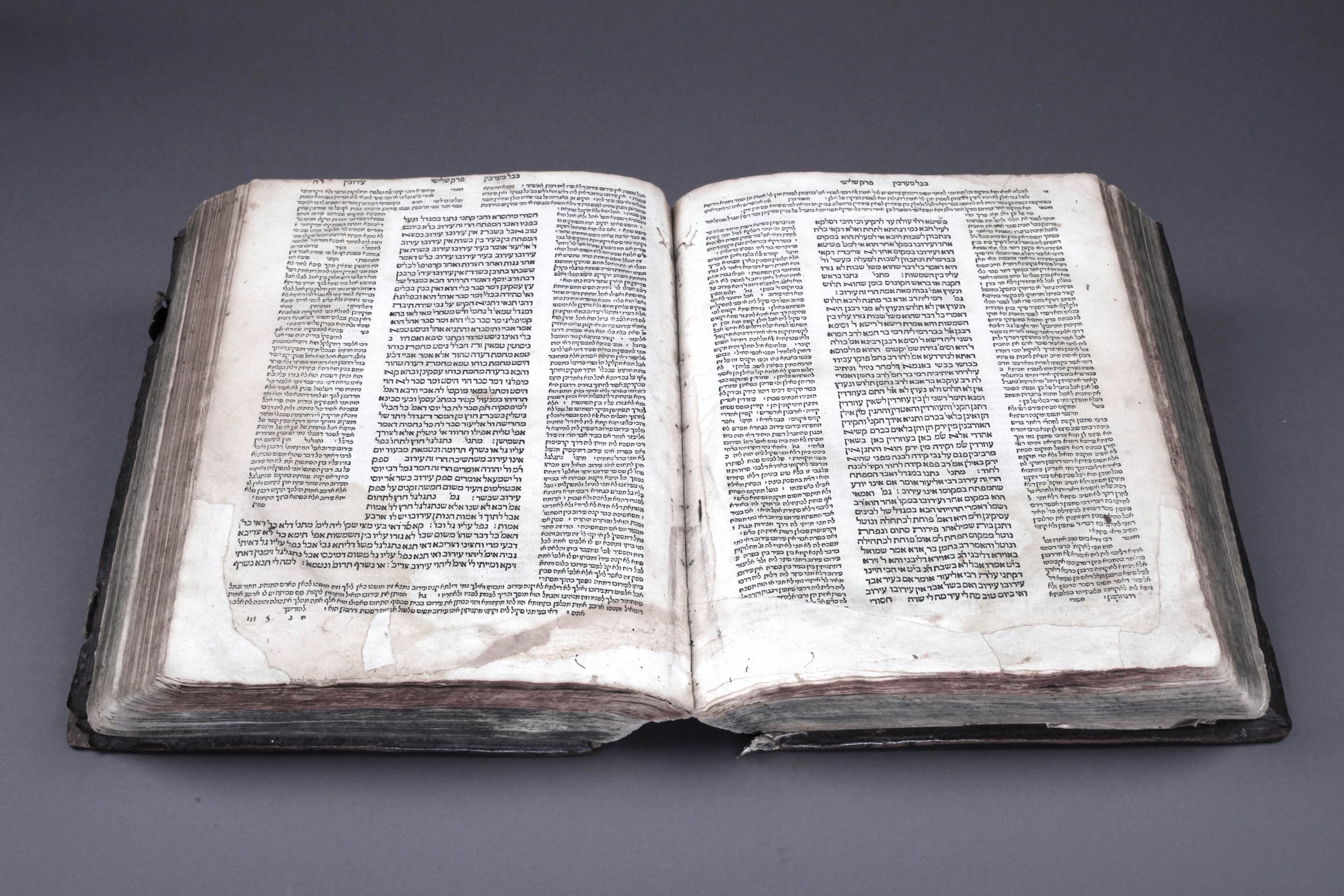
Deena: When I was a graduate student, I worked at the rare book room at the Jewish Theological Seminary. I remember sitting before a 13th- or 14th-century Talmud manuscript and seeing the handwritten text spill across the page. It was the words of the Talmud, but it was so different from the form of the printed text. It was like reading someone’s personal letter. The role of the human hand in the making of this text was inescapable. A manuscript can do that—it can disrupt any notion of the stability of the text. This encounter with a Talmud manuscript reminded me that the Talmud had a life independent of the Vilna Shas, or the Bomberg printed text. For me, there was no going back to the idea of an unchanged text that travels, unadulterated, through history. That’s not what texts are. They have a history.
The human history of sacred Jewish texts has not eroded my attachment to them. Quite the contrary. The notion of our classical texts as the carriers of the historical experience of the Jewish people explains their vitality and purpose. I can’t seem to turn away from them. The eternal history of the Jews resides in these texts.
There is a term that is available to us that might serve as shorthand for the role of everyday life in the shaping of Jewish textual traditions: the household. While settings such as the temple, synagogue, and rabbinic academy have functioned as a shorthand for significant sites of Jewish cultural activity over time, I propose that we add the household as a central institution in the history of the Jews. The household was the site within which the lion’s share of Jewish practices took place. As such, the household captures the role of everyday activity as the carrier and the generator of Jewish practice. For the purposes of this conversation, adding the household as a significant site in the making of Jewish texts implies a shift in how we read them; the texts carry the experience of the people. Human activity took on textual expression; textual expression shaped human activity.
Jon: Let me add another observation about the history of the study of texts. There’s a familiar idea about the Jewish tradition as a conversation that is carried out within our texts. It’s a wonderful idea, a compelling idea, but it also has a history. For example, we would not have that idea if it were not for the particular way, first, that the editors of the Talmud conceptualized their work as bringing together their sources in a back-and-forth way, what we call shaqla ve-tarya. That’s a distinctive feature of the Talmud, but it’s different than, say, the Mishnah, which also includes multiple opinions but without the “conversation.” And we would not have that idea if Jews did not borrow the Christian model of the Glossa Ordinaria, the compilation of biblical commentaries on the page in the twelfth century. And let me propose one more influence, which is the twentieth century rhetoric about the “Great Conversation” that was advanced by educational thinkers like Robert Maynard Hutchins and Mortimer Adler as a way of conceptualizing the historical tradition of Western thought.
All of these influences contribute to the way that Jews, now, are comfortable thinking and talking about the Jewish textual tradition as a conversation. It’s a powerful idea. It’s a valuable idea that enables certain kinds of intellectual activity. But it’s not an absolute truth, and it’s not inevitable. Jews did not always use this metaphor or think this way.
Jane: I also think it’s important to consider the way that putting Talmud or any text study at the center makes being a “good Jew” equivalent to being good at school. Those who are good at school get to be good Jews. Those for whom school doesn't work don't necessarily get to be good Jews. That's problematic as well, because it obscures the variety of ways in which we may live full Jewish lives and the ways in which we can help people become embedded within the language of Jewish living.
Jon: This is such an important point, and actually, I think we can extend it further. It’s not a coincidence, it seems to me, that the increasing textualization of liberal American Jewish culture towards the end of the twentieth century occurred at precisely the moment when American Jews emerged into upper middle class culture in such overwhelming numbers, including astronomical rates of secular education and the domination of professions that emphasize the production and manipulation of words. For Jews who were good at school, who then found themselves in and were good at professions that required the reading of texts, the idea of a Jewish practice that asked them to do what they were good at in the rest of their lives was particularly welcome. These hyper-educated Jews embraced a Jewish practice that involved reading words on a page and making meaning of those words. So, when we tell the story of the increasing centrality of text study in the American liberal Jewish community, we should put that in the context of the emergence of upper middle class educational norms in the American Jewish community in the late twentieth century.
The Future of Jewish Text Study
Jon: We’ve been thinking about the underlying assumption of the centrality of Jewish text study to Jewish culture, and about the historical development of Jewish text study, but now I want to ask you to think more about the future. What changes do you want to see in how we think about or talk about or enact Jewish text study?
Jane: I wonder if something would shift if we didn't use the singular word “text,” or “the text,” which has become a kind of object of worship. I happen to be in love with Talmud study. I'm not going to stop studying and teaching Talmud. But I wonder if something would shift if we could actually name Tanakh, or even Bereishit, or Talmud, or even the particular masekhet. That kind of specificity might signal that we are not entering into a magical realm of “the text.” We are encountering a particular text, a particular work, with particular characteristics, that can generate certain kinds of experiences if approached in certain ways and other kinds of experiences if approached in other ways. There’s value in that work, but just like there is not one text, it’s also true that there is not one transhistorical practice of “text study” that Jews have always enacted and that some Jews are now returning to.
Deena: The core of Jewish culture is practice. These days, many people study classical Jewish sources without feeling bound by their dictates. I often wonder how this affects the interpretations that emerge. Is the tension with the text—in particular, one that results from a wrestling with its hold upon one’s everyday life—somehow a foundational aspect of traditional text study? How does this classical tension, the state of boundedness, affect interpretation? If in previous eras, approaches to the texts have been informed by its demands upon the reader, then we must acknowledge that a study of these texts absent these bonds is novel and strays from the modalities of earlier eras.
Josh: Jewish text study has increased in fraternity houses and board rooms and bars, in all these alternative spaces. But I wonder: Are we creating a habitus for Jews, a set of communal norms and practices into which Jews are comfortably inducted, within which text study has a place but that is also bigger and broader than text study?
Ariel: We often think of text study as something cerebral, but one of the things that comes through in reading the Hasidic canon is the way in which text study is deeply embodied, emotional, and affective. In pretty much every Hasidic source that talks about what it means to learn Torah, the emphasis is not on the what but the how. Why would we be engaged in study if it wasn't working on us? This is a vision of text study not for practical purposes, and not for intellectual purposes, as a ritual in the most positive of senses. Here, I go back to the narratives and stories about the hevraya, the group of scholars in the Zohar who wander around in the world and, by experiencing things, enrich their capacities for interpretation of life, world, and text. This is not an image of text study in the beit midrash.
Jane: A central purpose of Jewish education is to help people live Jewishly, in a wide range of ways. Text study can play a role in that process, although it doesn’t always. But text study doesn’t exist in a vacuum, and it alone cannot—and should not be asked to—build vibrant Jewish communities. The educational task then becomes asking about the wider context in which we might embed text study and the ways in which we can help people build rich Jewish lives and communities even without text study.
Deena: The Jewish household is filled with so much Jewish expression. Household activity includes how you organize your daily life; it's about the food you eat, the songs you sing, with whom you assemble. All these actions may be inflected with a kind of Jewishness, even if not directly linked to textual dictates. What happens when we broaden what we mean by text? Is the singing of biblical ballads by converso women in their households the performance of sacred text? Is the recitation of Ladino lullabies that bring biblical elements into the most intimate precincts of life, textual performances? If we broaden our category of traditional texts to include these household elements, a vivid and new picture of sacred texts begins to emerge.
Jane: I think we're still very much tied to the book. We're still very much tied to the idea that if you're not reading a text, you're not really learning. And I think that's a problematic assumption. But if we think about tefillah, Jewish prayer, for example, that's a place where it's very much about a spoken text and a performative text. For many contemporary Jews, that's their primary engagement with Jewish tradition. In the synagogue, in the experience of tefillah, not in a book. I’m wondering how we can teach our students to access the Jewish tradition in a variety of ways—not just through the printed page, but through oral traditions, through ritual, through performance, through art, through music. How can we give them the tools to navigate some of those different modalities of Jewish expression? And, how can we help them to see the connections between those different modalities, so it's not just a grab bag of different things but a coherent whole?
Jon: Your point about tefillah really resonates. I’ve been thinking about an aspect of my own Jewish education. I went to the Maimonides School in the 1970s and 1980s, where one of my teachers was Rabbi Isaiah Wohlgemuth, z”l, a kind and gentle soul who was beloved by the students. The school took great pride in one of his educational innovations, his course on Bi’ur Ha’tefillah, explanation of the liturgy. The underlying idea was that most Jews are ignorant about the textual bases for Jewish prayer. They do this thing, if they do it, that they do not understand, and maybe that’s a reason that they don’t do it! And when it comes to our kids, maybe that’s why tefillah in school is so hard for them, why it’s a location for so much disruption and resistance, because they don’t understand it. So, let’s fix that problem by studying the texts of the liturgy in a systematic way.
When I think back on that now, the underlying assumption is kind of astonishing to me. I’m not advocating for ignorance. The liturgy is a really amazing compilation of texts that are surely worthy of study. But I’m noticing the assumption that the way to improve the experience of prayer is by textualizing it—taking the embodied spiritual practice and turning it into a text—and then making the encounter with the text foundational to the practice. There may be lots of good outcomes of understanding the meaning of the liturgy. I certainly have benefited from that myself, in my own life! But the idea that that will fix the problem of prayer in schools, or in life, is highly questionable.
Josh: I want to help those people working in the field of Jewish education, who feel committed to teaching Jewish texts, recognize the purpose and the reasons for why they want to center their educational experience around Jewish classical or contemporary sources. I want to help them make decisions about and become more attuned to those types of purposes. And how might it look different than it does now?
Jane: Many years ago, I had the opportunity to spend some time with theologian Judith Plaskow. After hearing all the feminist questions that I brought to her, she said to me that I could keep studying Talmud, but I needed to de-center it. I have not done that. Talmud study is very much the central mitzvah of my Jewish life. But I have tried to learn it and to teach it in very different ways, to teach it as both strange and familiar, and to teach it as a window into lost worlds, and to use it to teach my students to read imaginatively and in a grounded way. I'm a believer in Talmud study as it can be deeply empowering; it can be a deeply spiritual practice, that is, a way to access God; and it can be a way into Jewish life. At the same time, I would like the creativity of Talmud study to lead us to an expansive definition of what it means to live a Jewish life.
Ariel: I come at this question in a kind of funny way, because my primary job is teaching Jewish text to non-Jews. More and more of my teaching has shifted into the School of Sustainability. More and more of my conversations are with policymakers, lawyers, and conservation biologists. So, I think about why they should be reading little bits and pieces of the Bavli, or Hasidic sources that talk about the mythic generation of humanity from the souls of animals and things like that, as a way of disrupting the ways of thinking that have been handed to us in modernity.
I come back to two phrases from the Hasidic canon that go all the way back to rabbinic literature. One is reading al derekh ha-avodah, searching for “the path” or the “avenue of sacred service” that is opened through the encounter with the text. This mode of interpretation includes the intellect, but it combines mental activity with vulnerable closeness, and allegiance to the text with the search for its contemporary personal, intellectual, and spiritual implications. It opens us to consider the kind of work, or avodah, we wish to do in the world, and what type of world we hope to create. And the other is diber hakatuv behoveh, “Scripture spoke in the language of the time,” so there are certain examples that have been brought to the table by our tradition, whether they are camels and oxen and things like that, but it's not meant to stay there. The power of reading traditional texts is that, not only do they annex our time to the past, but they provide us with a vocabulary and a system of thinking that in some ways challenges and may even overturn our own.
Jon: Picking up on your last point, with everything that we’ve said about the ways that Jewish text study does not work for everyone, and about how we need to be expansive in our thinking about the purposes of education beyond the study of texts, and certainly to avoid an ahistorical romantic attachment to a particular yeshiva culture from a particular moment in time, nevertheless it remains true that encountering a text can be a profoundly significant experience. Texts are residues of human culture. They are gifts to us from the past. Encountering that piece of frozen culture, turning it around, exploring it, is an exquisite way of deepening our humanity.