Showing up as a Jew on Campus
Natalia Mehlman Petrzela
Natalia Mehlman Petrzela is Professor of History at The New School.
STEPHANIE KEITH / STRINGER
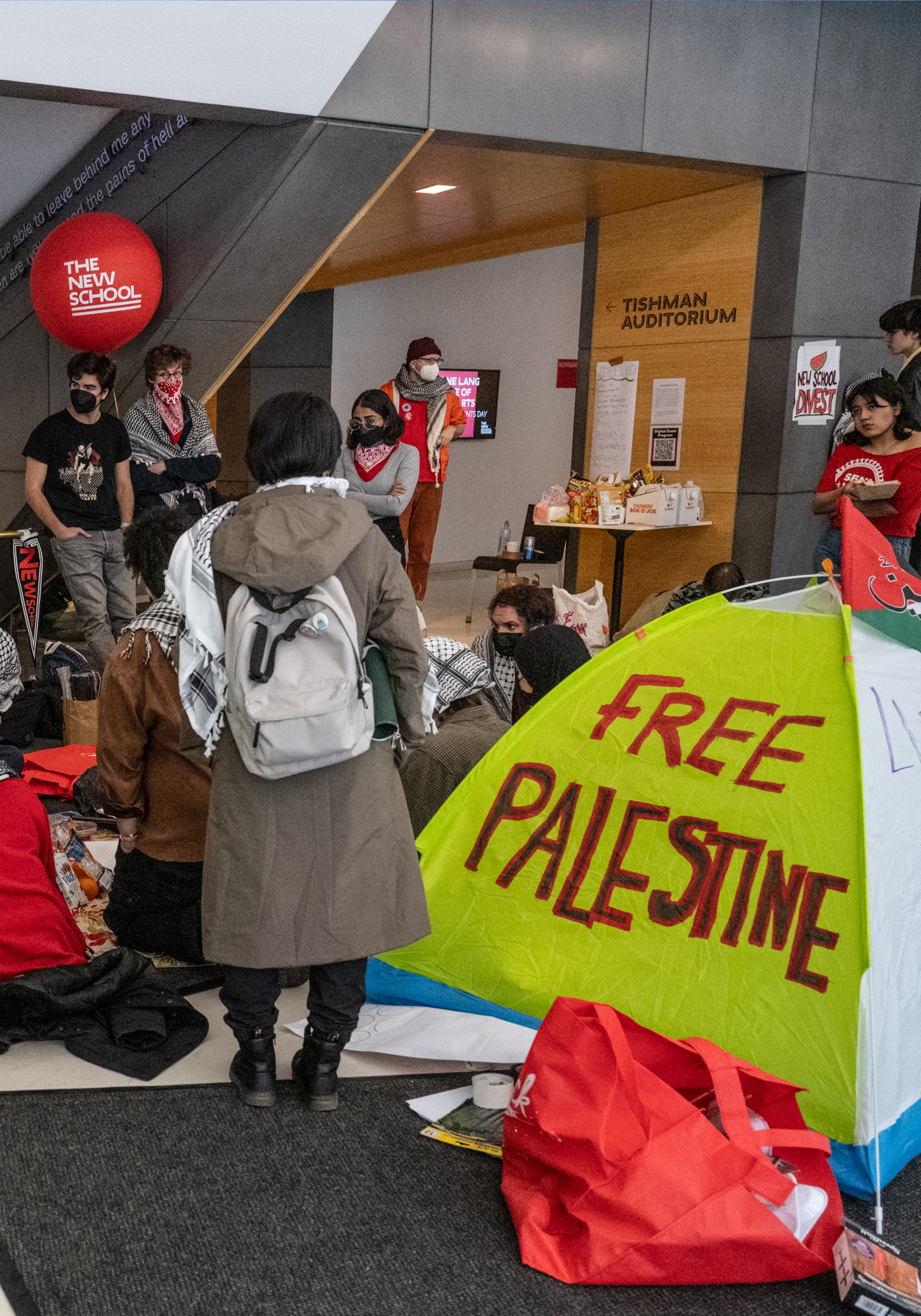
When I returned to my classroom on the Monday morning after Hamas’s October 7 attack on Israel, it quickly became obvious how far my college was from embodying the open-mindedness and empathy that it—like most colleges—markets as its guiding ideals. One of my usually astute undergraduates waved away Hamas’s documented brutalities as “IOF propaganda.” (The “o” is for “Occupation.”) A young man in a keffiyeh invited his classmates to protest the “Zionist entity.”
As various campus organizations issued bold statements of solidarity with Palestinians, biting denunciations of Zionists, and even celebrations of “the martyrs,” and regular protests kicked up, principles that I had been taught, and generally believed, governed our progressive campus—or at least our code of conduct—vanished. “Impact,” it turned out, did not supersede “intent” if the target was an Israeli student screamed at as a “baby killer”; free speech was no longer understood as a rhetorical cudgel conservatives used to circumvent norms about microaggressions and safe spaces, as had long been argued by my progressive colleagues, but rather as carte blanche for anti-Israel activists.
At first, especially as a Jew, I was too stunned to make much of an intervention. But as the weeks wore on and this climate only intensified, it became clear that there was never a more important time for us educators to, well, educate.
I began by asking questions. At the height of the encampments in the spring semester of 2024, I asked one class what they thought about this prolonged, politically fraught moment that seemed to be seeping into every conversation. One student lobbed back a question that made perfect, perverse sense in this environment: “Whose side are you on anyway?"Her query, posed sincerely, chilled me more than the menacing posters condemning Zionism as terrorism, the tents pitched by faculty and students clogging the public walkways, or even the hisses of my colleagues when I opposed an anti-Israel resolution at my professional organization.
This student rightly identified the us-versus-them outlook that dominated so many discussions of the Israel-Hamas war on campus, but she failed to resist or critique it. I didn’t blame her, but I knew that this framing made impossible both serious intellectual engagement and basic empathy—two crucial conditions for effective teaching and learning. I experienced this unapologetic, uncritical antipathy to any whiff of Zionism primarily on the campus where I work as a scholar of the United States, but evidence of its influence felt like it was everywhere: in the American Studies Association statement that notably did not mention the 10/7 attack that precipitated retaliation in Gaza, but announced on October 20 that “the violence of the last twelve [not 13] days has shaken us” (they later tweaked this wording); in the maps of the Middle East my daughter’s classmates drew in a social studies unit, which did not include Israel, only the “Occupied Palestinian Territories”; and in similar stories that emerged from schools across New York and elsewhere in the United States.
Anyone who has been paying attention to progressive educational politics was likely not surprised by this strong anti-Israel animus, but the intensity of the post-October 7 onslaught was still jarring. In response, some launched their own pressure campaigns, which ranged from doxxing trucks to social media watchdog accounts, to calls for the federal government to crack down on universities perceived as perpetrators of these troubling environments. We have seen the results of these efforts in the withholding of federal funding from universities that refuse to sign on to the federal government’s conditions for combating antisemitism in the future.
But even as I understand the impulse driving these actions, I vehemently disagree with this scorched earth approach that mimics the censoriousness of BDS and its broader burn-it-all-down ethos.
Caricatures of academics and educators as radical ideologues belie the fact that many of us in classrooms are doing all we can to create learning environments that are a reprieve from the polarized world rather than a reflection, or worse, a source of it. The very same classrooms, conference halls, and educational spaces that can allow ignorance and intolerance to fester, also can—and do—cultivate the humility, curiosity, and commitment to the pursuit of knowledge we so sorely need, on and off campus. No place is better suited to fulfill this urgent task.
In the past two-and-a-half years, I have redoubled my efforts on this front beyond just asking tentative questions, and I have been heartened to learn of others doing the same. It is important that those who care about education in general and antisemitism in particular, identify and amplify ways to maintain classrooms and campuses as the intellectually adventurous and inclusive places they must be in these trying times. With the hostages home and the ceasefire holding, I want to share several experiences, and attendant insights, that I hope can inspire action on divisive issues that explicitly engage Jewish questions and beyond.
Interpersonal efforts matter
Still reeling, but feeling it was important to “show up” as a Jew, I began wearing a chai pendant not long after 10/7. When a Jewish student thanked me for “daring to be visible,” an astonishing thing to say in 2023 New York City, I occasionally added a Magen David ring. (He was not the last Jewish student to express as much.) Later in the term, another student, who happened not to be Jewish, noticed the necklace, and asked me after class what it meant and why I wore it. We had a valuable conversation about the difference between Jewish and Israeli symbols, the bounds of political and cultural expression in the classroom, and how much any professor or employee should “bring their whole self to work.”
My answer to that question? It really depends. On the one hand, in an era of widespread antisemitism unlike that which many of us in the United States have experienced, I think it is valuable for Jews who feel reasonably safe to inhabit this identity more deliberately—perhaps especially Jews like me, who are often told, “but you don’t look Jewish.” To be a source of support to my Jewish students who felt more anxious about such openness than I do, my choice to make my identity more public was valuable. At the same time, I would never have worn an overtly political button or even shared with total transparency how gutted I was by 10/7 and the ensuing reaction on campus. My chai necklace acknowledged my Jewishness and invited conversation about it in a way that felt productive, but didn’t inappropriately broadcast my political views or my personal feelings. Still, because I created this opening, students felt comfortable approaching me and asking frank, vulnerable questions that they might not have otherwise, individually or in class.
Beyond the specific question of Jewish identity, I believe that thinking hard about how much you want to share about who you are, and to what end, is crucial for educators working with young people who are learning from us how to navigate these boundaries as well. It can be enormously validating for a young person in a minoritized group to be able to connect to an educator who shares their background. Some identities are, of course, more visible than others, and signaling your willingness to engage in this way can be as vital as any official aspect of the syllabus.
Especially in fraught moments like our own, these actions are both most urgent and most difficult, as staying silent or oversharing can feel like the only two options; either is a missed opportunity.
Stay in your lane of expertise and be honest about its limits
I’m not a scholar of Jewish Studies or the Middle East. As the war in Gaza intensified, some students wondered why I wasn’t jettisoning my syllabus, as some colleagues already had, “to talk about the genocide.” I explained that out of respect for them, I would not spend class time on a topic outside my expertise, and on material different from the course I was prepared to teach, and which they had signed up for. I told them that I was reading voraciously to learn more about the conflict, offered recommendations of writers and publications I had found illuminating, and asked what they could recommend to me. And then we got back to talking about the history of American youth cultures, the topic of the course, and of my expertise. I think everyone was relieved to have a break from the unremitting emphasis on this faraway war that preoccupied so much conversation on campus.
Beyond providing intellectual reprieve in this difficult moment, staying in one’s lane in terms of expertise is a commitment we owe both to our students and to academia at large. When we play fast and loose with the limits of expertise, we undermine the entire idea on which most of us build our professional identities: that our deep, sustained study on a topic gives us uniquely valuable perspective and knowledge. When we use the position of authority we have gleaned through this expertise—our spot at the head of the classroom—to opine on issues outside this realm, we all lose credibility. Furthermore, while scholars continually debate the boundaries of academic freedom, many agree that it should be constrained to one’s field, reasonably defined.
While I think that it is absolutely appropriate, and even advisable, for professors to address the questions on their students’ minds, they should do so with both an eye to their relevance to course themes and instructor expertise and with a commitment to modeling intellectual humility. This sort of disposition may be the most valuable lesson that we can teach students.
Objectivity is impossible, but we should still hold it as an ideal
We historians spend a lot of time in graduate school learning about the illusory nature of objectivity; I still believe it is impossible to rid ourselves entirely of our biases, and that those who are considered most “neutral” have tended to occupy identities holding the most social and political power. (To cite a classic example: Women are sometimes considered too biased to report on “gender issues,” while men, despite also having a gender, are considered capable of neutrality.)
But even as we acknowledge all this, it is our job to strive valiantly to acknowledge and transcend our deeply held identities and ideas in the questions we ask, the sources we examine, and the viewpoints we present. I never use my classroom as a pulpit to reveal students’ political worldviews or recruit them to mine, and I am explicit with them about this commitment. Instead, I try, however imperfectly, to introduce a range of perspectives on the issues we examine, including those with which I disagree. Students are no more a singular archetype than we professors are.
Over the last two-and-a-half years, as some professors spent time, or even held class, in the encampment and signed onto various public statements, many of my students have shared with me that they think the fact that they can’t tell whose side I’m on means “we can actually figure things out together, without knowing what our endpoint is supposed to be.”
Usually, I consider this responsibility to relative neutrality solely within the context of my classroom, where I introduce scholars and journalists who argue multiple sides of policy issues like charter schooling, or about the cultural impact of 1960s youth movements. Generally, I find this is the pedagogical approach with the greatest intellectual payoff. However, in the aftermath of 10/7, I realized that a significant number of students only knew the term “Zionist” as a slur, or the characterization of Israel as “a genocidal state.” In this context, when the topic did arise, I felt that it was my responsibility to introduce the students to sources that offered perspectives besides those so often reiterated on campus, whether a moving speech by hostage mother Rachel Goldberg-Polin, or a podcast by Sam Harris, before returning to course material.
There is no one correct way to present multiple viewpoints, but in this case, our campus discourse—if not our community—was so staunchly anti-Zionist that it felt important to introduce voices that tilted towards supporting Israel. The bottom line is that it is imperative that college be a place where students are pushed to engage with a range of worldviews, especially those that challenge their assumptions or reigning orthodoxy, whatever the issue. We professors must step up to be the stewards of this process.
Speak up where you can, but with a keen eye to context
Virtually every talk and “teach-in” on the Israel-Hamas war on my campus was expressly anti-Israel, featuring speakers including Norman Finkelstein, Francesca Albanese, and Amin Husain. In certain cases, the speakers were openly pro-Hamas. One campus office charged with “social justice” regularly listed tens of Palestinian organizations and events, and not one for Israeli or Jewish students, save the anti-Zionist group Jewish Voice for Peace. I may not be a scholar of the Middle East, but the bias of these offerings was plainly obvious. On my own, I invited the peace activists Standing Together, a coalition between Israelis and Palestinians, to discuss the possibilities for peace and to showcase an inspiring form of collaboration. I felt comfortable organizing an extracurricular event with experts and activists offering a new approach to a pressing political issue outside my area of expertise precisely because it happened outside of my classroom.
Similarly, as circumspect as I am about airing my own opinions in class, I sought spaces where my expertise on American political culture could shed new light on this issue. I wrote an opinion piece calling out, and trying to explain why, usually vocal American feminist organizations did not condemn the sexual violence perpetrated against Israelis on 10/7, and on how this denialism emboldened antisemites and misogynists everywhere.
With a former prosecutor, I wrote about how the media framing of the murder of a young Jewish couple in D.C. as a political act against “Israelis” gave political cover to overtly antisemitic targeting. And, at the annual meeting of our professional association, several fellow historians and I argued against a proposed resolution denouncing Israel “scholasticide” without mentioning 10/7, the hostages, or Hamas’s lack of distinction between civilian and military sites; we felt this organization should focus on the scholarly work that binds us, not the political issues that divide us.
All contexts are not created equal, and where and how we speak up in each of them matters, a nuance often absent from debates about free speech and silencing.
Reconsider your own work
Over time, I became concerned that the censorious nature of campus discourse since 10/7 was at least partly driven by a deeper ignorance of Jewish identity and experience. And this was in New York City, home to the largest concentration of Jews outside of Israel! I tried to address these knowledge gaps while staying within the bounds of my work, incorporating Jewish stories in my teaching and talks: I brought the turn-of-the-century “muscular Judaism” movement into my course on fitness culture, for example, and the career of disability rights advocate Judy Heumann into one of my education seminars.
When I was trained in feminist history, I learned to instinctively inquire how gender and sexuality shaped any particular historical moment. I am now endeavoring to do the same with the lens of Jewish identity. The results are often illuminating: I’d never noticed how many of the fitness entrepreneurs I studied were Jewish, but it makes sense, given the low barriers to entry to this new, and often seedy, industry. Knowing this also challenges both longstanding assumptions about Jewish physical frailty and popular narratives about the fitness industry.
Even as this new interpretive perspective emerged from my being a vocal advocate for Jewish issues on campus, it revealed that I shared in the ignorance of some of my students. Having the humility to realize, and remedy, this lack of knowledge is a lesson applicable beyond more thoughtful inclusion of this one group.
Know that none of these problems start in college
University campuses have been such a hotspot in the post-10/7 era that we academics and college administrators are easy to blame for their problems. Yet the seeds of these issues are planted far earlier. For this reason, I agreed to lead a New York City Department of Education curricular initiative to incorporate Jewish American “hidden voices” into K-12 social studies and US history classrooms where Jews may only be mentioned in the context of the Holocaust, if at all. Conceived in part as a response to a riot targeting a Jewish teacher at a Queens high school, the Jewish-American Hidden Voices curriculum was authorized as a way to address antisemitism beyond the trainings that often take place after an incident, or the Holocaust lessons that can risk only associating Jews with this tragedy. Both interventions are important, but Hidden Voices integrates Jewish stories across the curriculum as an integral part of American history, both for Jews who have not seen themselves represented, and equally important, for the many Gentile schoolchildren and teachers who may only have encountered Jews as an idea, rather than a classmate or neighbor. At a recent workshop I led on this curriculum, teachers told me they often teach about some of the figures we profile in Hidden Voices, like Clara Lemlich, Levi Strauss, and Harvey Milk, but never as Jews, a common but unfortunate elision that obscures important aspects of American society, past and present.
The lesson here is about integrating Jews into social studies and history curricula from an early age, but it is also about creating greater linkages between K-12 and college experiences. I am confident that the antisemitism that coursed through the campus protests, and that too easily festers in certain corners of academia, would not insert itself so readily if students arrived on campus with a deeper understanding of Jewish experiences. This applies across almost all of the issues that manifest among college students, from literacy to numeracy to social-emotional learning. Having worked in both spaces, I have been surprised and disappointed at how rare these collaborations are, even when almost every educator, parent, and student expresses how valuable they could be—and are, when they transpire.
Find your people
I have colleagues who won’t speak to me, or worse, because I questioned the apparent collective academic orthodoxy on Israel. This can be lonely, but I write “apparent” because the loudest, most strident voices are rarely the most representative ones. From the moment I began to take any of the actions I mentioned above, other colleagues and students have quietly, and sometimes not so quietly, reached out in emails and direct messages, confiding that they feel similarly. Speaking out publicly empowers others to do the same, and at a minimum, makes one visible to others who can be sources of solidarity and connection. On campus and off, these relationships with others can be a lifeline, powerful in actually moving the needle away from collective ignorance and orthodoxy. Had I not spoken up, I would not, for example, have joined the national Faculty Against Antisemitism Movement, learned of the depolarization work of the Or Initiative (where I am now a board member), or met the many scholars, activists, and educators with whom I have collaborated on work that is centrally about, but much broader than, Jewish concerns. Some of these thoughtful colleagues live and work across the country, while others are people I have seen in faculty meetings for years, but only now have we connected in new ways that range from supportive group text chats to more sustained organizational efforts.
These networks, which begin at the most individual and informal level, can become the foundation for institutional renewal. Speaking up about controversial issues on campus is understandably not for everyone, especially those who are insecurely employed or whose disposition is incompatible with entering what can be an intense and disorienting fray. The most vocal colleagues may be the catalyst for generating new alliances, but others are crucial for at least beginning to shift a culture. On campus and off, such connections can result in concrete intellectual collaborations or—equally important if less tangible—the assurance that we are not going it alone.
Seek immersive new experiences
Last summer, I was invited to Israel with a group of professors from a range of intellectual and personal backgrounds to learn firsthand about “the most complex region in the world,” as the program director explained, and to shed our preconceived notions in pursuit of “getting confused.” Chasing uncertainty is an uncommon, almost existentially uncomfortable, goal for academics, but I left that week confident that greater comfort with confusion, borne of firsthand experience, is exactly what we need in academia. The agenda prioritized immersion as much as expertise, taking us to the Syrian and Lebanese borders, a Druze village, East Jerusalem, and the Gaza Envelope. Some of what I took away came from experiences that were not planned: Within hours of our arrival in Tel Aviv, we were running to a “safe room” after the rocket sirens woke us at 5:30 a.m., immediately highlighting the contradictions between common portrayals of Israel’s strength and the acute sense of being encircled by enemies wishing for this nation’s elimination. It was the first of many on-the-ground examples that challenged my prevailing assumptions. Being there, with people, standing on the land, made it impossible not to appreciate a more complex reality than what was apparent from the relative safety and comfort of my Greenwich Village office, where most of my colleagues understand Israel exclusively as a powerful and prosperous American proxy.
Traveling thousands of miles is not necessary to accomplish this goal. Rather, “education” should deliberately encompass “experience”—and not only our own. That is, it is common to hear people preface their remarks with a statement of their position—e.g., “as a Jewish woman, I..”—but this framing too often presents identity as an implicit justification for only being able to see things a certain way. What if we valorized the educative experience of seeing beyond one’s own identity and perspective, rather than stopping there?
Seek out ideas and opinions different from your own
I was struck on this trip to Israel by many things, but especially by a program constructed to be more politically diverse than any I had ever encountered on this topic, whether at the unapologetically pro-Palestinian campus “teach-ins” or the ardently pro-Israel panels sponsored by many mainstream Jewish organizations, both of which are common in New York City. This agenda included learning from an official of the West Bank settler organization, Regavim, founded by hardliner Bezalel Smotrich, about its legal strategy to push the Israeli government to enforce its own laws, quite transparently with the goal to expropriate Palestinians. Not an hour later, in the same conference room, a former Shin Bet official dismissed these sober characterizations as whitewashing effrontery—what he described as “Jewish terror.” Later, a Palestinian East Jerusalemite shared with us his rage at bringing his daughter into a fundamentally unequal Israeli society, while an ultra-Orthodox woman articulated her very different utopian vision of a just society: a “greater Israel” governed by the laws of Torah. The jarring juxtapositions kept coming.
I had worried that the trip would be one-sided, but as a fellow participant with similar hesitations later shared with me, the schedule made it quite clear “this was not your typical propaganda tour.” It often felt overwhelming, but was incomparably valuable, to encounter these clashing opinions firsthand and face-to-face, rather than through a screen or as simplified by their opponents, and to experience the context in which they were formed—with a diverse group of strangers, over 10-hour days.
This intense experience, I realized, was not so different from that of our students, who show up on an unfamiliar campus to encounter new ideas, experiences, and individuals. International travel and cultural immersion are powerful teaching tools, of course, but we need not fly thousands of miles to deliberately encourage uncertainty and engage in good faith with a wide range of perspectives, even if they are in conflict with one another. In one very different, but congruent example, I partnered with a colleague at a conservative evangelical Christian college to co-teach an online mini-course on American political divisions. Our students, mine hailing from my Greenwich Village campus and his from rural Pennsylvania, were polar opposites in some expected ways—and in some cases, each other’s first sustained one-to-one exposure to “the other side”—while in others, were quite similar, including in the fact that they found the exercise valuable. As modest an experiment as it was, where else but college could this happen?
*****
Educational institutions and academics, including me, are going about navigating this complicated moment imperfectly and inconsistently, at times embarrassingly so. This is one reason universities continue to plummet in public esteem. But just as it is unfair to pinpoint professors as the sole source of today’s political and cultural malaise, it is not solely the responsibility of academics to fix it.
Educational institutions may not always fulfill their never-more-necessary role as beacons of bold engagement, rigorous inquiry, and humanistic empathy, but it is all of our responsibility as educators, students, administrators, and funders, or simply as citizens, to understand this situation and work to redress it. There is no other space in our society where we make even a nominal commitment to fighting ignorance, modeling intellectual curiosity and courage, elevating expertise, and cultivating cross-cultural connection, and we should recognize all the ways this is already happening and encourage and amplify more such work. As bad as acting like we are above reproach, dismissing universities as an ideologically monolithic mess beyond salvation— as has become fashionable—is a terrible mistake if we want to bring our campuses, and our culture, back from the brink on which we teeter.