What Discomfort Makes Possible in the Classroom and Beyond
Arna Poupko Fisher
Arna Poupko Fisher is a Jewish educator who has taught extensively in both formal and informal settings, including the University of Cincinnati, Hebrew Union College-Jewish Institute of Religion, and the Wexner Heritage Program.

ESTHER WERDIGER
I imagine that most educators vividly remember a teaching moment that failed. And by failed, I do not mean that the timing of the lesson plan was off, or the concepts either too deep or shallow for the students’ skill sets, or even that the lesson was overly tedious or taxing. I mean the kind of failure that results in a student feeling humiliated or disrespected—the kind of pedagogical failure that can have a lasting effect on both the student’s sense of self and their future openness to the content or teacher.
I was once the perpetrator of such an outcome. It happened over 28 years ago, and it has stayed with me. In a one-off session I was teaching at a UJA Young Leadership Conference in Washington, I teased a participant about his familiarity with an obscure newspaper article that I had referenced. It was intended as a sort of backhanded compliment, but it was definitely a “tease.” At the end of the session, as students thoughtfully stopped to offer their thanks, this man, who appeared to be in his early thirties, stayed behind.
Once we were alone, he asked, “Have we met before?” (We had not.) “Do you know me?” (I did not.) He then asked, “Then why did you embarrass me in such a public and painful way?”
My face flushed, and I felt the dampness of sweat at the back of my neck. I apologized as fully as I could and walked away, vowing never to make a student feel that way again. I pray that I haven’t, but I’m also pretty sure that, at the very least, I have danced on the edge.
As a Jewish educator who has been teaching mostly college age and older students for over forty years, I have experimented with many teaching modalities and approaches to understand which conditions are most likely to produce the maximum learning experience, particularly for the (potentially fragile) adult learner.
In the process, I have identified three dynamics or conditions that I believe ought to be present for “meaningful” (exciting, deep, charged, effective, memorable) learning to occur. When one of the three elements is missing—and at least one but probably two were missing in the case above—outcomes will suffer. In brief, they are:
Disjuncture: The noted educational theorist, Peter Jarvis (1937-2018), defines this as the learning that begins when students encounter a gap or mismatch between their existing knowledge and the new content the teacher is providing. Disjuncture describes the initial affront or shock of oppositional views and the potential emotional dislocation that this might cause. The tension of disjuncture prompts reflection and adaptation, driving the process of learning.
Humility: This is modeled by the teacher as a willingness to show personal vulnerability and to grapple with the material in real time. Ideally, this will, in turn, be reflected or mirrored by the students.
Trust: The students’ learning experience is maximized when it unfolds in a framework of trust and safety, allowing for disjuncture to not only be encountered and endured, but welcomed.
In Teaching Community: A Pedagogy of Hope (2003), bell hooks writes that “the classroom remains the most radical space of possibility in the academy because it is the one place where we can build community across difference.” A classroom can in fact become a micro community in which we practice how to encounter oppositional views, including those that challenge fundamental beliefs. When such encounters are anchored in a framing of humility and trust, the classroom can become a “radical space of possibility” that models a way in which our complicated, frequently uncomfortable, and disjunctured world can be experienced in a less destabilizing and disorienting way.
The Three Conditions
1. Disjuncture
לֹא־תִרְאֶה אֶת־שׁוֹר אָחִיךָ אוֹ אֶת־שֵׂיוֹ נִדָּחִים וְהִתְעַלַּמְתָּ מֵהֶם הָשֵׁב תְּשִׁיבֵם לְאָחִיךָ.… וְכֵן תַּעֲשֶׂה לְכל ־אֲבֵדַת אָחִיךָ אֲשֶׁר־תֹּאבַד מִמֶּנּוּ וּמְצָאתָהּ לֹא תוּכַל לְהִתְעַלֵּם׃
“You shall not see your brother’s ox or sheep straying and ignore them; you must take them back to your brother… and so too with anything that your brother loses, and you find—you must not remain indifferent.” (Deut. 22:1,3)
As someone who is no stranger to losing objects, I know the feeling of relief and joy when a lost object is found; it's almost worth losing something to experience that deep appreciation—and, for a moment, the feeling that all is well with the world. The initial disorientation over the loss of any object, even temporarily, is not unlike the requisite, albeit frustrating, condition that a teacher must conjure to achieve powerful learning moments.
The condition of “disjuncture” was first introduced by Jarvis in his foundational work, The Paradoxes of Learning (1987), where he explains this term by recalling the sin/fall of Adam and Eve in the biblical Garden of Eden:
Disjuncture occurs when there is a lack of accord between the external world experienced by human beings and their internal biographical interests or knowledge. It was suggested... that when dwellers in the Garden of Eden ate of the tree of knowledge of good and evil, they were no longer in harmony with nature. Disjuncture came about, forcing them to try to recapture this harmonious relationship. Disjuncture makes learning possible…. The paradox is that if harmony is fully established, there can be no learning situation. This highlights the major paradox in human learning: Interpersonal harmony is considered extremely desirable, and learning is also considered a laudable goal. However, to achieve the best conditions for learning, the ideal state of harmony must be disturbed, and juncture must occur between the learners and their natural world, or their social-cultural world, or both.
Jarvis’s thesis, at the outset, alerts us to the distinct experience of encountering, then overcoming, disjuncture. This can be experienced both psychologically and emotionally—a kind of “embodied understanding.” Jarvis argues that the story of Adam and Eve is one of disjuncture, that upon eating the forbidden fruit, the world they now perceived was radically different than the world they had known. Jarvis’s thesis is more complex than the simple satisfaction of grasping previously incomprehensible content—for isn't that, after all, the definition of learning? Where is the epiphany? Jarvis’s key realization is that learning does not start with mere knowledge gaps, but rather, with the moment when our very assumptions no longer fit what we are encountering. In this way, learning can become more than merely a cognitive act: It is a moment of profound, ontological reframing.
Jarvis’s claim is that growth begins with disturbance and that we learn because we are thrown off balance. Learning is the process of making meaning out of dissonance, and that dissonance drives us toward seeking resolution, a resolution that is fundamental to our identity and sense of coherence. This is a very different understanding of learning than simply the accumulation of facts.
George A. Koulaouzides, a leading scholar of adult learning and transformative education, understands Jarvis’s disjuncture in this way in a 1966 article:
[Disjuncture] is a brilliant word to describe the moment when a person realizes that it is not possible to give meaning to an experience. There are moments in our lives that a new situation appears and it seems that we do not have the necessary “tools” to cope with it. These moments may be happy moments like the birth of a child... but they can also be moments of sadness like when we experience the loss of a significant person in our life.... All these moments usually lead to the initiation of a learning process.
Koulaouzides broadens our understanding of disjuncture, framing it not only as moments of new cognition that disrupt our reality in unsettling ways, but also as moments of profound joy. I remember the jarring dislocation I felt when I walked into our synagogue for the first time after my mother’s death. What had been as familiar to me as my own living room now felt entirely different. I was so shaken that I grabbed the back of a pew to steady myself. In that moment, I realized that living in this disjunctive reality as a daughter without a mother would require a recalibration of how I encountered the external world. Joy, too, can be disjunctive, as when a conflict is suddenly resolved or an unexpected raise requires a realignment of assumptions and expectations.
If learning begins, as Jarvis claims, when “our biography and experience do not fit,” then educators (primarily those who are teaching adults) are tasked with presenting content that, at the very least, allows for moments of unease, pauses, or contradictions, and coaxes students into the gap between knowing and not knowing. Jarvis’s claim is that learning arises out of disharmony and that growth begins with disturbance.
If an important component of teaching is presenting materials that introduce disjunctive ideas and propositions (with the goal of making the learning deep and lasting and our students able to navigate them intellectually and emotionally) then how fortunate is the educator who teaches Judaism! For the Hebrew Bible, rabbinic texts, Jewish philosophy, and certainly the trajectory of Jewish history are all rich with disjunctive ideas and narratives layered with ambiguity and opacity. The content itself enables the educator to present tension not as a threat but as an opportunity to engage with complexity as the essence of learning and meaning making.
The epic myth in the Garden of Eden that captures Jarvis’s attention—the first disobedience of a divine command—is understood in rabbinic and post-rabbinic thought as nothing less than a cosmic fracture, a tragic rupture of innocence and a fundamental change in human nature. But it is also understood as the beginning of the human story; the disjuncture that was destined to occur if the history of humans and their spiritual thriving was to have meaning.
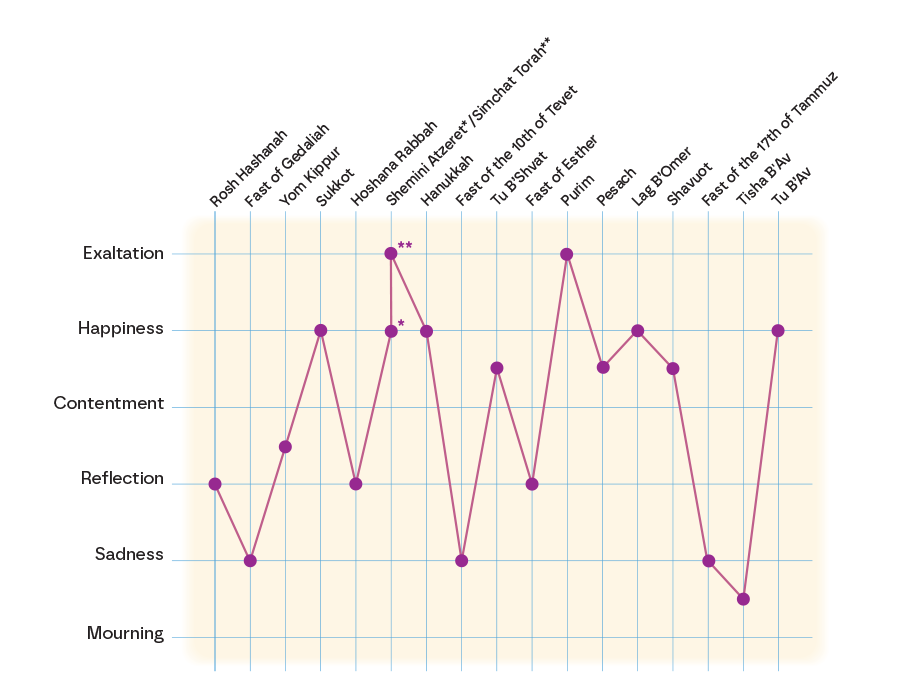
In my teaching, I have drawn a graph that places biblical and rabbinic Jewish calendar observances along the top and, along the side, a list of emotions, beginning with mourning and culminating with exaltation. When they are plotted, a jarring visual emerges—continual ups and down, rising, falling, and rising again—reflecting the almost disorienting emotional range built into the rhythm of the Jewish year, a kind of habitual disjuncture. Think, for example, of the Ninth of Av, also known as Tisha B’Av, which falls in the middle of a perfectly lovely summer, and asks a Jew to fast, sit on the floor, and cry over the most tragic moments in Jewish history. I suggest that this insistence by Jewish tradition on bringing counterintuitive or unwelcome emotions into our midst—beyond the affirmation of memory and ritual—is an invitation to face what is unknown and resist the comfort of certainty: a calendar date with disjuncture.
Seen through this lens, it appears that the current world at large, and the Jewish world in particular, have been experiencing disjuncture at an alarming pace—and the lessons we are meant to draw from these unsettling moments remain uncertain. What is clear, however, is that with disjuncture as pervasive as it has been (and is likely to remain for some time), we are called to foster conditions that enhance our abilities to cope and persevere. Such conditions are not unlike those an educator might employ to create a climate in which endurance, even in the presence of disjunctive ideas, can take root: the cultivation of humility and trust. Without these grounding conditions, the deliberate inclusion of disjuncture in the classroom is, at best, risky, and at worst, reckless.
2. Humility
.אֵין דִּבְרֵי תוֹרָה מִתְקַיְּימִין אֶלָּא בְּמִי שֶׁמֵּמִית עַצְמוֹ עָלֶיהָ
The Torah is only retained when one “gives up his life” for it. (bBerakhot 63b)
.וּלְכָן אָמַרְנוּ כִּי הָעֲנָוָה בְּיִחוּד הִיא הֲכָנָה אֶל הַתּוֹרָה הַשִּׂכְלִי
“Torah is only acquired by one who makes oneself humble (as if giving up one’s life) for it.”
Netivot Olam — Netiv Hatorah, Ch. 3
When a teacher models humility—expressed in style, in small signals of personal vulnerability and uncertainty—it can soften the sting of disjuncture and create a space where students feel supported rather than unstable.
At first glance, this might seem like the very last dynamic a teacher would want to bring into a classroom already unsettled by jarring ideas or dissonant discussion. Wouldn’t we prefer an educator to have the calming assurance of authority and expertise? Yet, when an educator teaches with humility, they become a participant rather than a distant authority, democratizing the room and helping put the student at ease. Teaching—and one could add parenting or leading in any form—from a posture of humility changes how knowledge is sought, shared, and received.
In his 1978 essay, “Majesty and Humility,” Joseph B. Soloveitchik (1903–1993), one of the most influential voices in modern Jewish thought, posits that human life is shaped by a fundamental dialectic: The “ethic of majesty” is a “forward movement” that is our drive to create, assert, and master, and the “ethic of humility” is a movement of recoil when we withdraw, submit, and accept defeat. This dialectic profoundly models the tempering of authority and strength with humility and vulnerability. When an educator can embody this, the classroom becomes kinder and safer, a space where students can remain with the unease of disjuncture long enough for genuine learning to occur. Soloveitchik’s “readiness to accept defeat” can be understood as a posture of surrender; an acceptance that uncertainty and disagreement are not to be feared but welcomed.
But how does such openness and humility take form in the practice of teaching? An educator manifests humility and vulnerability in subtle but significant ways, including a tone and manner that reveal an ongoing grappling with the material. The most meaningful teaching is rarely polished; it maintains the texture of process, allowing ideas to unfold in real time. While it always surprises me, students, and adult students in particular, tend to be more engaged and more willing to consider new ideas when they catch a glimpse of who is really standing before them.
The humility and, we will add here, authenticity in creating secure and supportive relationships is explored in a Bar-Ilan University study by Ellie P. Schachter and Jonathan J. Ventura (2008). The research examines how parents function as agents in shaping their children’s religious identities. In describing his own approach to cultivating a love ofJewish values, “Amitai” (a pseudonym assigned by the researchers to preserve confidentiality) explains his parenting approach as informed by humility and not control or authority: “I don’t want to define or delimit for my kids what they will or can be. I do want to set particular boundaries that will create tangible foundational, primordial experiences… but with the deep belief that I have no idea what will be—only a deep faith in the sanctity of the process.”
Later in the paper, Amitai explains further that
It’s crucial that [my daughter sees] authenticity—and if my being authentic means that she… sees me in religious crisis then I want her to see that…. I want to make a point out of it…. I want her to see the broken heart…. If I go to synagogue just in order that she see that [I go]… what can I expect her to become? That won’t breed anything interesting.
Finally, he also adds, “I am looking for relations, for process, for dialogue—and I am willing to change, too (along the way).”
Authenticity in teaching (and parenting) is a powerful modality through which humility can be demonstrated and felt. This is captured, movingly, by Brazilian educator and philosopher Paulo Freire (1921–1997) in Pedagogy of Freedom, who insists that authenticity is the foundation of all meaningful teaching: “I cannot be a teacher without exposing who I am.... Without revealing my own incompleteness, I cannot call my students to be more than they are.” Or, as he puts it in Pedagogy of the Oppressed, “Authentic teaching is not carried on by ‘A' for ‘B’ or by ‘A’ about ‘B’ but rather by ‘A’ with ‘B.’” Freire contends that a meaningful and pedagogically effective relationship between teacher and student is only possible when the teacher comes into the classroom as themselves.
In Amitai’s moving description of his own faltering relationship to religious observance, we see the process of transmission that is rooted in his full presence and readiness to share the vulnerable, imperfect, searching dimensions of life. Both parent and teacher stand before the same task: to expose the internal disjuncture, unsteadiness, unsureness as an opportunity for growth and discovery, for both the child and the student, and to resist the impulse to resolve the ambiguities too quickly.
For this reason, I caution against using one’s own storybook Jewish family moments when teaching. The perfectly curated, parsha-focused Shabbat table, the exemplary Passover seder that stretched late into the night, or the intimate exchanges between parent and child while walking to synagogue are all idealized educational moments, but they are not necessarily helpful models for the classroom. The issue is not that such examples are inaccurate or unattainable, but that they can widen the distance between the teacher and the learner and therefore between the learner and the material. The personal examples that serve the learning space well are those marked by humility, self-effacement, and especially humor.
This is not a gesture toward a false egalitarianism between student and teacher or a denial of the teacher’s expertise, but rather an educational strategy. It is a way of gently coaxing the learner into new territory, where they are best positioned to voluntarily and eagerly engage with uncomfortable, challenging, or difficult ideas.
But humility alone is not enough. It must be coupled with trust to form the grounding conditions that make disjuncture not only bearable but fruitful. Together they create a framework in which uncertainty can be risked with less fear of the learner retreating.
3. Trust
לוּלֵא הֶאֱמַנְתִּי לִרְאוֹת בְּטוּב־יְהֹוָה בְּאֶרֶץ חַיִּים׃
“Were it not that I trusted I would see the goodness of God” (Ps. 27:13)
Rashi: “Were it not that I trusted—I would already have perished.”
Trust rests on a felt, often unspoken sense of safety within a particular group. Among the conditions an educator must cultivate in the classroom, it is the most difficult to attain.
While an educator can introduce disjunctive ideas and model humility, trust often develops organically and unintentionally. Yet, in my experience, an educator can cultivate trust by encouraging students to share small vulnerabilities and ensuring those moments are met with empathy and support. This approach requires a tolerance for risk, but the reward is significant: When humility and trust are both present, a learning community becomes strong enough to welcome not only disjunctive ideas but also the “disjunctive personalities” who invariably appear, including the contrarians, the show-offs, and the nudniks.
Of course, so much of this depends on the chemistry of a group! We hope for a basic good nature among the individuals and for a majority who lean in this direction. Without this mazel, trust can be elusive. When a teacher, at any level of instruction, feels confident about the individuals in the room—their willingness to listen, to be patient with one another, and to show a little care—that confidence allows the teacher to take risks and introduce material or moments that depend on trust. Even a single student’s generous and deeply supportive presence can outweigh other energies in the room and move the class in a more trusting direction.
I see this demonstrated again and again in cohort-based study programs, particularly those formed through highly selective processes. Recruiters ought to look beyond participants’ resume accomplishments and pay at least as much attention to their intellectual and emotional generosity. These strengths are often discernible only in the interview process: How well does the candidate listen, show interest in others and in ideas that differ from their own, demonstrate a sense of self while also possessing humility? The presence of these qualities in participants plays an important role in how a group approaches challenging material and tolerates a high level of tension.
If trust and feeling cared for can make tension survivable, its absence—and its repair—can be seen in the study of psychological trauma. Dr. Henry Krystal, a psychiatrist and psychoanalyst who survived the Holocaust, became a leading figure in understanding and treating severe trauma. He maintains that trauma can break a person’s basic capacity to feel and to trust their own emotional life, and that repair begins not with interpretation or explanation but with the slow reestablishment of trust.
Several decades ago, at the conclusion of an informal seminar at McGill University in which Krystal was speaking about the impact of massive psychological trauma on the human mind and the role of reestablishing trust, one of the residents mentioned having learned that Krystal himself had survived Auschwitz and asked how he believed he had endured. Krystal answered without hesitation, setting aside his usual formal tone: “I have no question about how I survived. I survived because I knew my mother loved me.” When individuals experience trust and internalize the sense of being trusted, loved, and believed in, they become resilient enough to take risks, confident that they will survive.
Recently, I had the privilege of teaching a cohort of adult students participating in a two-year study and leadership program, and though my work with this cohort spanned many months, one session stands out. Shaped by the trust that had already formed among them, the will of the group moved our study of the Book of Job beyond the philosophical problem of theodicy (and the work’s insufficient responses) and toward a deeply personal understanding of suffering and despair. Students’ humility, vulnerability, and willingness to be exposed in this way gave rise to a growing sense of trust in the room, to a level that was genuinely moving. Students shared their own experiences of the ways in which their communities responded sufficiently or effectively during their moments of loss. Cultivating an environment of trust improved the odds that an impactful exchange would emerge, which, in turn, begat a greater level of “risk tolerance” among participants. Sharing intimate, revealing, and even unflattering aspects of the self can happen when students (even children) know that it will be met with support and love.
Recognizing that the objective of the learning is to understand a text or idea, it becomes the educator’s job to appreciate (even out loud) the significance of the personal and emotional exchange and then to gently return the group to the analytic demands of the material; the emotional exchange ought to inform the learning and not define or overtake it.
In the end, trust does not come from strategy or technique, but it can be helped along by an educator who approaches the group with humility and a feel for what the room can bear. When trust develops, a group can encounter difficult ideas without tipping into defensiveness or retreat. The educator’s role is to pay careful attention to the learning opportunities that emerge, to be nimble and also willing to meet with failure, for each foray into challenging material or dynamics is a risk, and it requires the confidence (and humility) to risk not getting it right.
***
In thinking about the conceptual design of the ideal class—particularly for adult learners—I consider not only the conditions necessary for real engagement with the material (i.e., opportunities to encounter disjuncture) but also what makes for a supportive learning environment (i.e., humility and trust). It should be a place where individuals can face dissonance, the unfamiliar, and the foreign with curiosity. It should also offer a way to practice the experience of being unsettled or shaken up without becoming angry, defensive, or despondent.
At different moments over the past nine years—years that have been rocked by extreme political division, a worldwide pandemic, and October 7 and its aftermath—many of us have faced forms of disjuncture that have shaken us to the point of profound disorientation, as if an object we’ve lost has yet to been found.
Adam Symson, the CEO of the 150-year-old E.W. Scripps media company, recently shared with me that what worries him most is that “we’ve entered an era where people have retreated into safe havens of ideological sameness…. [We] watch the cable news and read the digital publications that share our own viewpoints and interact with algorithms that expose us only to reinforcing facts and perspectives. On-demand confirmation bubbles are comfortable for us, but they leave us less willing—and less able—to engage with ideas that challenge us.” While Symson’s concerns are hardly unique, what followed was striking: He went on to explain that when the format of placing sports and weather at the end of a broadcast was first conceived, the intention was not only to keep audiences tuned in but also to ensure they would stay for the full range of news stories, thus fulfilling an implicit societal obligation to expose audiences to as many divergent views and narratives as possible, including perspectives they might not otherwise encounter.
If Peter Jarvis were alive today, he might not have reached back to the opening of the Hebrew Bible and the Garden of Eden to locate a moment of existential disjuncture. We are now feeling it with such force that we search for harmony just to keep going. Yet real harmony comes only after we move through periods of disharmony—facing them, working our way through them, and reaching the other side with some semblance of balance restored.
Educators can help cultivate individuals who stay courageous amid disagreement, dissonance, and even fierce opposition by presenting materials that cajole rather than coddle, prompt reassessment rather than reaffirmation, and invite a firm review of long-held assumptions rather than their confirmation. We should seek out the strange and provocative Talmudic narrative, the disconcerting biblical verse, and the disturbing episodes in our collective past and present. This is no time to shy away from our complexities, imperfections, and brokenness. But as I have argued, this audacious approach is too risky to execute without the supportive presence of humility and trust.
I expect that the Washington student I described in the opening of this essay has successfully moved on from his teacher’s failure to understand and model this. Because it was a one-off session, there was little opportunity to build trust, and my lapse in humility prevented me from carefully weighing the upside of a playful “jab” against the potential disjunctive dynamic that, for my unfamiliar students, might have felt too sharp to bear.
For me, the revelation of my carelessness was itself a moment of classic disjuncture; it was a learning that has stayed with me and made me, I pray, a better teacher.