Who is the “We”? Teaching Jewish Identity with American Jewish Literature
Na’amit Sturm Nagel
Na’amit Sturm Nagel is a doctoral candidate in the English department at the University of California, Irvine.
ESTHER WERDIGER
Last year, on the first day of a course in Jewish literature for post-high school Jewish American and Jewish Israeli students, I asked them to introduce themselves and share their favorite Jewish characters from books, television, pop culture, or film. The American students spoke about the character Schmidt from New Girl and “Charlotte’s husband” from Sex and the City. But the Israeli students seemed flummoxed by the question and came up instead with biblical figures like David Hamelech and Calev ben Yefune. We all laughed, especially as we quickly noted that both Schmidt and King David have strong leadership qualities and a pronounced interest in women.
The laughter and the genuine curiosity that day reminded me why teaching Jewish literature in Jewish educational contexts is so valuable. But the surprise of discovering that the category “Jewish” carries radically different connotations across cultures also pointed to a more serious gap in Jewish education that seems to be increasingly widening. A refrain many of us have been hearing from young Jews for a few years now: “You never told us.” This complaint has echoed across educational settings—coming from high school students, from college students, and from young adults all discovering uncomfortable truths about Israeli-Palestinian history and confronting antisemitism. “You never told us” accuses Jewish education of failing to focus on the deep fissures within contemporary Jewish experience. It also assumes that it is the educator’s responsibility to “tell” students what to think in the first place.
What exactly do students wish they had been told? I do not think they are expressing a desire for simply more information about history or politics. Rather, it seems to me that what Jewish education is too often failing to give its students is a methodology for sitting with complexity, for holding multiple truths simultaneously, and for developing one’s own interpretive voice in relation to Jewish tradition without a teacher telling the student anything. Jewish literary texts offer a distinctive intervention for educators seeking to answer the problem of “you never told us” and, along the way, to enrich Jewish identity and give it the resilience our students need.
A Jewish educational approach grounded in close textual reading and interpretive questioning of literary narratives also equips students to resist the reductive, algorithmically driven analyses that characterize contemporary digital discourse. In an era when social media platforms and AI systems generate and amplify competing interpretations of unfolding events—often before those directly affected have had time to process their experiences or lift their heads out of the trauma-induced haze—the capacity to critically interrogate narratives becomes essential. Training students to creatively explore the category of “Jewish” and engage texts as sites of complexity, contradiction, and multiple meanings cultivates precisely the interpretive skills necessary to navigate an information ecosystem that privileges speed and certainty over nuance and reflection.
Building Jewish identity by exploring the tensions within Jewish cultural texts differs meaningfully from relying on traditional texts to do this work. Though the Torah commentators and the Talmudic rabbis bring divergent interpretations and rulings on law, studying Tanakh and Talmud often positions students primarily as receivers of established interpretations. More contemporary Jewish literature openly invites them to become darshanim themselves; they understand that they are the interpreters who must bring their own questions, experiences, and insights to bear on such texts. This interpretive empowerment can then be transposed onto their engagement with classical Jewish texts, but, more fundamentally, it cultivates a mode of being Jewish that is generative, confident, and deeply personal.
Twentieth- and now twenty-first-century American Jewish literature in particular works as an educational resource in classrooms, adult learning programs, synagogue communities, and informal reading contexts because of its honest quality and its internal ambivalence. From interwar writers negotiating immigrant assimilation and the earliest experiences of American antisemitism, to the postwar generation processing the Holocaust and the paradoxes of Jewish success in mid-century America, to the contemporary writers still working in that tradition, this literature is defined by its refusal to resolve the tensions it raises. It does not tell you whether Jewish identity is a burden or a gift, whether solidarity is a virtue or a manipulation, or whether assimilation represents loss or liberation. It asks these questions, holds them open, and allows the text to deepen them. A Jewish identity formed in contact with literature expressing the complexity of Jewish belonging is, paradoxically, more resilient than one built on frictionless affirmation. It has already holds contradiction without collapsing.
To teach American Jewish literature as a means of developing identity, we must begin by locating the literature that speaks to us and uncovering the questions the literature raises. Only then can we debate the breadth of possible answers and engage with students’ ambivalence. For example, one of the questions I used when teaching Jewish literature was: “Why does the word ‘assimilation’ carry negative connotations in the Jewish community?” One student who wanted to engage with this essential question developed a more specific inquiry: “Much of Jewish children’s literature is read by a larger American audience—think, for example, of Are You There God? It's Me, Margaret by Judy Blume. Do these texts qualify as Jewish? How is their portrayal of Judaism shaped by the author’s intention to write a book that would be read and appreciated by a wide range of Americans?”
A question about the content and audience of Blume’s novel has a way of becoming personal quickly. Students who begin by analyzing Blume’s authorial choices often find themselves describing their own life choices. They talk about code-switching: the version of themselves they bring to Jewish spaces versus secular ones, the Jewish references they translate for non-Jewish friends and the ones they simply drop. In asking questions about an author’s conscious choices, they discover and question their own unconscious ones.
Margaret remains a touchstone for young Americans, and the question Blume invites us to ask about assimilation remains potent. Yet, as the Jewish and American landscape transforms rapidly, becoming unrecognizable in a post-COVID, post-October 7, post-AI reality, it is more important than ever that we do not avoid other evergreen pressing questions. Sitting with questions like, “Who are we as a people?” and “What does it mean to belong?” and using them as lenses for reading and discussing American Jewish literature with our students is an apt response to living within increasing societal polarization.
I developed the approach to literary texts that I describe below in a high school context, but the questions they raise are not only for teens. I offer them here for educators working with students of any age who are trying to make sense of what it means to be a Jew right now.
Going Back to the Text: Who Is the “We”?
“What makes something—or someone—Jewish?”
One of the first quotes I often use to deepen students’ understanding of this question comes from Nicole Krauss’s novel, Forest Dark (2017). In the novel, the protagonist, also named Nicole and also a Jewish American novelist, flies to Israel because her father’s cousin, Effie, has someone he wants her to meet. After making the connection, Nicole finally sits across from a retired English professor, Eliezer Friedman, for breakfast in Tel Aviv, and he tells her, “I’ve read your novels. We all have.… You’re adding to the Jewish story. For this, we’re very proud” (74). The protagonist cannot identify the “we,” and while she admits to being “flattered,” Friedman’s comment is disorienting for both the character and the reader. The compliment raises questions about the nature of “the Jewish story” and what role a Jewish American author should play in telling it, especially for Israeli readers. It leads Nicole to reflect on her childhood and the sense of Jewishness with which she was raised, a story with ancient roots:
The very first Jewish child was bound and nearly sacrificed for something more important than him, and ever since Abraham came down from Mount Moriah, a terrible father but a good Jew, the question of how to go on binding has hung in the air.
Going down the rabbit hole of her “Jewish story,” Nicole locates its beginning in the biblical Abraham’s binding of his son, Isaac. She then traces that language of “boundedness” in a temporal whirlwind that even takes into account the idea that feeling bound to or by the past is not solely a Jewish practice:
If a loophole was found out of Abraham’s violence, it was this: Let the ropes be invisible, let there be no proof that they exist, except that the more the child grows, the more painful they get, until one day he looks down and sees that it’s his own hand doing the tightening. In other words, teach Jewish children to bind themselves. And for what? Not for beauty, like the Chinese, and not even for God, or the dream of a miracle. We bind and are bound because the binding binds us to those who were bound before us, and those bound before them, and those before them, in a chain of ropes and knots that goes back three thousand years, which is how long we’ve been dreaming of cutting ourselves loose, of falling out of this world, and into another where we aren’t stunted and deformed to fit the past, but left to grow wild, toward the future.
The intensity and weight of being bound are expressed in the sheer length of the first phrase in Krauss’s final sentence, with its plosive, repetitive Bs; readers find themselves trapped within the sentence, just as its subject cannot escape the entanglement of living in relation to Jewish history. The questions Nicole raises hang over the book: “How to go on binding?” “And for what?” As educators, these are the questions we should also be asking. The layers of reading available in this description of Jewish stories allows students to engage with the definitions and questions of Jewishness that reverberate throughout the twentieth and twenty-first centuries.
Reading with students, we can push them further by asking them to interrogate Friedman’s “we.” Friedman is Israeli, yet he tells Nicole that all Israelis are also reading her stories, pointing to a cross-cultural definition of Jewish literature that defies geographical and linguistic boundaries.
Friedman’s perspective in this decade-old book eerily foreshadows the challenges of this moment, as Nicole’s skepticism leads her to wonder how a Jewish American story could possibly straddle the diversity and difference that characterize the vastness of Jewish experience in Israel and America. When he tells Nicole that “we”—Israeli readers—have all read her stories and claimed them as part of the Jewish story, he is performing exactly the kind of confident communal assertion that many young American Jews are now pushing back against. The post-October 7 landscape has made visible what was always true but easier to suppress: that American Jewish experience and Israeli Jewish experience, however intertwined, are not the same
Jewish students in an American or an Israeli classroom might be asking themselves in this moment: In what ways is there and isn’t there a global Jewish “we”? How have I been “bound” to a Jewish peoplehood to which I simultaneously do and do not relate? More broadly, what does it mean to be part of a people that relates to Jewish identity in radically different ways?
Krauss’s choice of a biblical text as the foundation for her character’s Jewish story could take a group of students in a different direction: Does the “we” of Jewish identity stem from biblical origins? And even more elemental, do you see yourself as tied, knotted, bound, or shackled to “three thousand years” of Jewish heritage?
The “you never told us” accusation is, at its core, a complaint about binding, about having been tied to a Jewish past without being told how to relate to it or even been shown that the binding was taking place. Nicole’s sense of inherited weight that was never explained, and over which she finds she has little agency, reverberates with the same frustration as the students’ complaints. When students read this passage and encounter their own inchoate feelings articulated with such precision, they stop experiencing their ambivalence as disloyalty and start experiencing it as literacy, as a sign that they are reading their own lives carefully. That shift, from shame about complexity to curiosity about their Jewish identity, is one of the things Jewish education most needs to cultivate.
The Complexity of the “We”
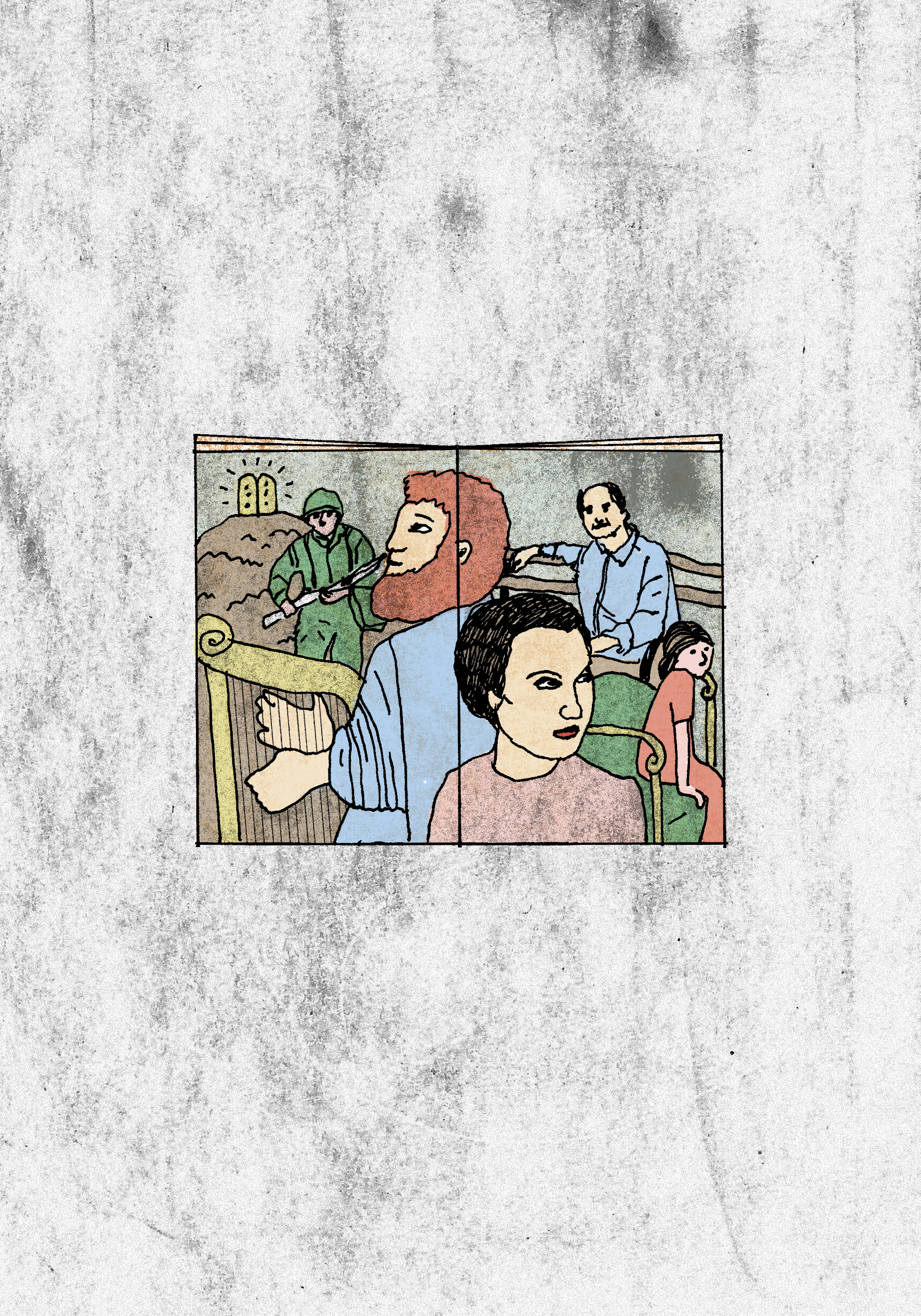
Making space for a conversation about boundedness to Jewish peoplehood through American Jewish literature gives students permission to talk about feeling uncomfortably constrained by their Judaism. In Philip Roth’s “Defenders of the Faith” (1959), Sergeant Nathan Marx, a Jewish World War II veteran, is assigned to train new recruits at an American training camp in 1945, an epochal year in Jewish, American, and global history. Three Jewish trainees requesting special dispensations for Jewish holidays prompt Marx to reflect positively on his own buried connections to his Jewish identity. His identification with their Judaism leads him to feel “bound” to the three young men, to commiserate with their plight and support their request.
But when one of the three recruits, Sheldon Grossbart, gets upset that Marx will not go a step further and help him avoid being sent to the front in the Pacific, the boundaries of the Jewish “we” shift:
“Why are you persecuting me, Sergeant?”
“Are you kidding!”
“I’ve run into this before,” he said, “but never from my own!”
“Get out of here, Grossbart! Get the hell out of my sight!”
He did not move. “Ashamed, that’s what you are,” says Grossbart, “so you take it out on the rest of us. They say Hitler himself was half a Jew. Hearing you, I wouldn’t doubt it.”
Here, the positive feelings of a shared Jewishness gives way as the recruit Grossbart insists that the sergeant Marx should break the rules to keep him—a fellow Jew—out of harm’s way. When Marx refuses, Grossbart accuses him—a Jewish soldier who just fought the Nazis—of being like Hitler. Grossbart is exploiting Jewish trauma to serve his own personal agenda and reject the military’s universal ethical code. (Ultimately, this being a Roth story, Marx proves not to be a paragon of virtue either. But that’s another piece of the complicated puzzle of Jewishness.)
Capturing the messiness of the moment immediately following the war, Roth invites readers to ask when, why, and how individual Jews are part of the Jewish “we” and what that “we” entitles them to ask of one another. This story invites students to consider: “How can we be loyal to both our Jewish identity and our American identity? What happens when the needs of these two identities or peoples conflict with one another?” The moral murkiness of Jewish identity in Roth’s stories complicates how they might form the answer to these questions.
Our current moment further deepens the questions this text raises. Today, Jewish students and adults across the political spectrum are being asked, with increasing explicitness, to choose. Progressive Jews are told that solidarity with Palestinian suffering requires distance from Israel and, by extension, from Jewish communal institutions that support it. Jews in more conservative or establishment spaces feel pressure to defend Israeli government policies they may privately oppose, or to subordinate concerns about domestic antisemitism to broader political allegiances. In these cases, the ask is the same: Prove your loyalty by abandoning some part of your identity. Roth’s Marx understood this pressure. What makes his story so useful right now is that it refuses to tell us which compromise, if any, is the right one to make.
Parameters of the “We”
Muriel Rukeyser’s poem, “To Be a Jew in the Twentieth Century,” offers students an additional powerful site for exploring the parameters of Jewish collective identity. Originally published as the seventh part of her larger poem, “Letter to the Front,” in her collection, Beast in View (1944), the poem was significant enough in the post-war period that it was included in the 1975 edition of the Reform movement’s central prayerbook, Gates of Prayer. The poem’s power in the classroom lies in how it problematizes a simplistic relationship with Jewish identity:
To be a Jew in the twentieth century
Is to be offered a gift. If you refuse,
Wishing to be invisible, you choose
Death of the spirit, the stone insanity.
Accepting, take full life. Full agonies:
Your evening deep in labyrinthine blood
Of those who resist, fail, and resist; and God
Reduced to a hostage among hostages.
The gift is a torment. Not alone the still
Torture, isolation; or torture of the flesh.
That may come also. But the accepting wish,
The whole and fertile spirit as guarantee
For every human freedom, suffering to be free,
Daring to live for the impossible.
In the poem, as a Jew, “you choose” to either “refuse” or “accept” the “gift” of your identity. There seems to be no middle ground. But the poet is using the language of choice and the understanding of Jewish identity as a “gift” ironically.
When I have asked students why Rukeyser writes “to be a Jew in the twentieth-century is to be offered a gift” instead of “to be a Jew is a gift,” the responses varied and built on one another. One student observed that the phrasing suggests you can decline what’s offered, but Rukeyser immediately undercuts that possibility by showing that refusal means “death of the spirit.” Another noted that being “offered” something implies a giver, raising the question of who or what is doing the offering. These student insights demonstrate exactly what literary study enables: the development of original interpretive voices engaging seriously with textual nuance.
Reading the last sentence of the first stanza today—“God/Reduced to a hostage among hostages” —alongside the final lines of the next stanza—“For every human freedom, suffering to be free,/Daring to live for the impossible”—I would ask students how this 1944 poem uncannily evokes the struggle and the language of our current historical moment. We would slowly, delicately, sensitively, parse the words: “God/Reduced to a hostage among hostages.” Then I imagine we might ask: What is the relationship between Jewish identity and “blood” and “torment” in this poem, and how does it connect to our contemporary understanding of Jewish identity? Does Rukeyser think we even have a choice about whether we accept this gift of Jewish identity or not? How does her description of it as a gift align or not align with Krauss’s understanding of being bound?
Building a Jewish Foundation
In her personal essay, “The Education of a Poet,” Muriel Rukeyser wrote about how important Jewish storytelling was to her own Jewish education. She notes that there were “no stories, no songs, no special food,” in her family’s home; it was a household emptied of the traditional markers of Jewish cultural transmission. Yet her mother once memorably told her the story of the martyrdom of Rabbi Akiba and made sure to note that they were his descendants.
Rukeyser presents this single narrative act of one story passing from mother to daughter, with a claim of lineage attached, as enough of a foundation for her to start building a Jewish identity—an identity that would continue developing throughout her life and work. This story, as story does, stuck with her, and we see reflections of the complexity of the Jewish martyr’s anguish in her twentieth-century poem and in our twenty-first-century reality. Rukeyser’s experience suggests that Jewish identity formation may depend less on the quantity of Jewish content transmitted and more on the quality of engagement with even a single, powerful narrative.
Questions about Jewish identity not only produce more questions, they also produce laughter, connections, and—according to some of the graduates of my high school classroom—a shift from cultural consumption to cultural production. Recent correspondence with former students revealed that my course introduced one of them to klezmer music for the first time, and after graduating, he joined a klezmer ensemble. Another recently wrote to me because the course’s short stories had stayed with him through his college years, and in the current moment, they had inspired him to write his own Jewish short stories, one of which he sent me. (It involved a tryst that developed out of love notes heretically tucked into the crevices of the Kotel.) It was pretty good. It raised some questions.