Ambient Antisemitism and its Quiet Cost to Jewish Identity
Yael Silverstein
Yael Silverstein is a Research Fellow at NYU’s Center for the Study of Antisemitism and a Ph.D. candidate in Social-Organizational Psychology at Teachers College, Columbia University.

KURT HOFFMAN/DALL-E
When the Air Turns Hostile
Last Yom Kippur, during Kol Nidrei, an usher hurried down the aisles of my East Village synagogue, whispering three words that then reverberated through the sanctuary: Evacuate. Bomb threat.
I lifted my toddler from the floor where she had been quietly playing with magnetic tiles and joined the stream of people moving quickly toward the exit. For a split second—a primal flash—I thought: What if this isn’t a bomb threat but an ambush? The kind meant not only to frighten Jews, but to flush us into the open? Now I can add: an ambush of the kind that transpired exactly one year later, during the 2025 Yom Kippur attack at the Heaton Park Hebrew Congregation in Manchester, England.
Thankfully, there was no bomb on this night, and, after a break, services resumed. I later tucked my daughter into bed. But an echo of the bomb threat lingered in the air at synagogue and at home: You are not safe here—not entirely, not anymore.
Antisemitism is easiest to recognize when it’s loud. We recognize it when our institutions receive bomb threats. We recognize it when swastikas are graffitied on our walls. We recognize it when our classrooms are infiltrated with slurs of “kill all the Jews” and “go back to Auschwitz.” We recognize it when an Uber driver attacks us because of our Jewish names. We recognize it when our childcare centers are set on fire. None of these examples is theoretical. Each reflects real incidents reported in the press over the past two years. As the ADL reports, antisemitic acts in general continue to rise at an alarming rate: Nearly one in five American Jews report being threatened or harassed in the past year.
But Jewish life today is facing a quieter, yet equally corrosive, far more pervasive threat. Recent survey research indicates that Jewish individuals are experiencing silences, omissions, and unequal responses that signal their identities are devalued or unwelcome. Psychologist Caryn Block and I call this ambient antisemitism: a societal climate in which antisemitism is normative—where mainstream cultural and institutional cues signal that Jewish identity is less legitimate, less protected, or less welcome—a form of second-class citizenship. It is a manifestation of anti-Jewish bias that has been seeping quietly into the atmosphere of everyday life over the last few years—its presence is growing in classrooms, offices, and public discourse.
Below, I explain why ambient antisemitism offers a powerful framework for understanding contemporary antisemitism, not as a series of incidents, but as a broader climate that undermines inclusion. I’ll also consider what psychology research can teach us about challenging it.
The concept of ambient antisemitism can help us to explain what was offensive when, for example, four Columbia University deans were found exchanging private text messages mocking Jewish faculty, staff, and students who had discussed antisemitism and Jewish life on campus at an alumni reunion weekend panel. The deans’ comments that the Jewish panelists were engaging in “woe-is-me” theatrics and exploiting “fundraising potential” recycled centuries-old antisemitic tropes. While they were not as explicit as an outright slur, these messages did indicate that the deans did not take concerns about the safety of Jewish students seriously.
This incident was particularly troubling because when this type of more subtle bias lives comfortably inside the very offices charged with safeguarding students’ well-being, we can assume that ambient antisemitism is thriving within the campus community broadly, and Jewish students are feeling the effects.
Identifying Ambient Antisemitism and Its Impact
Psychologists describe the ways in which bias is expressed as ranging across a spectrum from overt hostility to subtle discrediting. Explicit antisemitism manifests through concrete acts: vandalism, slurs, threats, violence. Ambient antisemitism, by contrast,is more subtle and lives upstream, embedded in institutions and cultures, where unspoken norms quietly define which identities are considered legitimate and which are merely tolerated.
Forms of bias, including antisemitism, can also be mapped onto a second spectrum, this one ranging from interpersonal, i.e., directly between individuals, to environmental and thus indirect. Together, they provide this framework for understanding acts of antisemitism in general:
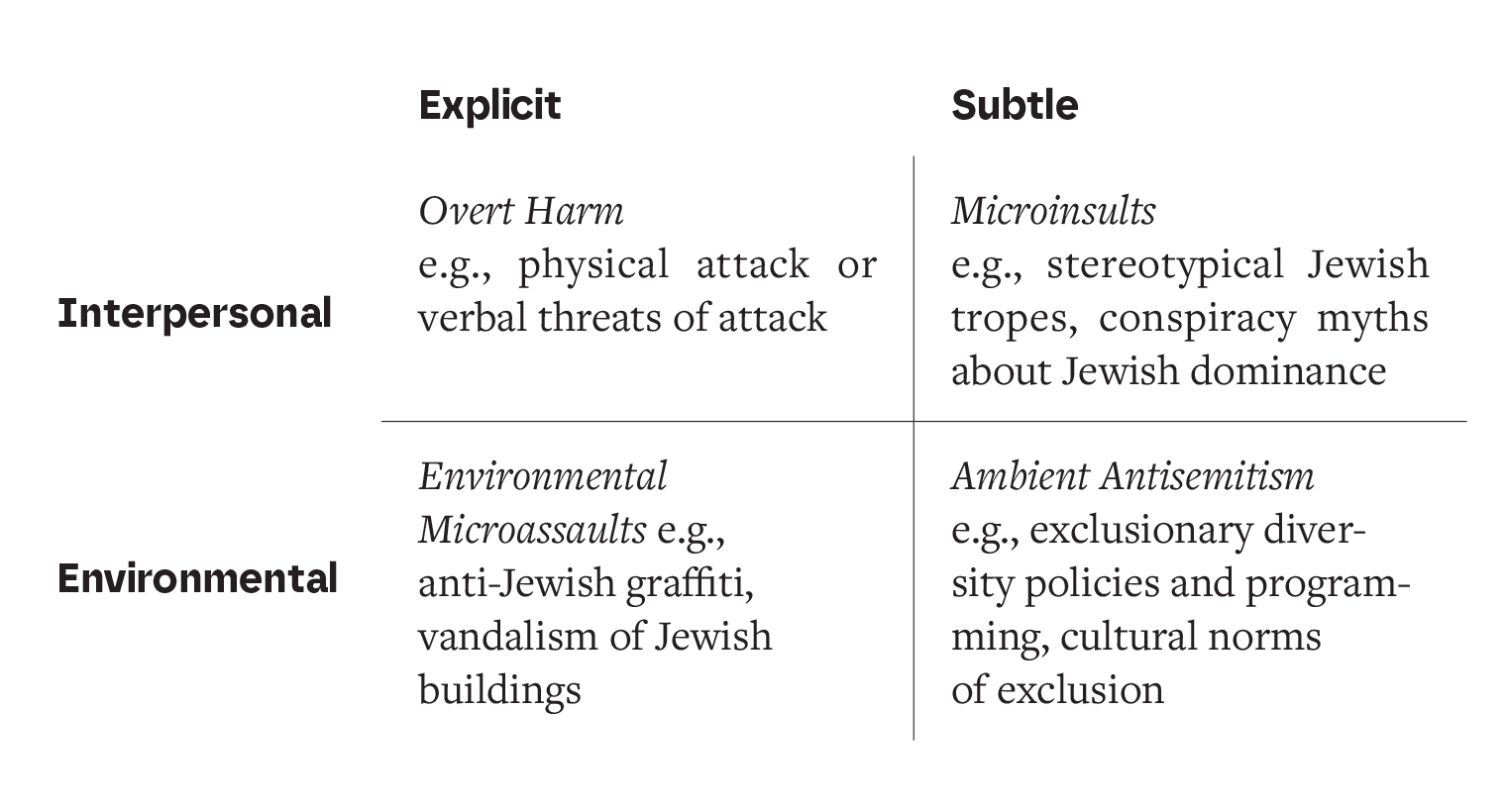
Ambient antisemitism is both subtle and environmental. It might not exclude outright. Instead, as management scholar Batia Wiesenfeld and colleagues have expressed, it creates a logic of conditional acceptance, operating through a quiet tradeoff between authenticity and belonging. It signals to Jews that they may belong, but only if they make others comfortable with their belonging.
Across institutions, ambient antisemitism takes forms that are now familiar to many of us: a diversity statement that omits Jews; students being asked to remove a mezuzah “for safety”; a tendency not to condemn antisemitic acts with the same intensity as other acts of bias are condemned. None of these moments is violent, and each on its own can be dismissed as inconsequential. But together, these send a clear message: Jews may be permitted to belong, but only on terms that dictate how fully—and in what ways—they can express their Jewishness.
This is the distinctive danger of ambient antisemitism. It does not force Jews out; it invites them in on narrowed terms, where belonging is secured by constraints on authenticity. In practice, it is a Faustian bargain: acceptance in exchange for erasure.
With bias, it is often assumed that the more severe the act, the greater the harm. However, research shows that’s not always true. Small, repeated cues of exclusion accumulate, like background noise that wears down the mind. This is why the “micro” in microaggression doesn’t mean minor in terms of impact. As psychologist Derald Wing Sue notes, the power of microaggressions lies in their repetition.
Seen in ambient cues like decor, signage, or representation, stereotypes and bias can shape an individual’s sense of belonging and participation, a phenomenon shown by social psychologist Sapna Cheryan and colleagues. Researchers have found that members of stigmatized groups are finely attuned to these institutional cues of inclusion and exclusion. In workplace environments, for example, those perceptions reliably predict workplace trust and satisfaction. Individuals impacted by this type of threat come to see their sense of belonging as conditional and remain at high alert to its presence in their lives.
The costs of chronic experiences of ambient bias are measurable in other ways, too. Dozens of studies link subtle, persistent devaluation to increased rates of anxiety, depression, and burnout. People who work or study in what psychologists call “invalidating environments” report reduced satisfaction, reduced performance, and greater intent to leave. The most corrosive damage often stems not from the severity of a single incident but from the accumulation of minor exclusions.
We in the Jewish community often focus on overt, but relatively rare occurrences of discrimination. The very pervasiveness of subtle discrimination is what makes it particularly harmful, and we would do well to pay it more mind.
Sociologist Ilana Horwitz captured the effect of ambient antisemitism in a recent reflection about her Jewish Studies students published by the Jewish Telegraphic Agency (JTA). These young people, she writes, are not apathetic about their Jewish identities, but are soul-weary and drained by the barrage of antisemitism they encounter online and in daily life. “Seeing constant antisemitism and antizionism has just made me so tired of it that it’s easier to ignore,” one student told her. Others described learning to mute parts of their identity as a way to feel safer or to protect their mental health. Many avoided discussing Israel altogether, afraid of “saying the wrong thing by accident,” or of being forced to speak on behalf of an entire people. As Horwitz observes, her students are not disengaged. They are simply exhausted.
The Cost of Ambient Antisemitism
When belonging feels conditional, people learn to monitor their visibility, what psychologists call image management. They modulate tone, edit disclosures, or in the case of Jews, tuck their Star of David beneath a shirt collar and self-censure their Jewish lingo. In one recent study, nearly four out of five Jewish college students reported hiding aspects of their Jewish identity. Some might have feared physical threat; but perhaps others simply feared being marked as “too political,” “too particular,” or simply “too Jewish.” Someone that doesn’t belong.
Sociologist Erving Goffman described this phenomenon six decades ago in his classic book, Stigma, in which he distinguished between two image management techniques: passing (hiding a stigmatized trait entirely) and covering (downplaying it so it does not “loom large”). Goffman’s example of Franklin D. Roosevelt, who arranged his desk so visitors would not see his wheelchair, encapsulates the distinction between passing and covering. Roosevelt was not passing—everyone knew he used a wheelchair. He was covering, ensuring that his disability did not become the focal point of interactions.
In a 2006 New York Times Magazine article, legal scholar Kenji Yoshino argues that freeing individuals from the demands of covering is the unfinished business of the Civil Rights Movement. Overt exclusion and the need to pass, he notes, is now largely illegal. The subtler pressure to cover—to be less feminine, less foreign, less gay, less Jewish—persists. “The new discrimination,” Yoshino writes, “does not aim at groups as a whole. It aims at the subset of the group that refuses to cover.” It is the continued instinct to cover that defines contemporary forms of discrimination, despite changes in the legal system or explicit policies against discrimination. Even in the wake of dismantled discriminatory structures, residual cultural prejudice may reinforce image management demands.
Since October 7, many Jews in workplaces and classrooms have found themselves feeling “suddenly Jewish” in public for the first time, their Jewishness not only newly visible but newly vulnerable. This feels to them like a rupture in their individual lives, an abrupt loss of the assumption that Jewish belonging is secure.
But the lessons of conditional acceptance are deeply encoded in Jewish history. Across centuries, Jewish acceptance has often come with terms, and we have learned that safety depends on self-erasure, and that belonging can always be revoked. This is why moments of threat can reverberate so powerfully. When our congregation was told to evacuate the synagogue on Yom Kippur, the fear that surfaced was not only about that night, but about what Jewish history has taught us to expect when the climate turns hostile.
The trauma of antisemitism today may be modern, but the reflex it triggers is ancient. It draws on a long-standing calculus of survival: how visibly Jewish one can be, and for how long, before acceptance gives way to erasure or danger.
Under Hellenistic rule in ancient Judea, Jewish boys sought to reverse their circumcisions to compete in the Greek gymnasium, where athletes customarily performed nude. As the historian Heinrich Graetz comments, for Jews, this pursuit of social acceptance was tied up in the pursuit of Jewish invisibility.
Nineteenth-century Europe offered a more refined but no less corrosive bargain. Legal emancipation granted Jews citizenship and access to universities and salons, but the social contract remained clear: Belonging required Jewish dilution. As writer Sarah Hurwitz, quoting Rabbi Jonathan Sacks, observes in her recent book, As a Jew, “Jews stopped defining themselves by the reflection they saw in the eyes of God and started defining themselves by the reflection they saw in the eyes of their Gentile neighbors. And their neighbors thought they were disgusting.” Many abandoned Yiddish, traditional dress, and public rituals in exchange for broader societal acceptance.
Twentieth-century America offered a gentler version of the same story. The explicit structural barriers of university quotas, hiring bans, and housing covenants eventually fell with the 1964 Civil Rights Act, but cultural enforcement of stigmatized identity remained. Families anglicized their names, softened their accents, and learned how to be culturally accepted. Invisibility became the entry ticket to public life.
The pressure to dilute one’s Jewishness did not solely come from non-Jews; it was eventually internalized and enforced by Jews themselves. When, in the nineteenth century, Western European Jews encountered their less assimilated Eastern cousins, they recoiled. Jewish composer Gustav Mahler once sneered that Eastern Jews “run about this place as dogs do elsewhere.… God Almighty, and I am supposed to be related to them.” That instinct to distance oneself from overly Jewish Jews did not end with Mahler’s Vienna. There are echoes today amongst some Jews who whisper their discomfort with the visible piety of Hasidic neighbors in Brooklyn. The setting has changed; the psychology has not.
These examples reveal a pattern of identity management throughout Jewish history. The bargain for Jews that allows them to stay, but not too loudly, has never fully disappeared. Rather, it has simply evolved and taken on new shapes in the modern age. Today, after decades of greater acceptance of Jewish particularity, the bargain is resurfacing in subtler forms. It is reasserting itself when a professional hesitates to post about antisemitism online or a student deletes their Jewish affiliations from a resume. Each decision may seem prudent in isolation, but together they trace the outline of a climate in which self-protection and self-suppression become indistinguishable.
For generations, Jews have survived by adapting and tempering language, tone, and visibility to ensure their safety and survive in the contexts in which they found themselves. But while image management shields the self in the short term, over time it can erode authentic identity and self-esteem. The danger of ambient antisemitism is not only about concealment from individuals, but that it may tempt whole communities toward silence, and the slow internalization of stigma, and the erosion of identity. Surviving is not the same as flourishing.
Responding to Ambient Antisemitism
So, what should we do? The long-term responsibility for eradicating bias, prejudice, and discrimination should never rest on the marginalized community. It should not be on individuals to become better at covering or concealing, but on institutions to become less hostile, and on antisemitic climates to become as socially taboo as other forms of prejudice. Yet, while that work unfolds, embracing our agency can offer us a path forward. We can choose visibility over erasure, connection over retreat, and presenceover absence. We can rebuild belonging from the inside out.
Psychologists point to identity resilience, the capacity to maintain a stable, positive sense of self even under threat, as an antidote to the corrosive effects of identity threat. Social psychologist Glynis Breakwell defines four pillars of identity resilience: self-esteem, self-efficacy, positive distinctiveness, and continuity. It is striking to me that these pillars align with important values in the Jewish tradition, offering us our own language for building them.
Self-esteem begins with the conviction that one’s identity is worthy of respect. In Jewish thought, this principle is expressed through the notion of b’tselem Elohim, the idea that every person is created in the divine image and all individuals are entitled to non-negotiable dignity. Jewish tradition commands us to treat all as if they belong without requiring a sacrifice of authenticity.
Self-efficacy is the belief in one’s own ability. Judaism not only respects this idea but requires it. I find it in the biblical concept of lobashamayim hi (“it is not found in heaven,” Deut. 30:21) and its rabbinic interpretations, that humans are empowered to reason, engage, challenge, and decide the terms of Jewish law (bBava Metzia 59b). It is the ultimate statement of self-efficacy in Jewish learning. Judaism also encodes self-efficacy as a mitzvah (commandment) when it insists that moral repair is human work. Agency, not acquiescence, is sacred. Mitzvot are acts of ethical resistance that assert that our choices matter.
Positive distinctiveness is the ability to see one’s difference not as a defect but as a contribution. This yearning to experience Jewishness as joy and not only as defense echoes Horwitz’s students, who wanted to explore Judaism on its own terms rather than only through the lens of antisemitism. Their desire is itself a form of resilience, in that it sees Jewish identity according to what it creates, not merely through what it endures.
Continuity is the thread that binds generations. It is the assurance that one’s story belongs to something enduring. Continuity lives in the Jewish calendar itself: a cycle that loops back on memory, retelling survival each year as proof that exile is never the end. In the words of Rabbi Sacks, Jewish rituals “turn us from lonely individuals into members of the people of the covenant.”
When people believe their group is worthy of respect, that their actions have power, that their difference carries value, and that their story connects to something larger, they can withstand even chronic threat.
In addition to cultivating the four aspects of identity resilience, other strategies may further attenuate the sense of threat to one’s identity. This includes finding and strengthening community and safety in connection with other Jews. Psychologists have consistently found that social support is the strongest buffer against chronic stress, particularly for members of stigmatized groups.
Judaism has long provided the tools to make this possible. Its rituals are not designed for private belief alone, but for collective belonging. As Rabbi Sacks put it, “We make a mistake when we think religion is only about believing. It’s also about belonging; and belonging is about community.” Even mourning in Judaism is communal. The Kaddish cannot be said alone. In Jewish life, resilience is never a solo endeavor.
This collective impulse stands in quiet resistance to America’s cult of individuality. Jewish strength has always been relational and sustained through covenant, community, and care. Social science may have its own contemporary terms to describe this, but Judaism has always known that community matters, that rituals anchor us, that joy is holy, and that resilience isn’t just about bouncing back. It is about building a future with purpose.
Our task, then, is not merely to survive but to rebuild the atmosphere around Jewish life. We have an imperative to make the climate inclusive, without a tradeoff between authenticity and belonging, through visibility, connection, and pride. That means nurturing self-esteem and positive distinctiveness through education and celebration: ensuring that every Jewish child can access communities of connection, learning, and ritual that make identity a source of joy. It means teaching self-efficacy as moral agency: equipping Jews to be critical thinkers and advocates of civil discourse and to hold complexity and speak with nuance, including about Israel, antisemitism, and justice. And it also means reclaiming self-efficacy through mitzvot—the daily, embodied acts through which we repair the moral fabric of the world. And it means sustaining continuity through story and ritual such as lighting candles, retelling Exodus, reciting Kaddish. Each time we say hineni—“here I am”—we counter isolation with belonging. Each act, each time we shrug off the pressure to cover, becomes an act of repair.
No conversation about antisemitism today exists in a vacuum. Some wonder whether naming antisemitism distracts from other struggles, or whether Jews can even be considered marginalized, given their relative economic success in American society. Others worry that confronting antisemitism risks deepening division in already fractured spaces.
These are fair questions. However, they rest on the false premise that fighting antisemitism competes with fighting other hatreds.
In reality, antisemitism doesn’t compete with other bigotries. It complementsthem, as much of the same psychological machinery and ideological structures that fuel antisemitism also sustain racism, Islamophobia, and xenophobia. To confront antisemitism is not to center Jews above others; it is to defend the shared infrastructure of human dignity.
Acknowledging antisemitism does not mean claiming a form of exceptional victimhood. The goal is not competitive suffering but moral consistency: a circle of inclusion wide enough that no one needs to trade authenticity for belonging.
When Jews are left out of that circle, the circle itself weakens. When they are included—named not as an afterthought but as part of the moral whole—the language of pluralism expands. The fight against antisemitism, then, is not a parochial matter that should only concern Jews. It is a test of whether diversity itself means what it claims to mean. To build a world where no identity is conditional, we must start by refusing to make any identity negotiable.
This Moment
Diaspora Jewry has put much focus on hate crime incident counts and understanding the psychology of antisemites. But the field of psychology can also offer conceptual frameworks to think about the more ambient climate that Jews are experiencing and ways to address it. Naming ambient antisemitism gives us a way to call out and address these harmful cues. And looking to interventions such as building identity resilience gives us constructive channels to build vibrant diaspora communities.
Coda: The Return to Kol Nidre
Last Yom Kippur, as our cantor finished the Kol Nidre prayer on the street where the congregation had gathered after the bomb threat, the choir formed a semicircle around her. Hundreds of Jews stood on East 14th Street, singing under the open night sky. For a moment, the thick air of fear was transformed into a space of presence, defiance, and vitality.
The bomb threat caller’s goal was to make Jews feel unsafe. Our answer must be the opposite: to make Jewish life unmistakably alive.
To be Jewish together in public, to belong without apology, to turn the air of threat into the air of song—that is how we reclaim the atmosphere itself.