Covenant and Country
From the Editor
Dear Friends,
Robert Cover’s “The Supreme Court, 1982 Term—Foreword: Nomos and Narrative” is one of my favorite pieces in the canon of American Jewish thought. It’s not immediately clear when you pick it up that it’s a work of Jewish thought: It was published in the Harvard Law Review, not a Jewish journal or book, and the terms it uses are Greek and Latin in origin, not Hebrew. There is no question that it is an important contribution to American legal theory. But in terms of both its origins and its impact, there are good reasons to consider Cover’s theory of nomos and narrative a work of Jewish thought. First, Cover was likely drawing on rabbinic literature as he developed his theory of law—although he wasn’t a scholar of rabbinics, he studied Talmud in adult Jewish education settings. More specifically, his argument rests on the difference between nomos, meaning law, and narrative—terms that echo the rabbinic categories of halakhah and aggadah, respectively. As a result, Cover’s article has had an important impact on our understanding of rabbinic literature and how the categories of halakhah and aggadah are intertwined. His account of how the stories we tell about who we are and who we want to be can lead to legal change has inspired key works of feminist Jewish thought.
As we approach the 250th anniversary of the Declaration of Independence and the founding of the United States of America, what interests me most right now is how Cover’s ideas can help us to appreciate this moment as American Jews and inspire us to recommit to the American project, not simply as it is, but with a vision of what it can be and how we might help it get there.
Cover writes that “a nomos, as a world of law, entails the application of human will to an extant state of affairs as well as toward our visions of alternative futures. A nomos is a present world constituted by a system of tension between reality and vision.” As we see in this quotation, Cover uses the Greek word nomos to describe the laws of a state not only as they exist on the books but as they shape the reality in which citizens and other residents of that state live. In doing so, he is calling attention to the gap between the world that laws would seem to create (vision) and the world as it actually is (reality). In both cases, narrative—the stories we tell to describe and explain the world—plays an essential role. Narrative gives us a way of explaining why our laws play out the way they do, and it also gives us a way of developing and describing the world that we want to create through new interpretations of the law or through the crafting of new laws. Further, laws in this account are not random. Much like the Hebrew word torah, the notion of “law” embedded in the word nomos is broader than a set of statutes. It is law in the sense of instruction on how to live a moral and ethical life and how to build a good society. It is an expression of values.
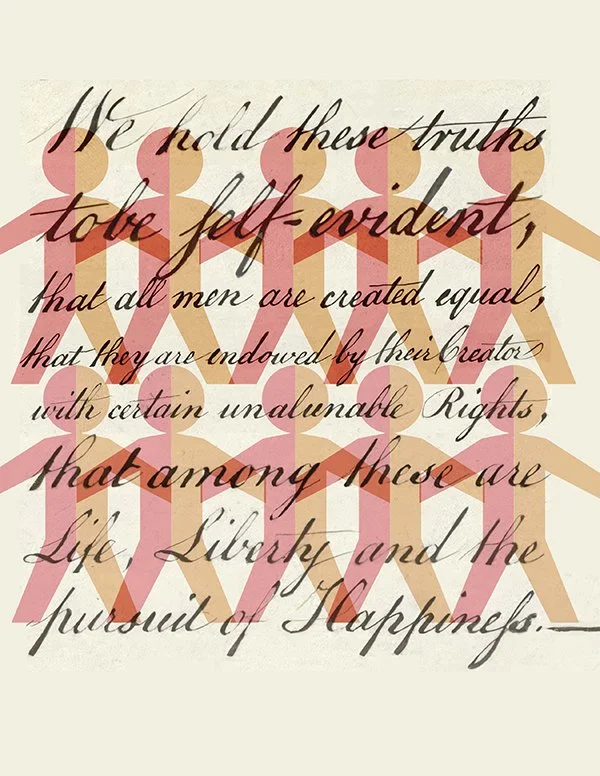
Cover’s efforts to draw our attention to the interplay of nomos and narrative in every legal system can help us to tell the story of the American Jewish experience and can also inspire us to imagine a better future. I see the connection especially in tellings of American Jewish history that explain the collective flourishing of Jews in this country as a result of its laws. This narrative emphasizes the Declaration of Independence’s pronouncement that “all men are created equal” and the Constitution’s promises of justice and liberty as well as the separation of church and state, and it explains how these legal principles allowed Jews to become citizens and to participate fully in American society without having to hide their Jewishness: The combination of educational and economic opportunities, freedom of religion and of expression, and democratic rule created an environment of safety and security ripe for the thriving of both Jews and Judaism.
Understanding how nomos and narrative are at play in the way we think about what it means to be an American Jew can also help us to understand how unsettled so many of us feel by the increasing rates of antisemitism (and with it, racism and other forms of prejudice and discrimination) in this country over the last few years. America’s values and principles, on paper, have not changed. But the ways in which they are being interpreted and the ways in which they are playing out push against a Jewish story that assumes a stable sense of safety and security.
Franklin Foer’s article on the end of the Golden Age of American Jews, published in The Atlantic just over two years ago, is an example of questioning and changing our story. His piece ends on a pessimistic note of caution for all Americans, and I think he is right that growing antisemitism—and with it, the growth of other forms of prejudice and discrimination—is an American problem, not only a Jewish one. But I am not prepared to give up on America. I believe that we can tell a story that expresses gratitude for the many ways in which American Jews have thrived in this country—and that we can and should describe how America is falling short for us and for others in that same story. This story needs to be broader and more detailed: It should not paper over early episodes of American antisemitism, and it should not ignore those Jews who are not flourishing here or those who face additional prejudices, whether sexism, racism, or something else. In telling our story in this way, we can recommit to America’s greatest ideals even while acknowledging that the country has not realized them fully.
As American Jews, we are inheritors of American narratives and live in an American nomos; we are also inheritors of Jewish narratives and a Jewish nomos. Being an American Jew means believing in the ideals of liberty, justice, and freedom and it also means bringing our Jewish values into conversation with these ideals. Sometimes they will conflict; oftentimes, they will not only complement one another but shed light on one another. But one of the most amazing aspects of the American project is the way in which this country, its culture, and its society—its nomos and its narratives—are a mosaic of its many subcommunities. We owe it to ourselves, we owe it to America, and we owe it to the Jewish people, to insist on our place in the mosaic and to join other Americans in imagining a better future and making it real.
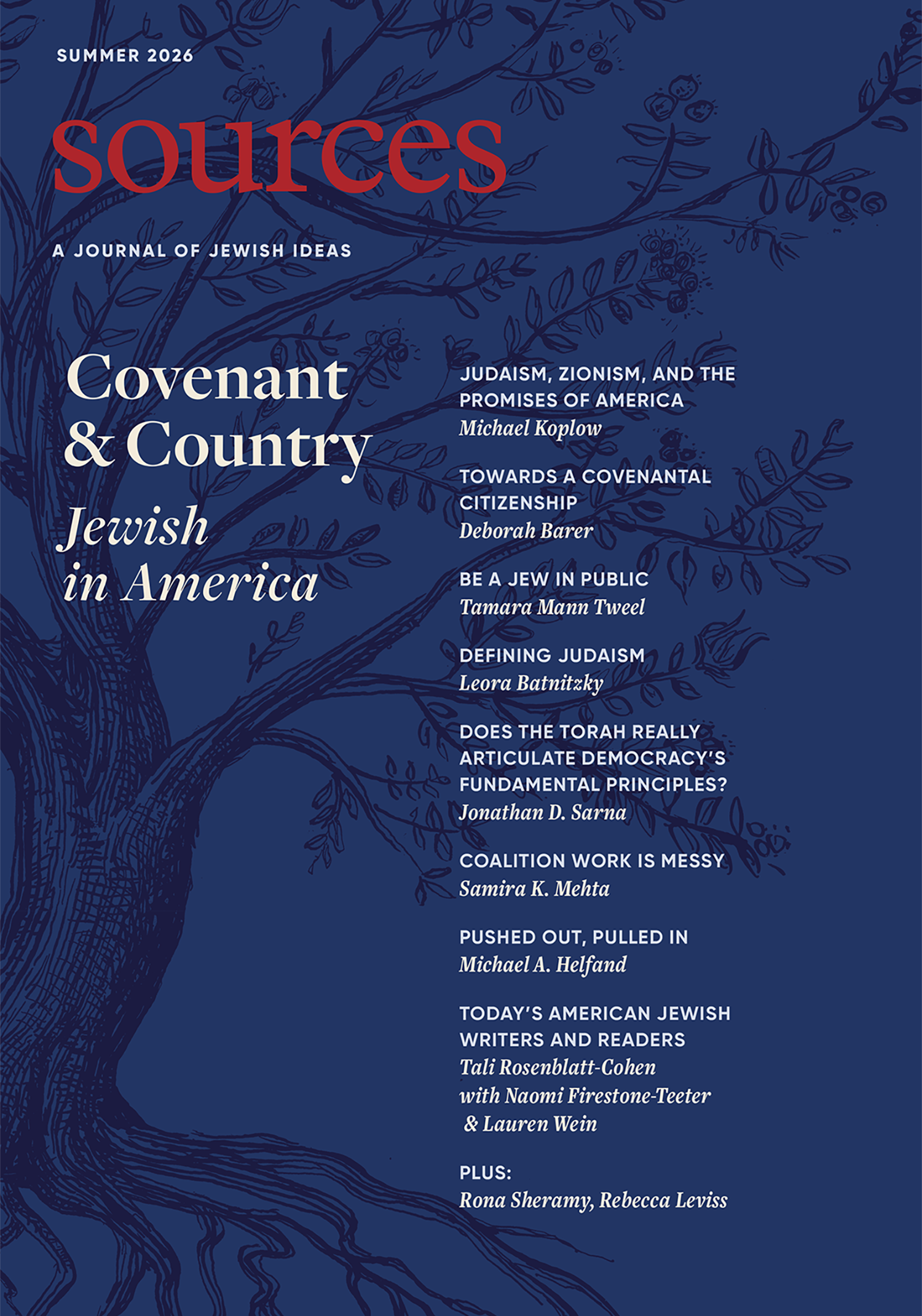
Although none of the authors featured in this issue of Sources use the language of nomos and narrative I’ve offered above, I think you’ll find a shared sense of appreciation for the unique set of opportunities America has offered to Jews, for the positive impact America has had on Judaism and Jewish identity, and for the impact Jews have had on American society. The writers also share a cautious optimism about the future—while there are hard choices to be made and there is challenging work to be done, America remains a place where Jews can thrive alongside others. As you read, I encourage you to ask: What is the American Jewish story this author is telling and what sort of nomos does it reflect or demand?
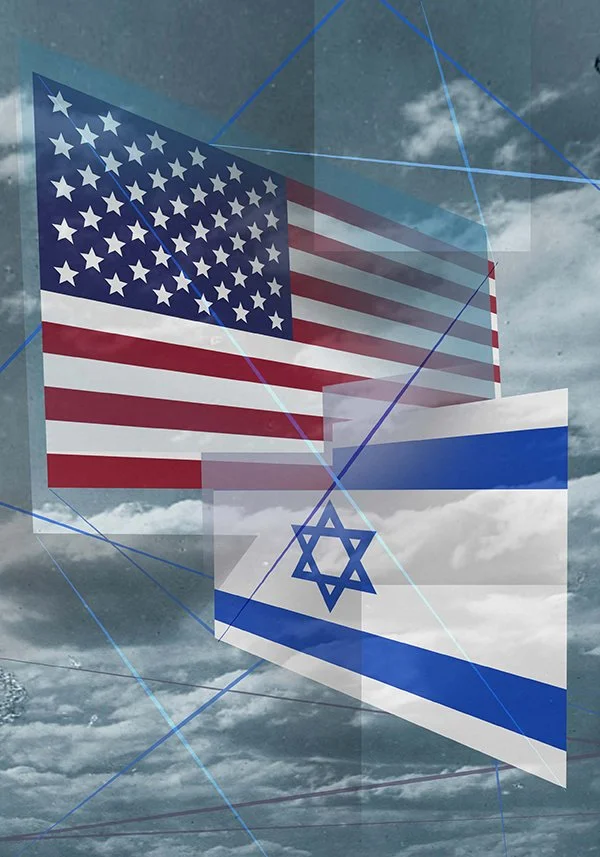
The first section of the issue, Defining our Commitments, opens with an article by Michael Koplow connecting this moment to a speech delivered by Louis Brandeis in 1915, calling upon his fellow Jews to join the Zionist cause. The case Brandeis makes for Zionism is rooted in a particular vision of American society, one that benefits when its citizens, especially its minorities, maintain their more particular identities alongside their Americanness. Koplow calls for a renewal of this vision and a refusal to retreat into Jewish enclaves.
In her piece, Deborah Barer asks a philosophical question with emotional resonance: How do we love a country that disappoints us? To answer, she turns to another relationship that is filled with both love and disappointment: the biblical covenant between God and the Israelites and its further development in rabbinic and contemporary Jewish sources. The lessons she finds in these materials center on the question of committing to a particular project without knowing exactly what it will entail. But her method of inquiry is itself an answer that echoes Koplow’s piece: As Jews, we love America in the terms we learn from our own particular tradition, and we bring the lessons of that tradition into the American cultural mosaic.
In the next piece, Tamara Mann Tweel offers a careful reading of an image by artist Mark Podwal published in The New York Times after the 1972 Munich Olympics massacre. She argues that his portrayal of an Israeli athlete beneath an arch adorned with the words of the Kaddish was an unapologetic expression of Jewish mourning in the American public square—and stands for us today as a model for Jewish religious expression without apology.
Leora Batnitzky then makes a case for thinking of Jewishness as a civilization rather than as a religion or any other category. The term “civilization” as applied to Jews was first suggested by Mordecai Kaplan in 1934, but Batnitzky places it in a larger history of limiting Jewishness to Judaism that began in the seventeenth century. I especially appreciate a point she makes along the way: Understanding the history behind the terms we use can free us to choose other ways of thinking.
A piece by Jonathan D. Sarna opens the next section of the issue, Expressing Our Values. Sarna asks about the tendency of American rabbis to read certain biblical verses as explicit groundwork for the values that undergird democracy. He argues that, rather than originating in the history of biblical interpretation, these readings are not only distinctly American, but they are also part of a broader pattern of democratization in American synagogues that began around the time of the American revolution.
The politics of working in coalition have been a central concern for many American Jews since October 7. Samira K. Mehta draws our attention in her piece to an earlier moment of interfaith coalition work: Planned Parenthood’s National Clergymen’s Committee, which brought together American rabbis, priests, and ministers in support of the organization’s movement to legalize birth control. Mehta identifies three important lessons she believes we should take from this episode, including how coalition work can amplify the voices of minorities even as it can also demand that they make difficult compromises.
In the next article, Michael A. Helfand considers the implications of recent shifts in the doctrine of separation of church and state for American Jews. He cautions that while allowing federal funding to support religious schooling will likely benefit students at Jewish day schools, a more permissive attitude toward bringing religious instruction and symbols into public schools may create a less welcoming atmosphere for Jewish students.
Rona Sheramy then draws our attention to American Jewish philanthropy and the current debate about whether Jews should be investing their charitable dollars in nonsectarian as well as Jewish causes. She forcefully answers this question in the affirmative, arguing that doing so is an investment in American democracy and an expression of Jewish values.
The final section of the issue, Telling Our Stories, offers two pieces directly about American Jewish storytelling. In a Conversation piece on American Jewish literature, Tali Rosenblatt-Cohen talks with Naomi Firestone-Teeter and Lauren Wein about current trends in the field. They agree that we are in a moment where more American Jewish writers are looking inward, exploring the fears, tensions, and joys of Jewish life today. The issue closes with Rebecca Leviss’s consideration of how the stories we tell and the way we tell them can limit or expand our visions for the future. In a striking move, she highlights similarities she has observed in efforts to strengthen American democracy and in American Jewish communal spaces.
I hope that this issue of Sources will inspire you to join me in considering the 250th anniversary of the Declaration of Independence a moment for commemoration, celebration, and critique. As always, I welcome your thoughts.
Claire E. Sufrin, Editor