Does the Torah Really Articulate Democracy’s Fundamental Principles?
Jonathan D. Sarna
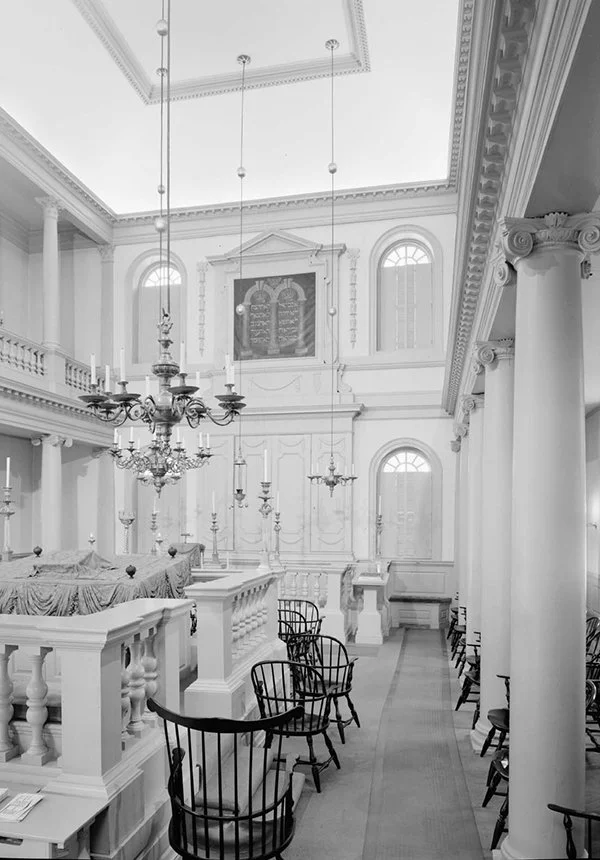
Interior of Touro Synagogue, built in Newport, Rhode Island in 1763. Credit: Library of Congress
Jonathan D. Sarna is University Professor and Joseph H. and Belle R. Braun Professor of American Jewish History Emeritus at Brandeis University and Chief Historian of the Weitzman National Museum of American Jewish History.
When I was a student at Ramaz Lower School many years ago, our Jewish Studies teacher, a rabbi, used to let our class vote on matters that seemed at the time to be of supreme importance, such as whether we should have our class party on Monday or on Tuesday, and whether we wanted it to feature cake or ice cream. Students would speak out on both sides of the issue, the class would vote (sometimes even with a secret ballot), and whatever the result, he would invariably smile and recite three words from Exodus 23:2: acharei rabim lehatot, which we took to mean “the majority rules.” That principle, a central pillar of democracy, is, so we learned, m'doraita, biblically ordained.
The other central pillar of democracy—equality (“all men are created equal”)—likewise derives from the Bible, our teachers taught us. As they explained, the creation story in the Book of Genesis makes clear that all human beings are created in the image of God, descend from Adam and Eve, and remain kin, related to one another. The lesson that elementary school imparted to us back then was clear: long before America existed, our precious Torah articulated democracy’s fundamental principles.
In crediting Judaism for the origins of democracy, our teachers were following a well-trodden American Jewish path. Back in 1885, Oscar S. Straus, perhaps the leading Jew in American public life in his day—a member of one of America’s most famous Jewish merchant families and, under Theodore Roosevelt, the first American Jew to serve in a presidential cabinet—published a book titled, The Origin of Republican Form of Government in the United States of America. There, with arguments based on the Torah, he credited the ancient Hebrews with the first achievement of “a government of the people, by the people and for the people.” Pointedly, he observed that this took place “1500 years and more before the Christian era”:
The children of Israel on the banks of the Jordan, who had just emerged from centuries of bondage, not only recognized the guiding principles of civil and religious liberty that “all men are created equal,” that God and the law are the only kings, but also established a free commonwealth, a pure democratic-republic under a written constitution.
Jewish leaders across the spectrum—Orthodox, Conservative, Reform and secular—echoed and extended Oscar Straus’s arguments. Annually, especially on patriotic holidays and at times of national celebration, they proclaimed to generations of American Jews the reassuring message that equality, majority rule, and other democratic American values were not only thoroughly compatible with Jewish teachings but largely derived from them.
As we celebrate the 250th anniversary of American independence, and with our democracy currently under stress, the time is ripe to reexamine the relationship between Judaism and democracy. That relationship, we shall see, is far more tenuous than Oscar Straus and many of our teachers led us to believe. As America struggles over how to celebrate its anniversary, and strongmen rulers threaten democracies around the world, it is perhaps worth recalling that majority rule and equality were not characteristic of Jewish life prior to the modern period. It was instead the American Revolution that played a large part in introducing democratic ideas into Judaism and translating them, however imperfectly, into American Jewish communal norms. Rather than crediting the Torah with these principles, we should add them to the list of what historian and former Chancellor of the Jewish Theological Seminary Gerson Cohen once famously called “the blessings of assimilation.”
I want to take a closer look at the Torah sources that American Jews have associated with democratic principles, starting with the proof text for majority rule in the Book of Exodus that I referenced above, acharei rabim lehatot. The full verse in Exodus 23:2 reads as follows:
לֹא־תִהְיֶה אַחֲרֵי־רַבִּים לְרָעֹת וְלֹא־תַעֲנֶה עַל־רִב לִנְטֹת אַחֲרֵי רַבִּים לְהַטֹּת׃
You shall neither side with the mighty to do wrong—you shall not give perverse testimony in a dispute so as to pervert it in favor of the mighty.
The Hebrew is difficult (even more so than the English), yielding numerous conflicting interpretations, many having nothing to do with the principle of majority rule whatsoever. The New Jewish Publication Society translation, for example, renders rabim not as “majority” but as “mighty,”the opposite of dal, the “poor man” who is mentioned in the verse that immediately follows (“nor shall you show deference to a poor man in his dispute.”) As biblical scholar Nahum Sarna explains in his commentary, the basic meaning of the passage seems to be that “in the interest of impartial justice, no consideration is to be given to the social standing of the litigants.”
Others actually read this verse as a warning against majority rule—“not to pervert justice by deferring to the majority view if one is convinced that it is erroneous.” Going further afield, the rabbis of the Talmud employed the verse to demonstrate that, in a judicial procedure, only a simple majority is required for acquittal while conviction requires a majority of two. How that derives from the text is far from clear. As Rashi admitted, “There are halachic interpretations of this verse given by the Sages of Israel but the wording of the text does not fit in well with them.” In any case, not even one of the traditional commentators understood the hard-to-understand verse to mean that, as a matter of universal principle, “the majority rules.”
Where the principle can seemingly be found is in the Talmud, where we are taught that, “When there is a dispute between an individual and the majority, the law follows the majority” (bBrachot 9a). That principle, though, only governs the judiciary—the Sanhedrin or a bet din. As Professor Shmuel Shilo explained in his “Majority Rule” article in the Encyclopaedia Judaica, the sages converted our hard-to-understand verse into “a decisory canon.” Since judges commonly disagree about verdicts and how laws should be applied, the principle of “the law follows the majority” ensures a functioning judiciary.
Even then, though, the principle could be interpreted in different ways. Although most assumed that the principle called for rov minyan, a quantitative majority of the judges, others insisted that rov chochmah, a qualitative majority, the side with the “majority of learning or wisdom,” should carry the day. From the time of the Geonim in the eleventh century, when Rav Hai Gaon articulated that view, until our own day, the rov chochmah position has won adherents, based on the theory that the most learned of the generation are best positioned to arrive at Truth. The thirteenth-century Sefer ha-Chinuch ruled that the principle of “the law follows the majority” only applies when the two disputing parties are equivalent in their knowledge of Torah. Otherwise, a majority of ignoramuses might prevail over a minority of the truly learned. The twentieth century doctrine of “Da’at Torah” (the Torah view), a political theology taken up by fervently Orthodox Jewish political parties in Israel, explicitly embraces this view. Rather than looking to a numerical majority, it places decision-making squarely in the hands of a Council of Sages, or even just a single sage, such as Rabbi Elazar Schach or Rabbi Ovadiah Yosef. The idea that such Great Men of Torah might be overruled by a majority of “lesser” rabbis is anathema to followers of Da’at Torah.
During the twelfth century, Rabbenu Tam, concerned about minority rights and fearful of what political philosophers would later speak of as the “tyranny of the majority,” advocated for consensus-based governance. At least when it came to communal enactments affecting pocketbook issues—taxes, spending, expropriation of land, and the like—he argued, in keeping with the medieval doctrine of quod omnes tangit ("what touches all must be approved by all"), that decisions needed to be “adopted and agreed upon unanimously.” If an individual, from the outset, refused to accept the burden of a communal enactment, the majority had no power to compel him to do so, he ruled. Majority rule was not, to him, an essential Jewish value.
Equality, another democratic principle, was not an essential Jewish value before the Revolution either, our common descent from Adam and Eve notwithstanding. Many traditional Jewish texts disparage non-Jews and consider them inferior, even biologically. The Tanya declares in its opening chapter that “the souls of the [non-Jewish] nations of the world… contain no good whatsoever.” Internally, most traditional Jewish communities were oligarchies, governed by leading citizens, so-called tovei ha-ir, who were males of social and economic standing. Only a small minority composed of the wealthy, the learned, and those with family pedigree (yichus) ruled. The majority, including women, illiterates, and the poor, were excluded from governance altogether. Synagogues, where leading citizens occupied the best seats, closest to the holy ark, and others sat behind them or above them in the women’s gallery, effectively mapped Jewish society’s inequalities. In addition, descendants of Priests and Levites, as well as firstborn sons, received unequal advantages in Jewish law, while mamzerim—children born of forbidden sexual relationships—suffered unequal disadvantages. Liberal Jews have challenged all these inequalities in recent times, but even they recognize that Jewish law and tradition enabled them to arise.
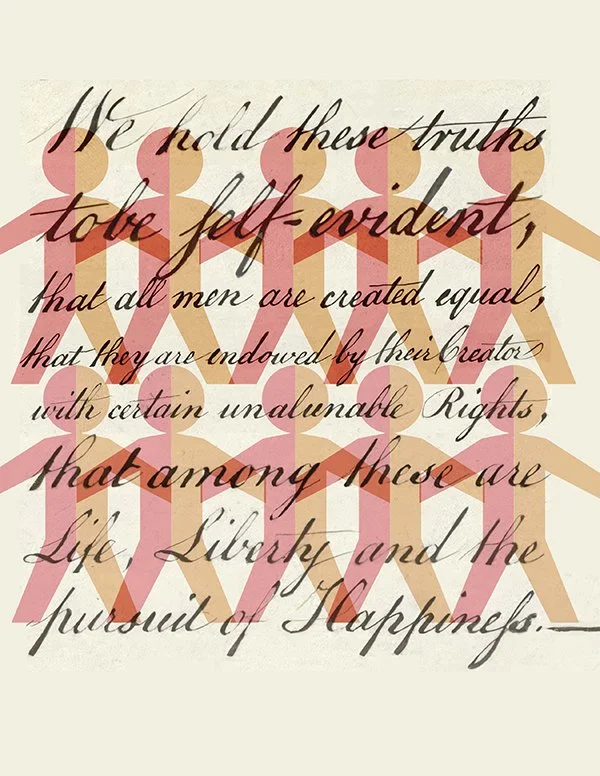
The American Revolution, which enshrined both majority rule and equality in American culture, challenged traditional Jewish views on majority rule and equality before liberal Judaism did. “It is my principle that the will of the majority should always prevail,” Thomas Jefferson famously wrote in a letter to James Madison (December20, 1787). At about the same time, America’s Declaration of Independence (“all men are created equal”) enshrined the ideal of equality. The new nation never fully lived up to either ideal, of course, but majority rule did become normative. As for equality, historian Gordon Wood powerfully argued in The Radicalism of the American Revolution that “equality was in fact the most radical and most powerful ideological force let loose in the Revolution. Its appeal was far more potent than any of the revolutionaries realized. Once invoked, the idea of equality could not be stopped.”
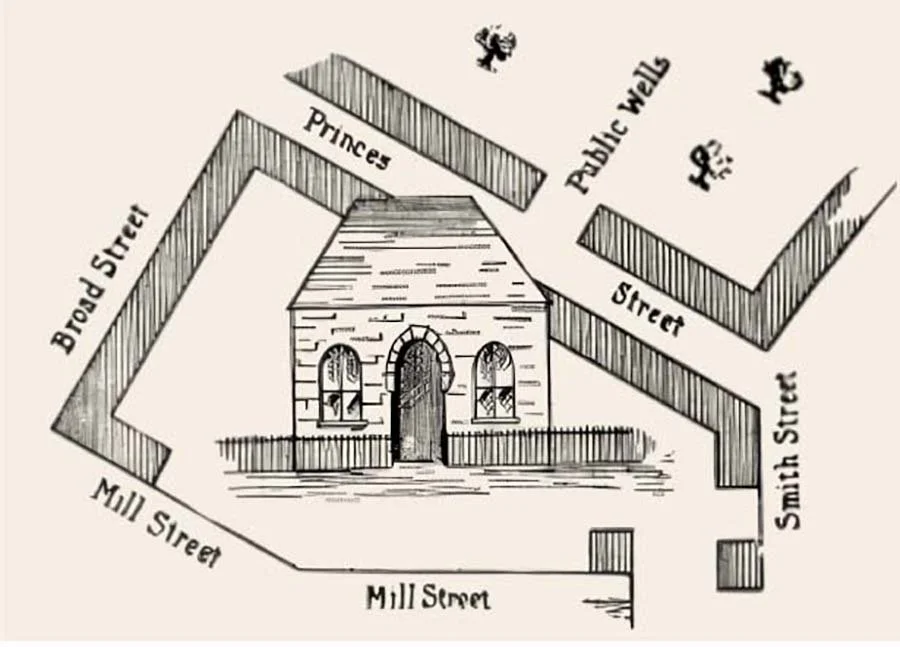
Congregation Shearith Israel, New York, was established 1654. This depiction of their first synagogue on Mill St. is based on a sketch “made from memory by an old resident” in 1744. Valentines’s Manual, 1854
In the wake of the American Revolution, America’s small community of Jews—at most 2500 in number—likewise embraced these two principles; dissenting Jewish Tories left the country. Synagogues soon abandoned the Sephardic rules (haskamot, askamot) that formerly governed them and wrote “constitutions” that incorporated large dollops of republican rhetoric, providing for much more in the way of equality and majority rule than heretofore. At New York’s Congregation Shearith Israel (today the Spanish and Portuguese Synagogue), for example, the new constitution, likely dating to 1790, made specific mention of the “state happily constituted upon the principles of equal liberty, civil and religious.” Seeking to conform, it ended the colonial-era distinctions between members and non-members, and declared that “every man, except a bound or hired servant, professing to be and living as a Jew, being of the age of twenty one years and upwards… shall be entitled to every right and privilege belonging to this society and are hereby declared to be in every respect on an equality with those now convened.” Significantly, “the whole congregation” needed to meet to ratify this constitution “and by the decision of the majority it shall be settled.”
Democracy similarly guided the new Jewish community of Richmond, Virginia, when its Jews gathered to form a synagogue in 1789. “We the subscribers of the Israelite religion resident in this place,” they began, echoing “we the people” in the new US Constitution. They embraced equality, extending the distinction of yahid, which traditionally restricted rights and privileges only to men of means, to include “every free man residing this city for the term of three months of the age of 21 years and who congregates with us.” They also wrote the principle of majority rule into their founding constitution, adding that the majority “must be 2/3 of the members in town.” The old practice of annually assigning members to synagogue seats based on their wealth and status disappeared after the Revolution; seats were sold or rented and, at least in theory, equally open to all. The special banca (bench) that female members of the elite Gomez family once occupied to display their superiority was taken down.
As the Jewish community of the United States grew, the principles of equality and majority rule continued to shape its political culture. The founding constitution of the Association of the American Hebrew Orthodox Congregations in 1888 stressed that “any person” could be a member “upon election by the Trustees” and that officers were to be elected “by a majority vote of the members present.” Hadassah, the Women’s Zionist Organization of America founded by Henrietta Szold, included “American Democracy” among the ideals to which the organization was dedicated. A collection titled The Constitutional Documents of American Jewry reveals that practically every other American Jewish organization likewise operated under the principles of equality and majority rule; American law and the lawyers who wrote those constitutional documents ensured it.
Free seating became the norm in many synagogues (often except on the high holidays), allowing people to occupy any open seat. The “best people” no longer automatically sat in the best seats. During the twentieth century, especially following passage of the Nineteenth Amendment giving women the right to vote at the national level, the definition of equality widened further in the United States. Women, as a result, soon won more rights within the Jewish sphere as well.
That is not to say that synagogues, federations, and other Jewish organizations ever became paragons of democracy. Most continued to be led by elites who contributed time and money, and expected power and deference in return. Calls regularly rang out, and do still today, for more democracy in Jewish life. (Sometimes, though, such calls are ultimately, as in the 1916 battle over a proposed American Jewish “congress” expressing a desire to replace one set of elites with another.)
When such controversies do arise, democratic principles come into play to resolve them. Or, to put it another way, by inviting us to vote on our classroom party, my teachers were training us to participate as adults in democratically-run communal organizations. They were part of an American Jewish tradition of asserting that majority rule and equality were Torah values in origin. As we have seen, this claim is not really true. Instead, democracy and equality are American values that Jews in the United States have incorporated into their understanding of Judaism. Sociologist Sylvia Barack Fishman once helpfully described this process of reinterpretation as “unconscious coalescence.”
As the United States turns 250, and more Jews than ever before call America home, we should be grateful to dwell in the land that taught us those values—and resolve to preserve and extend them. We can recognize that a connection between Torah and democracy is relatively new in the history of Jewish ideas and also claim it, with pride, as part of a distinctly American Judaism. Knowing this history—and teaching it to our children—can become an invitation for us to strengthen our commitment as Americans and as Jews to democratic principles.