Be a Jew in Public: Mark Podwal and <em>The New York Times<em>
Tamara Mann Tweel
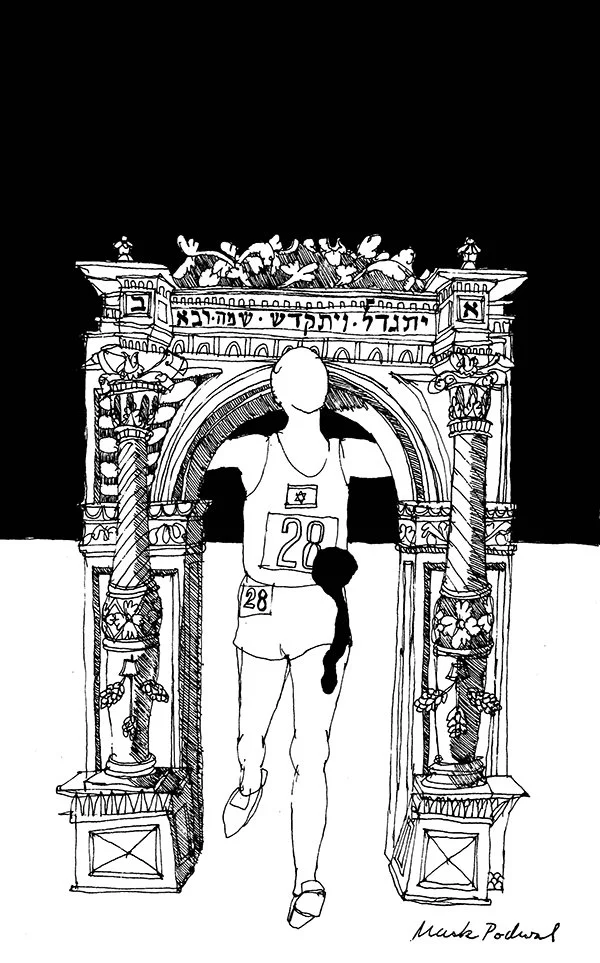
Mark Podwal, Munich Massacre (1972), originally published in The New York Times. Courtesy of the Estate of Mark Podwal
Tamara Mann Tweel is a Fellow at the Kogod Research Center of the Shalom Hartman Institute. She has spent her career educating students, faith leaders, and professionals on the history and value of American civil society and civic leadership.
On September 10, 1972, five days after the murder of eleven Israeli athletes in what came to be called the Munich massacre, an image appeared in the Op-Ed pages of The New York Times. It portrayed a faceless athlete wearing a Star of David, flanked by an arch adorned with the Hebrew letters: יתגדל ויתקדש שמה רבא. The drawing had no accompanying article, no translation of the foreign tongue, no explanation of what the illustration meant or to whom it referred.
It was a peculiar drawing to grace the pages of a storied American paper, stranger still to be featured on a page dedicated to the art of debate.
The artist, Mark Podwal, was a 27-year-old medical resident at NYU, and this was his first piece in The New York Times. The image offers something rarely seen in the American public square; it is not an editorial, a statement of advocacy, or a screed, but more akin to an utterance, a sincere religious expression. The image is not an argument—it is an enactment.
Since October 7, I have been striving to relearn how to be a Jew in public. By this I don’t just mean how to be myself in public, since I am a Jew. But rather, how to be a steward of my tradition in settings where being Jewish has become increasingly fraught. For most of my professional life, I wore my faith at work with unthinking ease. It is different now. When I prepare for public talks, visit with schools, interface with the media, or go to council meetings, it is with a new sensitivity and awareness. I think about when I am meant to exercise restraint and when I must act. When do I say plainly: I am a Jew? And what do I want that statement to carry into the room? I have studied different models of Jews in the public square. I have admired the witness and the advocate, the educator and the prophet, but Podwal and his illustration, Munich Massacre, have given me another model, the practitioner who gives the public an earnest window into Jewish faith and practice.
Munich Massacre appeared in a recurring interval between public acknowledgement of Jewish suffering and disgust at Jewish overreaction. Placed at the center top of page E17, the image is the height of four printed paragraphs and the length of two columns. It is flanked by opinion pieces: a critique of the campaign inadequacies of Nixon and McGovern, a musing on the “End of Vacation,” and a fawning response to the film My Uncle Antoine. The Times Op-Ed page is fairly new at this point—it dates to September 21, 1970, not even two years earlier—and this arresting image of a faceless man with an inkblot, like blood, lacerating his body, is one of the first drawings to appear without an accompanying article.
In Podwal’s image, the faceless man’s head is turned up, as if to the heavens, the arch flanking his body is heavily adorned by flowers and vines, and its two columns are crowned by the Hebrew letters aleph and beit. The number 28 appears on the faceless man’s athletic uniform—once on his shorts and once on his tank top, beneath his Star of David. An observer could easily infer that the man is an athlete and a Jew. And while a Jewish man bearing numbers and a Jewish star might suggest the Holocaust, here the numbers are not the dehumanizing scars of the Nazi regime but part of the ennobling symbolism of the athlete’s national uniform. And finally, a careful observer would learn that the Hebrew letters at the top of the arch, above the faceless man’s upturned head, spell four words in Aramaic: Yitgadal v’yitkadash sh’mei raba, the opening refrain of Kaddish, the prayer Jews recite to mourn the dead. The drawing is a form of mourning in the language of the mourner.
Later in Podwal’s career, the writer Cynthia Ozick anointed him the “Baal Kav Emet, Master of the True Line; or of the line that opens into truth.” Ozick understood that Podwal’s drawings do not reflect the world back to the viewer, nor do they capture an argument or a singular idea. They are meant to do something different. The Baal Kav Emet, she explained, creates “a plumb line to the depths of clarifying recognition and revelation.” In Munich Massacre, Podwal does just that: His lines beckon the viewer past death and into mourning, drawing the viewer ever closer to what it means to inherit and hold the title of Jew.
***
When he began kindergarten, Mark Podwal felt invisible. He missed the first few days of school due to an illness, and when he arrived, no one knew his name. He wasn’t even on the class roster. He followed along with the other children, listened to instructions, but the teachers did not acknowledge him. That changed with a drawing. In his words, “until the day my teacher noticed my drawing of a train I was invisible to her. And so it seemed to me, at the age of five, that my existence depended on my art.”
Podwal drew through elementary school, through middle school, and even through medical school. He never received formal training, he never imagined art would be his career, but it was always his calling, his way of making sense of the world. It was also an expression of his Jewishness, which he had developed on his own through reading and study. As he once explained, “For me drawing is a form of prayer.… Over the years, I’ve tried to imaginatively interpret and faithfully transmit my heritage with visual narratives.”
Podwal also felt the presence of death. “Perhaps my family history,” he wrote, “is why I often dwell on Jewish suffering. Museum directors and curators have urged me to broaden my subject matter—to become an artist more universal rather than being limited by Jewish content, but my heart is with the Jewish experience.” Podwal’s mother was born in Dąbrowa, Poland. In 1929, she immigrated to America with two of her three brothers. The third brother, David, Podwal later recalled, “was denied entry into the United States based on a mistaken diagnosis of an eye infection.” After years of failed efforts to bring him to America, David “perished in Treblinka.” When Podwal’s grandmother learned of her son’s murder, “she became severely depressed and was committed to a psychiatric hospital for the last eighteen years of her life.” David, like his nephew, was an artist, a child known in the family for his drawings. Podwal reflected, “I’d like to think that I am his legacy.”
Podwal’s professional breakthrough as an artist came when he was a medical resident at NYU. He started creating anti-war posters and chronicling “those tumultuous years” of the late 1960s with ink drawings, which were eventually published in 1971 in his first book, The Decline and Fall of the American Empire. The book came to the attention of the art director of a new section of The New York Times, the Op-Ed page. Yet, Podwal did not end up publishing those political drawings with the Times. In Podwal’s words: “While I’d be commissioned to create hundreds of drawings for the Times, that first drawing was not an assignment. Distressed by the horrific tragedy at Munich’s Summer Olympics.… I expressed my feelings through a drawing.” The drawing launched Podwal’s artistic career. From the Times, the image went on to be featured on the cover of Hadassah Magazine and to hang in the Musée des Arts Décoratifs Palais du Louvre. Podwal would go on to publish over 200 illustrations in The New York Times and have his work displayed across the globe in the Metropolitan Museum of Art, the Vatican Pontificia Università Gregoriana, the Israel Museum, and the Munich Stadtmuseum, to name only a few.
***
At first glance, Munich Massacre seems to be a symbolic representation of the dead Israeli athletes and an homage to their sacrifice and bravery. In Menachem Wecker’s article, “The Visual Jewishness of Mark Podwal,” in Image (issue 84), the writer points to the number 28 on the faceless athlete’s bib and shorts, noting that it is a numerological expression of the Hebrew word koach, or strength. That strength, he argues, is also visible in the figure’s stance, which “evokes Atlas shouldering the burden of the earth.” In this reading, the arch becomes the burden, and the athlete toils forever holding its weight. Some writers have also linked the arch to the Arch of Titus, the Roman monument commemorating the destruction of Jerusalem, suggesting an echo of earlier moments of Jewish loss and survival. The athlete, then, is carrying the history of attempts to destroy the Jewish people. The Kaddish prayer that anchors the image, in this view, acts like a protective presence, accompanying the newly dead as they move from one world to the next.
For Ozick, Podwal is more than just an artist; as a “master of hidden meanings, of symbol and metaphor,” he is akin to the Kabbalists, the Jewish mystics. She describes him as “a kind of salvational sorcerer.” But what is the sorcery in this particular image? What, exactly, is being transformed, what is being saved? The “plumb line” of this drawing goes past the eleven murdered athletes and past the ornate arch. To understand where the line goes, I think it is important to focus on Podwal’s choice to make the athlete’s face turn upward. In most images of Atlas holding the earth, Atlas’s face is often turned down, the weight of the earth pressed against his neck. Podwal’s athlete gazes up toward the sky, stretching outside the arch. His arms are straight, not weighed down but extended as if crossing a finish line. Most importantly, the stance is almost a replica of a photograph of the Israeli race walker, Shaul Ladany, who competed in the Munich Olympics on September 3, 1972, two days before the massacre. Podwal’s faceless man might very well represent the athlete who survived and not the ones who died.
***
At the end of August, a few days before the 1972 Munich Olympics were set to begin, Shaul Ladany exited the plane and walked back into Germany. He had been there before, as a child and Jewish inmate of a concentration camp. He remembered the language and defiantly quipped to anyone who asked that he learned to speak German in Bergen-Belsen.
This time, Ladany arrived in Germany not as an eight-year-old prisoner but as an Olympian. Reflecting on the experience, he wrote, “I was a member of an official delegation of the State of Israel, with our team patch on my jacket displaying the blue and white of the national flag. It was the Star of David in the center that had the most meaning for me, maybe because of my childhood memories. Nazi Germany tried its best to exterminate the Jewish people, fearing our status as an eternal nation that had survived two thousand years of exile. Now we were marching on German soil, the proud, strong representatives of the independent sovereign State of Israel.”
Two days before the massacre, Ladany donned his official uniform, shorts and a tank top, and began the 50-kilometer race walk. He learned his sport after arriving in Israel, as a Holocaust survivor, at the age of 12. His gift for endurance walking became evident as a young recruit during training marches in the military; the Israeli press, he recalled in his Shoah Foundation interview, soon “dubbed [me] the ‘King of the Marches.’” This particular race did not go according to plan. While he expected to have finished between 6th and 10th, he came in 19th with a time of 4 hours and 24 minutes. Still, he successfully completed a grueling race. The world witnessed a triumphant Jew crossing the Olympic finish line. It seemed that a chapter of history had closed. In the picture that graces the cover of his autobiography, King of the Road, Ladany’s right leg moves forward, and his chin is turned up towards the sky. It is an image of grit, of the relentless discipline of an unstoppable man who keeps walking.
Ladany woke up the morning after his race, and, true to form, trained before enjoying his first leisure activity in Munich, a local production of Fiddler on the Roof. The entire Israeli delegation joined him, and together they went backstage to meet Shmuel Rodensky, the Israeli actor playing Tevya. Ladany wrote, “The picture of us on stage with him is the last group photo ever taken of the delegation. Most of the men who were soon to lose their lives appear in that picture.”
At 4:30 the next morning, eight militants from the group Black September, disguised as athletes, broke into the Israeli dorms at Connollystrasse 31 in the Olympic Village. Two Israelis who attempted to fight back were murdered immediately, the wrestling coach Moshe Weinberg and the weightlifter Yossef Romano, whose mutilated body was left on the floor as a warning. Nine other athletes sleeping in Apartments 1 and 3 were taken hostage. Ladany had been assigned to Apartment 2 and escaped through a window.
Later, huddled in the Olympic Village with the few remaining Israeli athletes, Ladany waited for news. He recalled, “on the morning of September 6, the German radio announced that all the hostages had been released. We leapt up and threw our arms around each other, celebrating joyously. We could finally relax and get some sleep. I was awakened at six o’clock [the next morning] by Zelig Stroch, sobbing bitterly as he mouthed, ‘They’re all dead.’ It was only then that we learned the calamitous outcome of the botched rescue operation.”
Earlier that evening, the nine Israeli athletes had been led out of the Olympic village, bound and blindfolded, by Palestinian terrorists. Then, what was supposed to be an IDF rescue operation at the Fürstenfeldbruck Air Base turned into a massacre. At 3 am on September 6, after 16 hours of consecutive broadcasting, the ABC anchor, Jim McKay, faced the world and said, “They’re all gone.” For 24 hours, the Olympic Games were paused to honor the eleven murdered athletes. In Ladany’s words, “The whole modern world was in shock that the Olympic Games had become the scene of such a violent act of terrorism. For over two thousand years, the Olympics had been a symbol of peace and brotherhood, with all acts of hostility suspended for their duration even in ancient times.”
In his final act as an Olympian, Ladany tried, but failed, to persuade the Israeli government to let the athletes stay in Munich. Ladany believed a retreat at this point would give the terrorists an additional win, removing Israelis from an international forum. He also believed an Israeli athlete should be at the closing ceremony to carry the country’s flag, draped in black. He lamented, “The Olympic Games proceeded as planned and the closing ceremony followed long-established tradition, with a single exception: there was no trace of the Israeli delegation.”
Ladany’s story—the Holocaust survivor returning to Germany as an Israeli hero—was widely reported in the international and domestic press. It is almost certain that Podwal was aware of him. If we consider Podwal’s faceless athlete to be one of the Munich Olympics’ living survivors, of Germany’s living Jewish survivors, the meaning of the piece starts to change. The faceless athlete is not someone to be mourned but rather the mourner, the survivor who lives to recite the Kaddish for those who were slaughtered. The arch, too, need not be a sign of Jewish destruction. Abby Schwartz, former Director of the Cincinnati Skirball Museum, taught that Podwal’s arch is almost an exact copy of a design first created in Venice in 1549 as the title page to Shir HaShirim, the Song of Songs.
That 16th century image of an arch is the invitation to a sacred text traditionally read as a love song to God and attributed to King David’s son, Solomon. If we bring this meaning to Podwal’s drawing, the athlete there is not holding up the burden of an arch, but walking through an invitation to a timeless union. The drawing now becomes a tribute to the closeness that is possible between a person and God in the process of mourning. It is an offering that reflects the majesty of ritual even in times of massacre. And the four Aramaic words, the opening of the Kaddish prayer, appear as the concrete way Jews move towards life in the face of death.
***
Kaddish is one of the most repeated prayers in Jewish liturgy. The words are in Aramaic, a vernacular language spoken by Jews in Babylonian exile, rather than the traditional holy tongue, Hebrew. The root of the word kaddish, the letters kuf, dalet, shin, comes from the word holy. It is a word intrinsically connected to the many ways Judaism marks holiness in the world; wine, time, studying, and even recovering from loss can be framed and made sacred. Kaddish endows death with a form of spiritual meaning for the survivors.
Kaddish is a prayer meant for the public. It requires a Jewish quorum. The prayer leader or the mourner announces the opening four words, Yitgadal v’yitkadash sh’mei raba, “Exalted and hallowed be His great Name.” The congregation then responds, Amen, and later with the words, “May His great name be blessed forever and to all eternity.” Kaddish is a call with a clear response. These words are meant to be recited, to be felt, by the entire community. Following the death of a parent, their child recites the prayer several times daily for eleven months. No words of the prayer reference the dead, nor do they call the living towards remembering. Kaddish announces to the congregation, to the public, that God’s name is and will be blessed and hallowed.
During moments of weakness, fragility, and loss, the mourner and the community reaffirm God’s greatness. This can feel confusing, out of sync with the emotional reality of loss. But the words don’t reflect a feeling. They are an assertion of faith and hope even in desperate times. They are words designed to coax the mourner back into life, into the future. There are, of course, other interpretations. God, too, is in mourning, diminished by the loss of an irreplaceable individual, and the words are sent from the community to heal, repair, and strengthen God’s name or stature. In another interpretation, the words of the Kaddish are believed to have profound mystical power. When a child mourns a parent, it is said that the words of the prayer will act as an intercessor advocating for the parent’s merits or even redeeming the parent before they face final judgement. In Munich Massacre, the Kaddish is not a protective amulet, it is a prayer given by the living to intercede on behalf of the dead and a way to move from the claws of death into the sanctity of life.
On November 2, 2018, יתגדל ויתקדש שמה רבא, those same four Aramaic words, graced another American newspaper, The Pittsburgh Post-Gazette. Five days earlier, on October 27, a man carrying an assault rifle and three handguns entered the Tree of Life Synagogue in the Squirrel Hill neighborhood of Pittsburgh and murdered eleven Jews. The Pittsburgh Post-Gazette sought to muster a response that would honor that particular loss, which was driven by a particular faith. The Post-Gazette published the Hebrew letters stretching across the front page. Beneath them were the words, “These are the first words of the Jewish mourners’ prayer, ‘Magnified and sanctified be Your name,’ to be recited tonight on the first Sabbath since the tragedy at Tree of Life.”
The Post-Gazette’s executive editor, David Shribner, described this editorial choice: “When you conclude there are no words to express a community’s feelings, then maybe you are thinking in the wrong language.… That’s what prompted me to consider whether an excerpt from a 10th century prayer might be the appropriate gesture—of respect, of condolence—for a 21st century audience mourning its dead, whether family, friend, congregant, neighbor or, simply, Pittsburgher.” On that day, all of Pittsburgh grieved in the language of the Jews. But years earlier, it was Podwal’s work that opened the possibility for America, and Americans, to witness and participate in the way Jews mourn.
***
Five years after drawing Munich Massacre, Podwal published another image in The New York Times, this time in response to the capture and subsequent release of Abu Daoud, one of the masterminds of the Munich attack. Elie Wiesel, the Nobel Peace Prize-winning writer and Holocaust survivor, saw the image and wrote to Podwal, launching a four-decade collaboration. Later reflecting on Podwal’s body of work, Wiesel concluded: “Such is the power of this artist: he captures what death has forgotten to take.” It was this comment on his work, Podwal later wrote, that “moves me the most.” Wiesel understood Podwal’s ability to look directly at death and depict what must survive.
Over the course of his career, Podwal’s work, unrepentant in its religious particularism, appeared in the most public of settings: the White House, museums, and major national and international newspapers. I reencountered Podwal’s illustrations as I searched for a guide I could learn from. He taught me to enter the public square, not with my anxiety or fear, nor with my desire to explain, but rather with my own earnest religious practice, knowing that it is my duty to study, to cultivate, and to share.
Beginning with Munich Massacre, Mark Podwal welcomed viewers into the sacred rituals of Jewish life. His drawing did not merely memorialize a massacre; it placed the ritual language of Jewish mourning before the whole country. His work brings into American life a form of religious sincerity that moves beyond depictions of our suffering or our might, our victimhood or our aggression, and towards the truth that we are also carriers of an ancient tradition that contains faith and beauty. Even after loss, even after hate, we appear in public as Jews, dignified by how we mourn and how we choose to live.