Towards a Covenantal Citizenship
Deborah Barer
Credit: Kurt Hoffman
Deborah Barer is Senior Faculty at the Shalom Hartman Institute of North America.
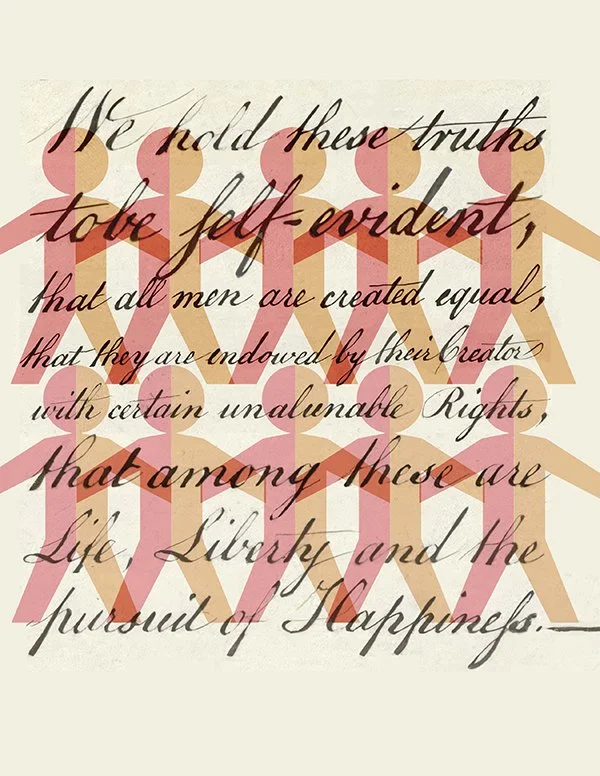
Since its founding, America has lived in the tension between dreams and reality. The Declaration of Independence proclaimed, “We hold these truths to be self-evident, that all men are created equal,” even as those truths were far from evident in the reality of the fledgling nation. The world of colonial America included genocidal campaigns against indigenous peoples, the enslavement of Africans and their American-born children, and the subordination of married women as the property of their husbands. Despite their proclamations of equality, the Founders did not recognize any of these people as endowed with the “inalienable rights… [to] Life, Liberty, and the pursuit of Happiness” that they championed. Today, we understand the vision of the Founders to be far more expansive. And yet, even today, the realization of that vision feels both tantalizingly possible and perpetually deferred.
As a child of the 1980s, I grew up believing that America was getting ever closer to achieving its own ideals. Liberalism was on the rise worldwide, and many of the adults around me believed it would triumph permanently. This trend helped create the conditions for the flourishing of American Jews like me, including the more complete integration of our Jewish and American identities. One of my formative memories is attending protests with my mother during the war in Bosnia in the early 1990s. A rabbinical student at the time and founding member of Rabbis for Human Rights North America, she publicly drew on Jewish communal memories of the Holocaust to insist that it was the moral responsibility of the US government to intervene in genocide. Watching my mother get arrested repeatedly on the nightly news defined my understanding of what it meant to be both a Jew and an American, a vision that entwined American exceptionalism and interventionism with a Jewish aspiration to repair the world. Despite being a member of a minority religion and the daughter of an immigrant, I felt that my Jewishness fit squarely within the American story and that my Jewish values were fully consonant with American ideals. To paraphrase Franklin Foer’s description of this “Golden Age” for American Jewry, I experienced my “anxieties as American anxieties... [and my] dreams as American dreams.”
Today, those dreams feel more like fantasy. The supposed triumph of liberalism has been replaced by polarization, civic distrust, and rising illiberalism on both the left and the right. While overt antisemitism is on the rise, so is what Yael Silverstein calls “ambient antisemitism,” a social climate “where mainstream cultural and institutional cues signal that Jewish identity is less legitimate, less protected, or less welcome.” An increasing number of American Jews describe themselves as feeling politically homeless. In an era marked by distrust of institutions, intensifying ideological sorting, and renewed debates about minority belonging in American public life, the question of what binds us together as citizens is newly urgent.
As American Jews, our tradition offers unique resources to navigate this moment—not simply as Jews, but as Americans. The Jewish idea of covenant offers a powerful framework for reimagining American citizenship today, one that anchors political belonging not in agreement, but in mutual obligation. A covenantal model acknowledges that we must accept the mantle of citizenship without knowing fully what it will ask of us, but it also grounds us in the relationships—to our founding principles and to one another—that will make it possible for us to fulfill our obligations. Thinking of citizenship as a covenant between citizens can help to generate a sustained commitment to the American project, despite its burdens and disappointments.
Visions of Citizenship
A covenantal approach both overlaps with and diverges from other visions of democratic citizenship in important ways. In her 2004 book, Talking to Strangers: Anxieties of Citizenship Since Brown v. Board of Education, Danielle Allen argues that citizenship depends on the cultivation of specific civic dispositions, including trust, reciprocity, and a willingness to make appropriate sacrifices for the common good. She frames her approach to citizenship as an orientation towards political friendship. “Citizenship,” she writes, “is plagued by rivalrous desire.” Friendship offers us a way to navigate those desires by teaching us “when and where to moderate our interests for our own sake.” For Allen, political friendship is what enables us to engage across differences; that engagement carries risks, but it is also essential for a functioning democracy.
Like Allen, a covenantal approach centers core practices of citizenship, but the practices themselves are different. In place of trust, it centers love; in place of reciprocity, it centers obligation. As a result, a covenantal approach offers new resources to address the disappointment and disillusionment that not only plague our current political moment, but that are an inevitable current in the American story.
Allen’s vision of citizenship draws repeatedly on the particularities of Black experience to shed light on important dimensions of a broader American civic project. This is especially evident in her treatment of a series of photos from the attempted integration of Little Rock High School in 1957, in which white students and protesters bar Elizabeth Eckford, a Black student, from entering the school. While these photos captured the experience of specific individuals in a particular time and place, Allen reads them as having an enduring message for all Americans about the challenges of democratic citizenship, the uneven distribution of burdens, and the demands of civic life.
Just as Allen draws on the canon of Black experience to articulate a set of practices that she sees as essential for democratic citizenship, regardless of each citizen’s race or ethnicity, I draw here on the Jewish canon to articulate a set of practices essential for American citizenship, regardless of each citizen’s religious identity or commitments. Building on the biblical description of the covenant at Mount Sinai, I call this a covenantal citizenship.
Through the revelation of the Torah, the constitutional document of Jewish life, the Sinai covenant implicates the Israelite nation both horizontally and vertically. It binds us, as Jews, to other people, clarifying that we have ethical obligations to all of humanity, but also particular bonds of kinship with other Jews. Those bonds are shaped by a shared history, and also a shared sense of mission.
To the extent that the Sinai covenant exists between Jews, the relationships and obligations it instantiates are horizontal. But the Sinai covenant is also—perhaps even primarily—vertical, a framework for understanding the relationship between God and this particular people. Indeed, the horizontal relationships that unite the Jewish people are defined by their shared reference to a relationship with God and Torah.
Like membership in the Jewish people, democratic citizenship also implicates us both horizontally, binding us to our fellow Americans, and vertically. However, this vertical relationship is different from the Sinai covenant in important ways. An American vision of covenantal citizenship is not (and cannot be) grounded in a relationship with God. Instead, our bonds as Americans are defined by our shared reference to the vision and principles outlined in the Constitution.
This means that the texts at the heart of an American covenantal citizenship are not infallible. We can recognize the limits of their human authors, and the ways in which they were products of a particular place and time. This recognition is powerful. It provides the rationale for our system of Constitutional amendments, demanding that we, as citizens, continue to reinterpret the founding principles of our nation and re-envision what American society should look like. It is no accident that many amendments directly address limitations in the way the Founders approached freedom and equality. These amendments abolish slavery and codify the voting rights of all citizens regardless of race or gender; in so doing, they move us closer to an ideal vision of America, even as they rewrite what that vision looks like in practice.
An American civic covenant can help us transcend the limitations of our humanity even without a God at its center, by pointing us back towards our responsibility to one another and to our interdependence. The framework of mutual obligation that it instills, and the reference to a shared set of principles and vision for our society, calls us to commit to the American project even in moments where we are deeply tempted to withdraw from it.
While this covenant differs from the Sinai covenant in important ways, Jewish experience nevertheless reveals a set of practices that must be core to a covenantal citizenship. These practices extend beyond the practices of reciprocity and “equitable self-interest” that are central to Allen’s model of political friendship. In that model, citizens who must sacrifice their own interests for the country or for one another also recognize that doing so is ultimately for their own benefit. The good of living in a democratic society, when it functions properly, will outweigh whatever good they must renounce. When this balancing is not achievable on an individual level, Allen argues that the burdens of sacrifice can be at least partially repaid through honor and proper acknowledgment of the debts we owe to each other.
At a time when trust in our fellow citizens and in the mutual benefit of the American project is eroding, however, a model that does not rely exclusively on reciprocity to articulate our obligations as citizens is sorely needed. Unlike Allen’s model of political friendship, a covenantal model of citizenship can sustain a framework of mutual obligation, even when reciprocity breaks down or mutual benefit disappears. Such a model may sit uneasily within liberalism’s emphasis on autonomy and choice, but that tension is precisely what makes covenant a compelling framework for this moment: it not only reveals some of liberalism’s limits, but also opens new ways of imagining and constructing a more robust account of civic responsibility.
A covenantal approach offers three core responses to the pressures in contemporary American society that drive polarization, radicalization, distrust, and a withdrawal from civic life. First, it can help us articulate a new patriotism, one in which serious disappointment does not lead to rupture. Second, by offering new paradigms of how love operates, it situates that patriotism within a set of practices, rather than treating it as an emotional orientation. These practices can help us accept the burdens of citizenship, even when we do not know what our country may yet ask of us. Finally, a covenantal model offers new pathways to read ourselves into the story of America and to see ourselves as authors of its next chapter, even as we continue to grapple with competing visions of what America is, can be, or should be.
Love and Disappointment
Like many Americans, I grew up believing that America was the greatest country in the world. But even as a child, my patriotism was not rooted in a simple naivete. Growing up in Massachusetts, both the glory of the American Revolution and the darker sides of our colonial legacy felt encoded in my surroundings: Lexington and Concord, the clip-clop of their names echoing with Paul Revere’s midnight ride; Salem, still smoking from the witch trials; my own hometown of Amherst, whose namesake notoriously advocated for the use of smallpox blankets to massacre the indigenous population. For me, patriotism has always depended on an ability to love through disappointment.
This is the first contribution of a covenantal model: It can reshape how we understand what it means to love our country, especially in moments of disappointment or disillusionment, and it can clarify what this love asks of us.
God’s love for Israel offers an instructive paradigm for thinking about these questions, even if this relationship has no direct parallel in the American context. The story of this divine love illustrates how to invest deeply in both people and ideals, and how to navigate the tension between those twin commitments. A robust covenantal citizenship can help us balance our commitment to the societal vision encoded in our founding documents with our fidelity to the American people today—a people that strives and yet often fails to realize that vision.
Throughout Jewish history, God’s relationship with Israel is characterized by both love and disappointment. The idea of Israel as a “treasured nation” (am segulah) is a foundational theme throughout the Tanakh, but God’s perennial discontent with Israel’s shortcomings is equally present. Israel emerges quickly as a “stiff-necked” people (Ex. 32:9), alternately whining and rebelling over the course of the Exodus from Egypt and their desert journey to the promised land. These challenges within the divine-human relationship are not rectified by the giving of the Torah, the conquest of the land, the building of the Temple, or the founding of the monarchy. Instead, the theme of failure and disappointment intensifies throughout the prophetic books and later writings. The prophets repeatedly castigate Israel for its short-sightedness and its disregard for divine teaching. Israel’s kings stray after foreign gods. From the divine perspective, to enter the covenant is to commit oneself to be in relationship with people who are a continual disappointment.
The profound surprise of this story is that it does not end in abandonment. As humans, it is natural to feel despair in the wake of repeated failures. When others let us down—whether those others are friends, family, or even our country—it is tempting to simply walk away. Strikingly, the rabbis imagine that God also feels this temptation. The Babylonian Talmud describes God as wrestling with the urge to give up and destroy the world on a daily basis. And yet, each day, God finds a way to consciously reorient and reinvest.
Avodah Zarah 3b centers this internal struggle in its account of God’s daily activities.
There are twelve hours in the day. During the first three, the Holy One, Blessed be He, sits and engages in Torah study. During the second three hours, He sits and judges the entire world. Once He sees that the world has rendered itself liable to destruction, He arises from the seat of judgment and sits on the seat of mercy [and thus refrains from destroying the world].
This text does not sugarcoat the challenges facing God. The problems plaguing the world are so catastrophic that, from the perspective of pure justice, the whole project should be destroyed. God’s disappointment in us is justified. And yet, God does not abandon the world. Why?
A potential answer lies in God’s decision to begin each day with Torah study. Before facing the world and its attendant problems, God grounds Godself in the covenant. That covenant commits Israel to God, but it also commits God to the world. Rooted in the primacy of that relationship and the commitments it entails, the response to human failure is not to give up, but to reinvest. Disappointments that could justifiably lead to divine anger instead prompt divine compassion.
How can this rabbinic understanding of divine love help us envision a covenantal citizenship as Americans? First, it suggests that the fundamental building block of covenantal obligation is people, not principles. Modeling our civic covenant on this divine love pushes us to stay invested in the wake of disappointment, and to sustain relationships even when shared ideals seem out of reach. Second, this narrative reminds us that a covenant is not an abstract commitment, but a daily practice. Just as God confronts the failures of the world each day, we also must regularly confront the ways in which the America we live in falls short of the America we dream of, sometimes catastrophically so. These disappointments present temptations—to give up and disengage, or to allow our anger over these failures to become destructive.
The Talmud pushes against these temptations. It acknowledges that our frustration and disappointment are justified. But instead of disengagement or revolt, its covenantal vision reminds us that our dreams for America must be rooted in our commitments to our fellow citizens. When it feels like America is failing to live up to its own ideals, we can choose to shift from judgment to mercy by re-centering our relationships with one another. Like God, we can reorient in order to reinvest.
But shifting our mentality on its own is insufficient. It is not enough to feel a sense of love or obligation towards the country, or towards our fellow Americans. A covenantal approach to patriotism must be grounded in a practice of caring for the needs of other citizens. The Talmud reminds us that this is a daily task, one that must be undertaken consciously and with intention.
Accepting the Yoke of Citizenship
In Jewish tradition, love is understood not only as an emotion or interior state, but as a set of external practices. Various commentaries on the commandment to “love your neighbor as yourself” (Lev. 18:19) emphasize that the obligation to love does not require that we feel a certain way, but rather that we act with care. Consider the Targum Pseudo-Jonathan’s interpretive gloss of this verse: “Love your fellow—that which is hateful to you, do not do to him.” Love is made manifest through action.
The challenge of such love, however, is that we cannot know in advance the demands that others will place on us. This is especially clear in one of the primary metaphors used to imagine the covenantal relationship between God and Israel: parental love.
In her book, The Obligated Self: Maternal Subjectivity and Jewish Thought, Mara Benjamin describes the dynamics of this love, and the obligations that extend from it, through her idea of the “Law of the Baby.”
Every child issues his or her own law: the baby who is colicky, the baby who is attached to tubes and needs his bandages changed to stay alive and healthy, the baby who needs to be walked around a room at a particular pace to fall asleep.…The force of the Law of Another was greater than anything I could have anticipated or to which I could have assented.… Nonetheless, I could not agree to the Law before I was already subject to it.
Benjamin’s description resonates deeply with my own experience of parenthood. I freely and fully embraced motherhood, but even as I did so, I had only a partial understanding of what I was embracing. The reality of parenting was shockingly specific and concrete. I knew, for example, that I would experience sleep deprivation; I did not know that one day, I would find myself creating my own personal map of every café in a 30-minute radius that had a drive-through and opened at 4:30am, so that I could stay awake while my toddler, who suffered from a sleep disorder and slept best while in motion, could get some rest at the end of his long, interrupted nights. What does it mean to consent to something you cannot fully understand? Can this vision of love, so central to the Sinai covenant, help us understand what it means to love our country when consent is foundational to our understanding of democracy?
Allen’s vision of citizenship rests on a more robust idea of consent than the model of parental love suggests. There are some core similarities: She highlights the importance of sacrifice, another theme common to parental love, and she also draws on the language of covenant. But in her model, consent must include foreknowledge—a full and conscious accounting of that to which we each agree. Without this, sacrifices will be imposed on some citizens more than others, and the foundation of the democratic covenant will erode.
While Allen’s vision is laudable, the ways in which it links consent and knowledge do not describe the reality of our lived experiences. Across multiple dimensions of our lives, from the personal and familial to the civic and national, we simply cannot know what the future will ask of us. This is the second contribution of covenantal citizenship: It enables us to consciously accept burdens that we do not fully choose and cannot fully foresee.
The Sinai covenant illustrates how a version of consent that does not depend on foreknowledge can retain personal agency while also obligating us more deeply to one another. Jewish interpretations of the Sinai covenant agree with Allen that consent is a central component; the Israelites must enter the covenant freely in order for it to be binding. A famous midrash in Shabbat 88a underscores this idea by imagining a different, more coercive version of the Sinai covenant.
Exodus 19:17 describes the people as standing under (taḥtit) the mountain as they wait to receive the Torah. This language is typically understood to indicate that they stood at the base, or foot, of the mountain, but the midrash exploits its literal meaning: In the rabbinic imagination, Mount Sinai is lifted over the Israelites, and they stand underneath it.
“They stood underneath the mountain” (Exodus 19:17). Rabbi Avdimi bar Ḥama bar Ḥasa said: This teaches that the Holy One, Blessed be He, overturned the mountain above [them] like a tub, and said to them: If you accept the Torah, excellent, and if not, there will be your burial. Rav Aḥa bar Ya’akov said: From here there is a substantial caveat to [the obligation to fulfill the] Torah.
Rav Aḥa bar Ya’akov’s objection hinges on the problem of consent. Jewish law establishes elsewhere that agreements made under duress are not binding. If the Israelites accept the Torah under threat, then it lacks the power to command.
The Talmud resolves the problem by arguing that, at a later point in Jewish history, Jews accepted the Torah of their own volition.
Rava said: Even so, they again accepted it willingly in the time of Ahasuerus, as it is written: “They ordained, and took upon them” (Esther 9:27). [This means that in the time of Esther] they ordained what they had already taken upon themselves [through coercion at Sinai].
Thus far, the rabbinic approach to the Sinai covenant seems to align with Allen’s vision of a democratic covenant. The burdens and risks imposed by these covenants are so significant that they must be accepted freely. And yet, another interpretation of this same Sinai moment underscores the fact that even if we freely consent to the Torah, we can never fully comprehend what that agreement entails.
When the Torah is revealed, the assembled Israelites famously proclaim “na’aseh v’nishmah”—literally “we will do, and we will listen.” Some interpreters understand these to be essentially parallel statements: We will do what the Torah asks of us, and we will listen to (i.e., obey) its commandments. However, many commentators understand these statements to be sequential: The assembled Israelites agree to do what the Torah asks, even before they have heard what it demands. Their consent is not informed; they do not know what will be asked of them.
This lack of comprehension runs deeper than either account acknowledges. Even if every person standing at Sinai knew the contents of the Torah in its entirety—even if they had read and studied every commandment in detail—they still could not fully understand what they were committing themselves to. Just as a parent cannot fully anticipate what their child will demand of them over the course of their lives, so, too, the Jewish people cannot know in advance what the Torah will ask of them over the course of history. The Israelites who accepted the Torah at Mount Sinai could not possibly envision what it would mean to keep Shabbat in an age of cars and electricity, nor could they imagine applying the Torah’s moral teachings about care for the vulnerable or the foreigner to contemporary immigration policies. Each new situation that presents itself redefines our understanding of the obligations that Torah places upon us.
The way these obligations develop over time stands in tension with liberal notions of consent: Even freely chosen commitments unfold in ways that cannot be fully known or controlled. And these tensions are not limited to the Jewish relationship to Torah. They are inherent in the way Americans relate to our founding documents as well.
When the Founding Fathers first declared that “all men are created equal,” they created a moral vision for society that transcended their historical moment. While the Founders themselves did not understand this proclamation to include all people, regardless of race, gender, or sexual orientation, this is precisely what it has come to mean in the unfolding of history. When Americans later cited the Founders’ own ideals to argue for emancipation or for women’s suffrage, they did so as part of an attempt to realize the Founders’ vision, not to diverge from it. The text, and its vision for America, transcends its own authors. As a result, the obligations that these texts place upon us are not static but continue to be revealed in history.
A robust vision for American citizenship must be able to contend with this challenge directly. Covenantal citizenship allows us to center the primacy of consent, but also the primacy of the relationships to which we commit ourselves as citizens. We cannot know in advance what our country or our fellow citizens will ask of us, but as patriots, we commit ourselves to them nonetheless.
Reading Ourselves into the Story
To accept these unfolding demands freely and fully, we must see ourselves as participants in a story that began before us and will continue after us.
If we are to treat the Constitution or the Declaration of Independence as covenantal texts—texts that both implicate and obligate us—then we must see the founding of America as the beginning of our own story. It does not matter if our ancestors were present at the founding of the country or not. It does not matter if we were born citizens or chose to become citizens. Covenantal belonging requires us to claim the full breadth of the American story as our own. We must see ourselves as having consented freely to this covenant, to its demands, and to a relationship that bonds us indissolubly to other Americans. We must, in other words, affirm a version of the Jewish claim that all of Israel stood at Sinai, seeing ourselves as part of a narrative that transcends history.
To read myself into the American story is to claim both its grand achievements and its abject failures as my own. It also means I bear responsibility for what happens next. This is a distinct burden in an era of increasing uncertainty and instability, an era that often feels politically disempowering. The scale of the problems facing us, as Americans and as Jews, often feels insurmountable. How could I, an average citizen with no particular political influence, possibly help to write the next chapter of the American story?
This is the final contribution of a covenantal citizenship: It orients us away from the grand scale of national politics and back towards our neighbors. It reminds us that our commitment to a set of founding documents or ideals plays out, first and foremost, in our daily practices—in the lives we build in our cities and towns, and in the relationships we build with our fellow Americans. It suggests that being part of this covenant, first and foremost, means being part of the American people.
This vision of citizenship does not resolve the tension between America’s ideals and its realities. It does not make it easier to achieve our dreams for America, or to resolve the differences between our many competing visions of what those dreams should be. Instead, it asks us to inhabit those tensions differently: to treat them not as a reason to withdraw, or to destroy, but as a call to sustained, collective responsibility.
To accept the yoke of citizenship is to bind ourselves to one another across disagreement, disappointment, and time—not only as critics of America’s failures or beneficiaries of its promises, but as caretakers of an unfinished project. The American dream may never be fully realized. But covenantal citizenship demands that we remain committed to one another in the work of trying.