Pushed Out, Pulled In: How the New Law of Church and State Is Reshaping Jewish Education in America
Michael A. Helfand
Credit: Kurt Hoffman, Shutterstock
Michael A. Helfand is the Brenden Mann Foundation Chair of Law & Religion and Co-Director of the Nootbaar Institute for Law, Religion, & Ethics at Pepperdine Caruso School of Law; Visiting Professor and Research Fellow in the Brodie Center for Jewish & Israeli Law at Yale Law School; Senior Fellow at the Kogod Research Center of the Shalom Hartman Institute; and Senior Legal Advisor to the Orthodox Union’s Teach Coalition.
As the People of the Book, it is no surprise that American Jews are, in many ways, most at home in school. American Jews are roughly 90% more likely than the average American to hold a college degree and more than twice as likely to hold a graduate degree. Academic achievement is woven into our collective DNA.
The education of Jews, however, has never been synonymous with Jewish education. American Jews receive their education in institutions of all shapes and sizes. Although comprehensive statistics are hard to come by, less than a fifth of Jewish children attend Jewish schools (even as that number has climbed from fewer than 10,000 students in the 1940s to nearly 300,000 today). The majority of Jewish children pursue their educational aspirations in public schools.
The American Jewish church-state consensus—what historian David Dallin has called the “separationist faith”—has long incorporated two basic pedagogical tenets: the importance of Jewish education and the evils of religious indoctrination in public schools. This consensus has long been central to the Jewish community’s legal advocacy in this country. As a prime example, consider the amicus brief filed by the Synagogue Council of America and the National Community Relations Advisory Council, two of the most prominent mid-century American Jewish umbrella organizations, in the 1948 Supreme Court case McCollum v. Board of Education. Jews, the brief explained, are unequivocally and simultaneously committed to both Jewish education and the education of Jews: "In Jewish history and tradition,” the brief explained, “religious instruction has always been regarded as a most sacred responsibility.” But in America, that education takes place in programs “conducted by the local Jewish communities” that are “wholly independent of the public school system.” And for much of the twentieth century, American constitutional law embraced that approach. Religion did not belong in public schools; and religious communities retained the right to administer their own “wholly independent” schools, but at their own cost.
But while this general American Jewish consensus has, by and large, remained remarkably consistent over time, recent transformations in the law of church and state threaten to upend our constitutional reality. On the one hand, the Supreme Court has prohibited the government from excluding religious schools from its funding programs, opening the door for vouchers and tax credits that can be used to support Jewish day schools. At the same time, the Supreme Court has whittled down limits on government-sponsored religious expression, which could open the door to some degree of religion in public school classrooms. And while there may be good reasons to celebrate the financial benefits that these developments could bring to Jewish private schools, those benefits should not blind us to their deeper constitutional and communal costs. If left unchecked, these changes may radically transform the ways in which Jews educate their children, increasingly pushing Jews out of public schools and pulling them into Jewish private schools—and in the process weakening one of the central institutions through which American Jews have historically participated in American civic life.
The Rise of Indoctrination in Public Schools
Most articles on American Jewish migration from public schools to private schools have, of late, focused on the post-October 7 surge in antisemitism in public schools—and rightfully so. By nearly any metric, public schools have failed to adequately address the recent rise in antisemitism. Since October 7, the Department of Education's Office for Civil Rights has opened over 60 Title VI investigations into “shared ancestry” discrimination: the legal category that includes, among other forms of discrimination, antisemitism.
According to the Anti-Defamation League’s 2024 Audit, antisemitic incidents in non-Jewish K–12 schools surged after October 7, 2023. In 2021 and 2022, incidents numbered 331 and 494, respectively. But in 2023, that figure more than doubled to 1,162 before settling at 860 in 2024—still nearly twice the pre–October 7 levels. Unsurprisingly, this heightened atmosphere has coincided with new pressures on Jewish families. In a Prizmah survey of day school enrollment conducted in the months following October 7, 2023, 39% of schools reported mid-year transfer inquiries from public school students. Among those inquiries, 73% cited a desire for a Jewish environment, while 68% expressed concerns about antisemitism in their community.
Consider California as a prime example. In the years leading up to October 7, Jewish institutions sounded alarm bells about California’s ethnic studies programs in districts across the state, warning that some curricula portrayed Israel exclusively as a colonial or apartheid state while marginalizing Jewish historical experiences and framing Jews primarily as “privileged” or “oppressors” rather than as a historically persecuted minority group. These concerns have only deepened since October 7. In the city of Santa Ana, concern escalated to full-blown litigation when Jewish advocacy groups sued the district over its ethnic studies courses. The district finally relented in 2025, settling the case and agreeing to discontinue the contested classes.
Nevertheless, concerns about antisemitism in California’s public schools continue. In 2025, California enacted AB 715, a legislative attempt to respond to what its own legislature described as “a widespread surge in antisemitic discrimination, harassment, and bullying.” Yet parents and advocates have alleged that these steps have done little to improve the facts on the ground. This past February, Jewish organizations filed suit alleging that the state has failed to address systemic antisemitism in classrooms across California, and that government officials “are standing idly by or are mismanaging the discharge of their constitutional and statutory duties when anti-Semitism is present.” And since October 7th, the Department of Education’s Office of Civil Rights has opened more investigations into California public schools for discrimination on the basis of shared ancestry and ethnic characteristics—again, the bucket that includes antisemitism—than any other state.
But antisemitism represents only one side of the indoctrination coin. While some critics warn that progressive curricula in states like California risk normalizing hostility toward Jews, other states are seeking to introduce explicitly religious instruction into public classrooms in ways that may likewise push Jews to the periphery.
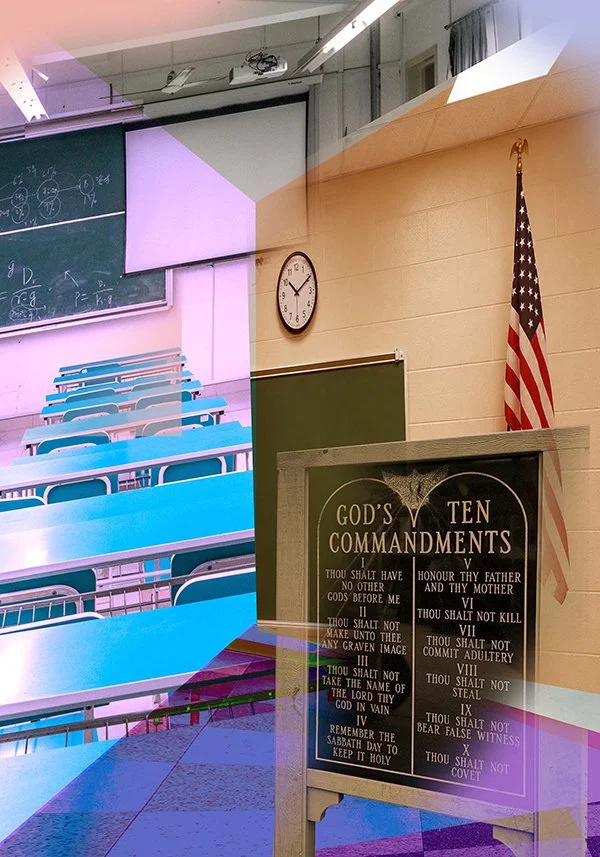
In June 2024, Louisiana became the first state to require every public school classroom to display the Ten Commandments. Arkansas enacted similar Ten Commandments requirements in April 2025, and Texas followed suit in June 2025. Some states have moved to more substantive religious integration; Texas has authorized chaplains in public schools, while Oklahoma has directed schools to incorporate Bible instruction into their curricula.
This wave is the direct consequence of recent changes to the Supreme Court’s First Amendment jurisprudence. For decades, the Supreme Court interpreted the First Amendment’s Establishment Clause—the constitutional prohibition against laws “respecting an establishment of religion”—to forbid governmental policies that, in either purpose or effect, advanced religion. Importantly, the Court concluded that government attempts to advance religion were unconstitutional even if they didn’t coerce citizens to participate in religious activities or practices. In 1980, the Supreme Court held that a law requiring the display of the Ten Commandments in Kentucky public school classrooms was unconstitutional even though it didn’t require students to do anything. And prayer in public school classrooms was unconstitutional; even if students could leave the classroom or otherwise opt out, such prayers still advanced religion.
But in 2022, the Supreme Court jettisoned its larger constitutional framework, adopting instead a framework that relies on the Constitution’s historical context to interpret the First Amendment. This new framework focused on the wide range of Founding-era practices, from legislative prayers to presidential proclamations, that all appeared to advance religion and were still embraced by those who themselves authored the First Amendment. There remains vigorous debate over what these changes will mean in practice. But some, including a wide range of state legislatures, have interpreted these changes as allowing the government to introduce religion into public spaces, including public school classrooms, so long as doing so does not entail religious “coercion.” And if this interpretation is upheld by the Court, it would mean that religious displays and voluntary prayers could now be in the offing.
Not surprisingly, many Jewish groups have opposed these developments. The Jewish Federation of Greater New Orleans was among the first to respond to Louisiana’s Ten Commandments law, with its CEO, Robert French, warning that while the Ten Commandments provide “fundamental moral teachings,” requiring them in public school classrooms would “undermine . . . the core principles of religious freedom and the separation of church and state that are essential to our democracy.” When litigation over the law came before the Fifth Circuit Court of Appeals, a host of Jewish organizations—including the American Jewish Committee, Anti-Defamation League, and Jewish Council for Public Affairs—filed an amicus brief, warning that “centering the text as an object of veneration . . . would pressure students from faiths other than the majority Protestant Christian religion into conforming to the beliefs of the majority faith.” Since then, Jewish parents and rabbis have joined similar lawsuits in Texas and Arkansas, while groups like the National Council of Jewish Women, Hadassah, the Union for Reform Judaism, and the Rabbinical Assembly have filed briefs opposing the laws.
Thus far, lower court litigation has provided a somewhat ambiguous picture as to whether this new wave of efforts to introduce religion into public school classrooms will ultimately survive constitutional challenge. After the Oklahoma Supreme Court enjoined the state from purchasing Bibles with public funds for classroom use, a newly appointed superintendent rescinded the directive requiring Bible instruction and classroom Bibles, leading the court to dismiss the case as moot. Litigation has also challenged Texas’s effort to authorize school chaplains, and those disputes remain ongoing as constitutional claims proceed.
But in April, the Fifth Circuit provided a stark indication of where the law may be headed, upholding the constitutionality of the Texas Ten Commandments law. Issuing a first-of-its-kind decision, the court held that laws violate the Establishment Clause only if they “compel any student to engage in formal religious exercise.” In many ways, this opinion goes well beyond formulations previously embraced by many of the conservative Supreme Court justices; those justices have suggested that government actions can violate the First Amendment when they “proselytize” or “denigrate” religion. By contrast, the Fifth Circuit’s approach would permit government religious messaging that proselytizes or denigrates religion so long as it stops short of formally coercing students into prayer, worship, or other religious exercise.
Other federal courts of appeals may ultimately reach different conclusions, and the Supreme Court may yet reverse the Fifth Circuit’s decision. But unless (or until) something changes, public schools may increasingly weave sectarian religious symbols and imagery into the walls and halls of public schools. And when religion is everywhere, Jews may have only two choices left: remain in an educational environment suffused with Christian content—and the attendant pressure to conform—or opt out of the public school system altogether.
Opting Out of Public School Religion
While the Supreme Court has not, as of yet, provided much guidance on how it will apply its new Establishment Clause doctrine to the public school classroom, it has recently shored up one legal option for religious objectors: opt out.
Consider the Court's recent decision in Mahmoud v. Taylor, which addressed religious liberty claims made by Muslim, Christian, and Jewish parents in Montgomery County, Maryland, seeking to exempt their children from classroom discussions of books with LGBTQ+ themes. The Court found in their favor, holding that “a government cannot condition the benefit of free public education on parents' acceptance of such instruction.” The reason: the “pressure to conform” to these alternative “viewpoints,” explained the Court, would “substantially interfere with the religious development of the child” or “pose a very real threat of undermining the religious beliefs and practices the parent wishes to instill in the child.” This the First Amendment prohibits.
Earlier cases had recognized that parents might withdraw their children entirely from public schools when the curriculum posed a direct threat to their faith commitments. But the Court’s decision in Mahmoud went further. It recognized constitutional protection not only for the decision to leave public school altogether, but also for parental objections to particular classroom materials and lessons within the public school setting itself. This marked an expansion of the Court’s willingness to accommodate parental religious claims in the public school setting.
On the ground, this shift matters. As Montgomery County’s attorney argued (unsuccessfully) before the Court, it is far easier to respect parents’ rights by excusing their children from public schools altogether than it is to permit opt-outs from selected lessons within them. Mahmoud nonetheless insisted that even this more logistically complicated accommodation was required, underscoring the Court’s broader turn toward protecting religious objections in the educational sphere.
As a result, the Court’s landmark decision in Mahmoud is likely to have significant implications. For example, it paves the legal path to parental claims demanding that their children be exempted from classes where the Ten Commandments have been placed on the wall—or lessons using ethnic studies curricula that parents view as antisemitic. But note as well what the Mahmoud argument does not entail. The parents may be able to opt their children out of public school classrooms and lessons, but they cannot change those lessons. Sure, the Supreme Court readily acknowledges, hearkening back to the legal battles of the 1940s, that compelling students to formally acknowledge, say, the American flag would violate the First Amendment. But Mahmoud also underscores the limits of the Court’s current approach: while parents may sometimes secure exemptions from particular lessons or materials, the First Amendment has—at least thus far—less to say about recent curricular flash points, such as exposure to Ten Commandments displays, LGBTQ+-themed materials, or curricula parents view as antisemitic. Instead, the Court’s recent decisions suggest that the constitutional concern lies not in indoctrination to contested moral, religious, or ideological messages, but in compelled participation in or affirmation of them.
As Justice Alito noted during oral argument in Mahmoud, “the plaintiffs here are not asking the school to change its curriculum. They're just saying, look, we want out.” And the lower courts have taken notice. This is precisely the argument the Fifth Circuit deployed when upholding the constitutionality of the Ten Commandments in public school classrooms. Mahmoud, explained the Fifth Circuit majority, “permitted [parents] only to opt their children out of the lessons.” The First Amendment, however, has nothing to say about “abolishing the lesson altogether.” In the eyes of the law, if it is out that the parents want, it is out that the Court’s First Amendment jurisprudence grants—nothing more and nothing less.
Opting Into Private School Religion
Concerns over the place of Jews in public spaces, including public schools, are nothing new. American Jews have long had to navigate dominant Christian norms and values in everything from employment to housing to schooling; even Sunday closing laws, pervasive for much of the twentieth century, tilted the calendar to generate financial obstacles for Jews. But what makes the current public-private school dynamic different is that the legal dynamics that threaten to push Jews out of public schools are now accompanied by an equally forceful legal dynamic pulling Jews into private schools.
At the core of this new legal dynamic is, once again, a constitutional transformation. For most of the late twentieth century, the Supreme Court's expansive interpretation of the First Amendment’s Establishment Clause rendered substantial government funding for religious education and instruction beyond the constitutional pale. Government action, the Court reasoned, could not have a purpose or effect of advancing religion—and government funding certainly violated that rule. This framework ensured strict separation between church and state and therefore required government to exclude religious schools from programs that provided substantial support for private schools.
But over the past two decades, the Supreme Court has systematically refashioned this relationship between church and state. First, in the beginning of the twenty-first century, the Court adopted a new approach that embraced neutrality rather than strict separation—and as a result, it ruled in a number of cases that states could grant religious schools funding so long as it was provided on equal and neutral terms with secular institutions. In these initial years, though, the Court also afforded government leeway to exclude religious schools from such programs, recognizing what it called “play in the joints” between the Establishment and Free Exercise Clauses—a zone of constitutional discretion that permitted states to still keep greater distance between public funding and religious instruction than what the First Amendment required.
The Court’s patience for government exclusions of religion has, however, steadily—and rapidly—eroded. Over the past decade, it has moved from tolerating certain exclusions in the name of church–state separation to treating those exclusions as unconstitutional discrimination. The culmination came in 2022, when the Court held that states may not bar religious schools from generally available funding programs, reasoning that such exclusions violate the First Amendment’s prohibition against religious discrimination.
The consequences of this doctrinal transformation have been legion. When it comes to state programs, legislatures across the country have responded to the Supreme Court's new permissive stance toward government funding of religious education by dramatically expanding school choice programs. The movement has reached remarkable scale: By early 2025, over 30 states offered some type of school choice program, with over a dozen states offering universal school choice programs that ensure every student within their borders is eligible for educational funding. Maybe the most dramatic example has been Florida's universal voucher expansion, signed into law by Governor Ron DeSantis in 2023, that provided approximately $8,000 per year to every student in the state, regardless of family income.
These initiatives are now poised to go national with Congress just recently enacting the Educational Choice for Children Act (ECCA), the first federal school choice tax credit. The program, which is slated to start in 2027, will provide individual taxpayers with up to $1,700 in federal tax credits for contributions to scholarship-granting organizations that in turn provide scholarships that students may use to attend private schools, including religious schools.
Even beyond vouchers and tax credits, religious schools, and especially Jewish day schools, are already the beneficiaries of significant and much-needed security funding, providing the resources necessary to address the rise of antisemitic incidents around the country. And recent legal challenges to state laws that continue to exclude religious institutions from government funding programs—such as special education and historic preservation grants—have been successful, further unlocking access to existing resources that had, until recently, discriminated against religious schools.
For American Jews, the implications are clear: As the Supreme Court's opt-out approach fails to address the specter of indoctrination in public schools, its shift from separationism to neutrality has opened the door to vital government support of private religious education, including Jewish day schools. In practical terms, that means increasing access to tuition assistance, school-choice programs, special education funding, transportation support, security grants, and myriad other forms of public aid that can either reduce the financial barriers to Jewish education or provide Jewish day schools with additional resources to strengthen and expand their educational offerings. Put simply, while it is getting increasingly difficult for American Jews to stay in public schools, it is getting increasingly easy for American Jews to enroll in Jewish day schools.
The Future of Educating American Jews
Reasonable minds will differ on what to make of this constitutional push and pull. On the private school side of the ledger, there are good reasons for American Jews to applaud the inclusion of religious schools in generally available funding programs. Jewish day schools play a central role in American Jewish life, and expanded government support for those institutions promotes their financial sustainability. Indeed, for many Jewish families, these institutions represent far more than educational alternatives; they serve as critical vehicles for transmitting Jewish knowledge, values, and identity across generations. And this function has taken on heightened significance in recent years as Jewish families increasingly feel squeezed out of public schools. Thus, the financial accessibility of Jewish day schools, long constrained by the substantial costs of maintaining both rigorous secular and comprehensive Jewish studies programs, directly impacts the ability of Jewish families to access educational environments that align with their religious commitments and community needs.
Beyond self-interest, the exclusion of religious institutions from generally available public benefits has long constituted a form of discrimination that undermines the equal standing of religious citizens. When government provides funding for secular private schools but excludes religious schools solely because of their religious character, it sends a message that religious commitment renders institutions—and by extension, their communities—second-class citizens unworthy of public support. In this way, the constitutional prohibition against such discrimination can be understood as reflecting a deeper commitment to ensuring that religious minorities can participate fully in American civic life without being forced to choose between their faith and the benefits of citizenship. It is, in sum, an affirmation of the equal standing of religious communities and religious education alongside all other forms of private schooling.
But enthusiasm for the constitutional changes pulling Jews into Jewish day schools need not—indeed, ought not—extend to enthusiasm for the simultaneous push of Jews out of public schools. The weakening of constitutional protections against indoctrination in public schools—indoctrination that can emerge from all corners of the ideological and political spectrum—raises serious questions about whether Jews will continue to be able to participate fully and confidently in one of the central institutions of American civic life.
Now the constitutional doctrines that govern these various forms of indoctrination are far from settled. Since shifting jurisprudential gears, the Supreme Court has yet to revisit the constitutionality of the Ten Commandments in public schools; it has similarly declined, thus far, to articulate when polarizing curricula cross the line from constitutionally permissible exposure to constitutionally prohibited indoctrination; and it has not yet had the opportunity to address newly initiated litigation challenging curricula labeled by advocates as antisemitic. As a result, current trends in public school indoctrination may yet meet their constitutional match in the years ahead.
That said, absent some jurisprudential counterbalance, American Jews may increasingly find themselves careening into a constitutional paradox not fully of their own making: Current church-state doctrine both expands government funding opportunities for Jewish day schools while simultaneously rendering public schools less genuinely open and hospitable to Jewish participation. And the costs of such a shift could be generational. Public schools have long served as one of the principal institutions through which American Jews gained access to opportunity, upward mobility, and participation in the shared civic life of the nation. A constitutional order that strengthens the position of Jewish education while undermining Jewish participation in public schools thrusts Jews onto the horns of an unenviable dilemma: abandon public schools altogether, or remain within them, increasingly isolated and beleaguered. The revitalization of Jewish private education should not come at the cost of closing the doors of public schools to meaningful Jewish participation.